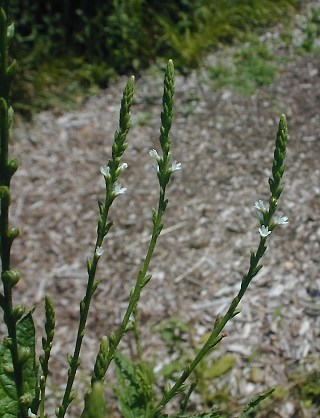
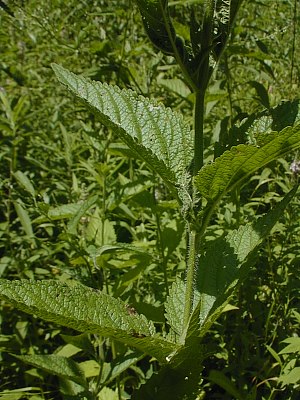
Description: This wildflower is an annual, biennial, or short-lived perennial about 3-6' tall; it branches occasionally in the upper half. The central stem is light green, stout, 4-angled, and densely covered with long spreading hairs. Along its length are pairs of opposite leaves up to 6" long and 2¼" across; they are lanceolate to ovate and coarsely serrated along their margins. The upper surface of each leaf is medium to dark green, shiny, hairless to slightly hairy, and wrinkled along the veins; its lower surface is light green and more hairy. The petioles of the leaves are up to 2" long. The central stem terminates in a panicle of floral spikes up to 2' long and half as much across; the upper side stems also terminate in such panicles, although they are smaller in size. Each panicle has narrow ascending branches (up to 6" long) and an airy appearance; sessile small flowers are sparsely distributed along each of these branches. Each flower is 1/8" (3 mm.) across, consisting of a white corolla with 5 rounded lobes and a tubular green calyx with 5 lanceolate teeth. The blooming period occurs from mid-summer to early fall and lasts about 1½ months. Only a few flowers bloom at the same time. Each flower is replaced by 4 nutlets that are oblongoid and flattened. This wildflower reproduces by reseeding itself.
Cultivation:
The
preference is partial sun, moist to mesic conditions, and a fertile
loam, clay-loam, or silt-loam. This wildflower can be started from
seed, but it is
short-lived.
Range & Habitat:
The native White Vervain occurs in every county of Illinois and it is
quite common
(see Distribution
Map). Habitats include open disturbed woodlands, woodland
borders,
thickets, powerline clearances in wooded areas, semi-shaded areas along
paths, damp meadows along streams, gravelly seeps, and abandoned
fields. White Vervain is usually found in habitats with a history of
disturbance. It is somewhat weedy, but rarely forms colonies, existing
primarily as scattered individual plants.
Faunal Associations:
The nectar and pollen of the flowers attract long-tongued bees
(honeybees, bumblebees, Little Carpenter bees, Cuckoo bees, Digger
bees, & Large Leaf-Cutting bees), short-tongued bees (Halictid
bees, & Dagger bees, including Calliopsis verbenae),
various flies (Syrphid flies, Bee flies, Thick-Headed flies, &
Tachinid flies), small butterflies, and wasps. These insects
cross-pollinate the flowers. Insects that feed on the foliage and other
parts of White
Vervain and other Verbena spp. (Vervains) include
the larvae of Crambodes talidiformis (Verbena
Moth), Longitarsus
suspectus (Flea Beetle sp.), larvae of Clinodiplosis verbenae
(Vervain Leaf Midge), Macrosiphum
verbenae (Verbena Aphid), and Melanoplus bivittatus
(Two-striped Grasshopper). The seeds are eaten occasionally by
various granivorous songbirds, including the Slate-Colored Junco, Field
Sparrow, Song Sparrow, Swamp Sparrow, Tree Sparrow, and White-Crowned
Sparrow. In contrast, the bitter coarse foliage is rarely used as a
food source by White-Tailed Deer and other mammalian herbivores.
Photographic Location:
Along a path in Busey Woods at Urbana, Illinois.
Comments:
Considering the large size of this plant, its flowers are remarkably
small. The lanky branches of the inflorescence are rather long,
however, and they sprawl in different directions. This makes the
inflorescence difficult to photograph in its entirety. The scientific
name of this plant refers to the resemblance of its leaves to
those of Urtica spp. (nettles). White Vervain
resembles two of its relatives, Verbena hastata
(Blue Vervain) and Verbena officinalis (European
Vervain). Blue Vervain has more narrow leaves and its flowers are
conspicuously blue, rather than bright white. It is found in sunny
wetland habitats more often than White Vervain. European Vervain has
small flowers that are white or lavender. It differs from White Vervain
primarily by its pinnatifid leaves, which have cleft lobes.