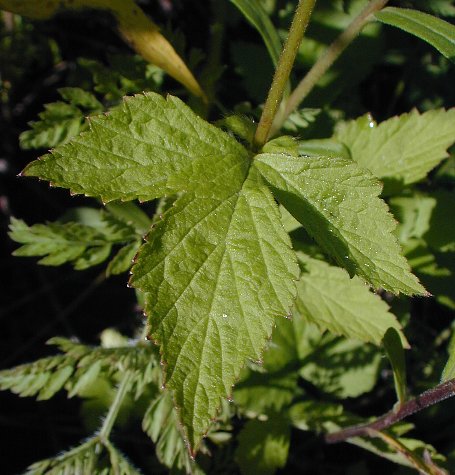
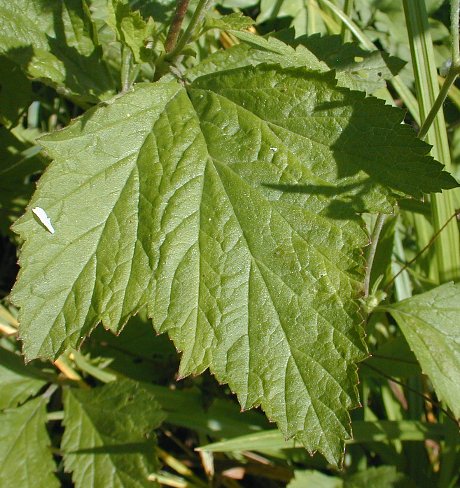
Description: This herbaceous perennial plant is about 1½–2½' tall, branching occasionally. The upper stems are light green and pubescent, while the lower stems are often brownish green and coarsely hairy. These stems are round in circumference, rather than angular. There are both basal leaves (produced during the spring) and alternate cauline leaves. The basal leaves are produced in a low rosette up to 6" across. The lower cauline leaves are trifoliate, while the upper cauline leaves are usually simple; they are rather variable in shape. Both simple leaves and leaflets of the compound leaves are up to 4" long and 3" across, becoming smaller as they ascend the stems. They are medium green, lanceolate to oval-ovate, coarsely serrated, and often cleft into 3 major lobes. Their margins are often shallowly cleft or incised as well.
The basal leaves are similar to the cauline leaves, except they are dark green and odd-pinnate with more than 3 leaflets. The wrinkled upper surface of each leaf is either hairless or it has scattered hairs that are very short and bristly; the lower surface is either hairless or it has a few hairs along the major veins. The lower leaves have stout petioles up to 1" long, while the upper leaves have either short petioles or they are sessile. At the base of each petiole, there are a pair of leafy stipules up to ½" long that are usually toothed along their margins. Each upper stem often terminates in an inflorescence of 1-3 flowers; sometimes individual flowers are produced from the axils of the upper leaves. The peduncles are up to 3" long and finely pubescent; they divide into shorter pedicels when there is more than one flower in the inflorescence.
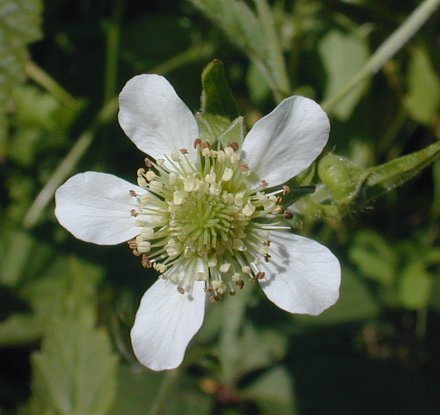
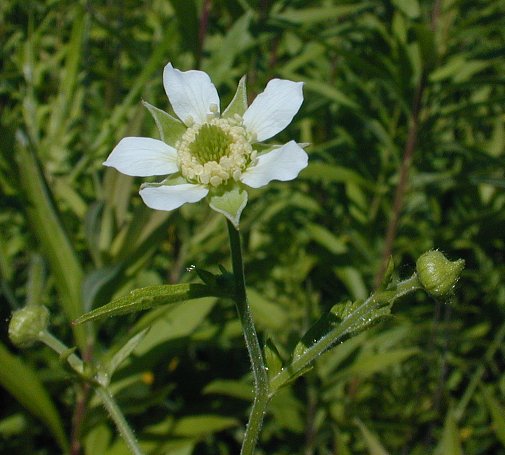
Each flower is about ½" across, consisting of 5 bright white petals, 5 triangular green sepals, and numerous stamens surrounding a cluster of green carpels with elongated styles. The sepals are the same length or shorter than the petals; they are initially spreading, but curve downward with age. The anthers of the stamens are initially white, but they soon turn brown. The receptacle of each flower (the surface underneath the carpels) is pubescent. The blooming period occurs during the summer and lasts about 1-2 months. There is no noticeable floral scent. Each flower is replaced by a spheroid cluster of achenes with persistent styles that are hooked at their tips. This fruiting cluster spans about ¾" across; it is initially green, but eventually turns brown. The root system consists of a taproot and rhizomes; from the latter, vegetative offsets can be produced. This plant occasionally forms loose colonies.
Cultivation:
The
preference is light shade or partial sun, moist to slightly dry
conditions, and a loam or clay-loam soil. At favorable sites, this
plant can spread aggressively and is somewhat weedy. White Avens is
able to grow underneath Black Walnut trees (Juglans nigra)
because of its tolerance to the phytotoxic chemicals that are released
by the fallen leaves and roots of this tree.
Range & Habitat:
The native White Avens is a common plant that occurs in every county of
Illinois (see Distribution
Map). Habitats include mesic deciduous woodlands, woodland
borders, thickets, partially shaded seeps, fence rows with woody
vegetation, powerline clearances in wooded areas, and edges of yards.
Sometimes White Avens can be found in disturbed meadows and tall-grass
prairies, but this is less typical. It adapts well to disturbed areas.
Faunal
Associations:
The flowers attract various insects, including bees, wasps, flies, and
beetles. These insects suck nectar; some bees also collect pollen,
while Syrphid flies often feed on the pollen. Insects that feed on the
foliage of White Avens and other Aven species (Geum spp.) consist
primarily of aphids, including Acyrthosiphon
pseudodirhodum, Amphorophora
rossi (White Avens is the preferred host plant), Macrosiphum gei, Macrosiphum pallidum,
and Macrosiphon
pseudorosae. In addition, the larvae of a moth, Tinagma obscurofasciella,
mine the leaves. Apparently the foliage of White Avens is not
attractive to mammalian herbivores; it is not often grazed by
White-Tailed Deer. The hooked achenes can cling to the fur of mammals,
feathers of birds, and clothing of humans; by this means, they are
distributed far and wide.
Photographic Location:
The photographs were taken near a powerline clearance at Busey
Woods in Urbana, Illinois, at a tallgrass prairie of Meadowbrook
Park in the same city, and along a woodland border at Chief Shemauger
Park in the same city.
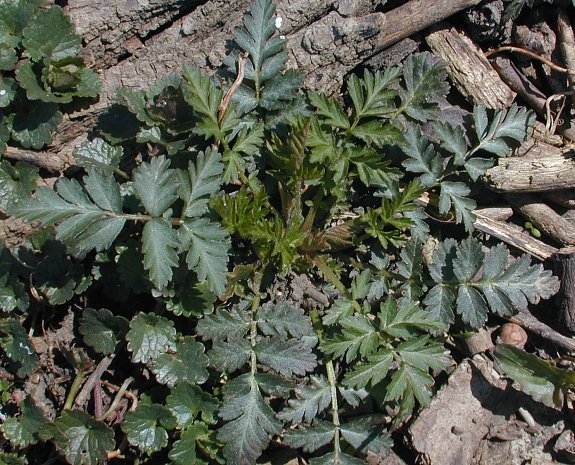
Comments: The flowers of White Avens resemble those of various Rubus spp. (Blackberries), except that they are a little smaller. The structure of its flowers is typical of many species in the Rose family. This is probably the most common Geum sp. (Avens) in Illinois. In general, White Avens can be distinguished from other species of Avens by its bright white petals, which are as long or longer than the sepals. Its lower cauline leaves are trifoliate, whereas the lower cauline leaves of other species of Avens are often oddly pinnate with 5 or more leaflets. In particular, Geum laciniatum (Rough Avens) resembles White Avens and occurs in many of the same habitats. However, the petals of its flowers are shorter than the sepals. The flowering stalks of White Avens are finely pubescent, while the flowering stalks of Rough Avens have coarse spreading hairs. Another species, Avens virginianum (Pale Avens), is restricted to southern Illinois. The petals of its flowers are cream rather than bright white, and they are substantially shorter than the sepals. Unlike White Avens, its lower cauline leaves are often odd-pinnate with 5 leaflets.