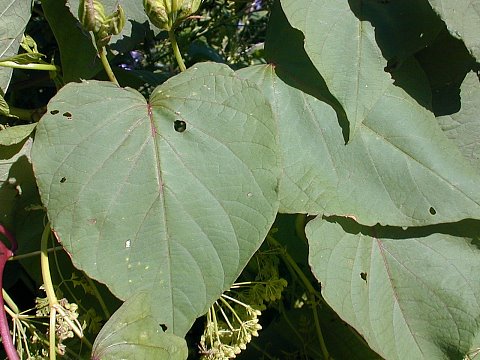
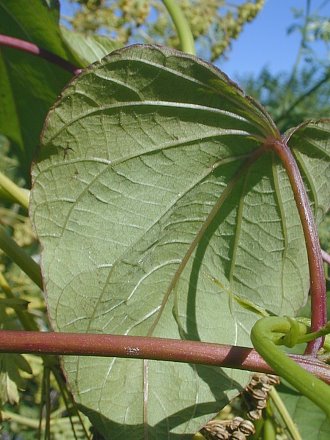
Description: This herbaceous perennial plant consists of a twining vine up to 20-30' long. It will climb adjacent vegetation readily, or sprawl across the ground in open areas. The terete stems are usually hairless, but sometimes pubescent, and often reddish purple. Along the stems are alternate leaves up to 6" long and 4" across. These leaves are usually cordate and hairless, although sometimes the smaller leaves are ovate. They have long hairless petioles and smooth margins. Both the upper and lower surfaces of the leaves are olive green, while the petioles are often reddish purple.
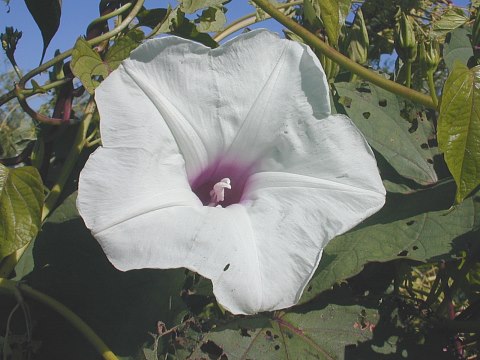
Flowering stalks develop from the axils of the leaves; each flowering stalk has a cluster of 1-5 funnelform flowers. The corolla of each flower is white, except for rosy pink or reddish purple coloration deep within its throat. The corolla has 5 shallow lobes; it is about 2½-3" across when it is fully open and similarly in length. The stamens of the flower are white; they project slightly from the throat of the corolla. The blunt overlapping sepals are light green, hairless, and about ½-¾" long; they often have narrow ridges. The flowers bloom during the morning (or during the afternoon on cloudy days), and they are individually short-lived. However, a typical plant will bloom for about 2 months during mid- to late summer. Each flower is replaced by a 2-celled capsule that contains 2-4 seeds. These flat seeds are conspicuously hairy along their outer edges, and pubescent elsewhere. The root system produces a large tuber that can lie several feet beneath the ground surface and weigh up to 20-30 lb.
Cultivation:
The
preference is full to partial sun and mesic to dry conditions. The
type of soil is not particularly important; this plant often grows
where there are rocky or gravelly slopes. Growth can be rampant where
the soil is moist and fertile; this plant can smother surrounding
vegetation and it prefers some kind of structural support. Drought
resistance is very good.
Range & Habitat:
The native Wild Sweet Potato occurs occasionally in most counties of
Illinois,
except in the extreme north and NW areas of the state, where it is
uncommon or absent (see Distribution
Map). Habitats include upland woodlands, edges of prairies
near woodlands, rocky streambanks, thickets, fence rows, abandoned
fields, and areas along railroads and roadsides. This plant is more
often seen in disturbed habitats, but it can be found in higher quality
habitats as well.
Faunal
Associations:
The flowers primarily attract long-tongued bees, including honeybees,
bumblebees, and digger bees (Melissodes
spp.). Some oligolectic bees that visit the flowers of the
Wild Sweet Potato and other Ipomoea
spp. include Melitoma taurea
(Mallow Bee) and Cemolobus ipomoea
(Morning Glory Bee). These insects seek nectar primarily, although the
oligolectic bees collect pollen as well. Less common visitors to
the flowers include nectar-seeking swallowtail butterflies, skippers,
and sphinx moths. Like other Ipomoea
spp., Wild Sweet Potato attracts
numerous tortoise beetles and other beetles that feed on the foliage.
These species include Agroiconota
bivittata (Striped Tortoise Beetle), Charidotella purpurata
(Tortoise Beetle sp.), Charidotella
sexpunctata (Golden Tortoise Beetle), Chelymorpha cassidea
(Argus Tortoise Beetle), Jonthonota
nigripes (Black-Legged Tortoise Beetle), Opacinota bisignata
(Tortoise Beetle sp.), Strongylocassis
atripes (Tortoise Beetle sp.), Chaetocnema confinis (Sweet
Potato Flea Beetle), and Typophorus
nigritus (Sweet Potato Leaf Beetle). Larvae of the Sweet
Potato Flea Beetle and Sweet Potato Leaf Beetle also feed on the roots.
Larvae of a long-horned beetle, Phaea
monostigma, bore through the stems of Ipomoea spp. The
caterpillars of such moths as Agrius
cingulatus (Pink-Spotted Hawk Moth), Bedellia somnulentella
(Sweet Potato Leaf-Miner), and Emmelina
monodactyla (Morning Glory Plume Moth) also feed on these
plants. Because the foliage is bitter and somewhat toxic, it is avoided
by mammalian herbivores as a food source. Because its long
leafy stems often form dense thicket tangles, Wild Sweet Potato
provides excellent cover for birds and other kinds of wildlife during
the summer and early fall.
Photographic Location:
The photographs were taken near an abandoned railroad in Champaign
County, Illinois. The plant was growing along a gravelly slope, where
it clambered over Conium maculatum (Poison Hemlock).
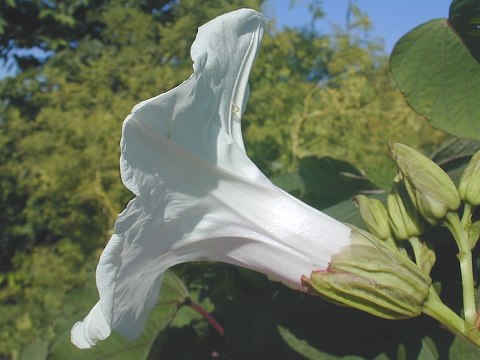
Comments: The common name of this plant species refers to the large tuberous root, which is edible (barely) after being cooked. Another common name, Man-of-the-Earth, also refers to this large tuberous root. It was one of the food sources of native Amerindians. The Wild Sweet Potato is fairly easy to distinguish from other members of the Morning Glory family by its large white flowers with pinkish purple throats and its heart-shaped leaves. Perhaps its most unusual feature (aside from the root) is the hairiness of its seeds; other Morning Glory and Bindweed species usually have smooth seeds.