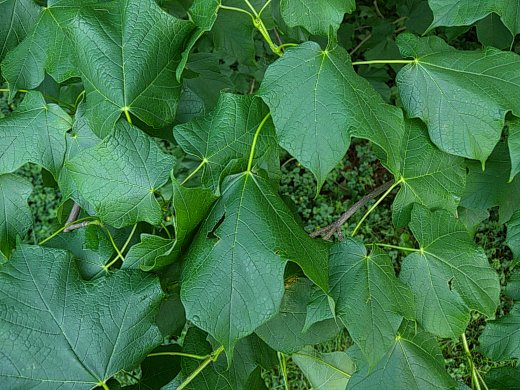
Black Maple is either dioecious or monoecious, producing separate male and female flowers on the same or different trees. Male flowers are produced in drooping umbels or sparingly branched corymbs about 2½-4" long. Individual male flowers are about 1/8" (3 mm.) long, consisting of a yellowish green calyx with 5 teeth and a variable number of exerted stamens (usually about 6-8). Female flowers are also produced in drooping umbels or sparingly branched corymbs, but they are shorter (about ¾-2" long). Individual female flowers are about 1/8" (3 mm.) long, consisting of a yellowish green calyx with 5 teeth and a 2-celled ovary with a divided style. Both male and female flowers can occur in the same inflorescence. The long slender pedicels of both male and female flowers are hairy. The flowers bloom during mid- to late spring as the leaves emerge (which are yellowish green at this time of year). Cross-pollination is achieved by the wind during a 1-2 week period. Fertile female flowers are replaced by paired samaras that become mature during the fall. The paired samaras form a 45º to 90º angle with each other. Individual samaras are about 1" long, consisting of a plump one-seeded head with a membranous wing; they are distributed by the wind. The woody root system consists of much-branched lateral roots that are relatively shallow. During the autumn, the deciduous leaves usually become bright yellow; less often, they turn orange or red.

Cultivation: The preference is full sun to light shade, moist to mesic conditions that are well-drained, and soil containing loam, silt-loam, or some mineral-rich glacial till. Similar to Sugar Maple, the saplings of Black Maple are able to survive in moderately dense shade, although higher levels of light are preferred. Poor drainage with standing water isn't tolerated for any substantial length of time. Because Black Maple casts a heavy shade underneath its leaves, it can kill turf-grass and other kinds of vegetation. This tree can live up to 200 years.
Range & Habitat: The native Black Maple is occasional to locally common in central and northern Illinois (see Distribution Map), while in the southern section of the state it is uncommon or absent. Black Maple is more abundant in the lower Midwest than elsewhere; it becomes relatively more common than Sugar Maple toward the western limit of its range (e.g., in Iowa), otherwise it is less common. Habitats of Black Maple include rich mesic woodlands, moist bottomland woodlands, and shaded riverbanks (above the flood zone). Black Maple is more vulnerable than most trees to wildfires.
Faunal Associations: The leaves, plant juices, wood, and other parts of maples (Acer spp.) are sources of food to many insects. These species include the larvae of Xylotrechus aceris (Gall-making Maple Borer) and other long-horned beetles, larvae of Corythylus columbianus (Columbian Timber Beetle) and other bark beetles, Phyllobius oblongus (European Snout Weevil) and other weevils, Periphyllus americanus (American Maple Aphid) and other aphids, Eratoneura spp. (leafhoppers), Pulvinaria innumeralis (Cottony Maple Scale) and other scale insects, Phenacoccus acericola (Maple Mealybug), larvae of Xiphydria spp. (wood wasps), larvae of Dryocampa rubicunda (Rosy Maple Moth) and other moths; also a spider mite, Oligonychus aceris (Maple Spider Mite). The Insect Table has a more complete list of these species. Other insects feed on the sap of maple trees after the protective bark has been damaged. These sap-feeding insects include honeybees, Andrenid bees, Braconid wasps, sawflies, Syrphid flies, Tachinid flies, flesh flies (Sarcophagidae), Calliphorid flies, Muscid flies, sap flies (Aulacigastridae), dung flies, (Scathophagidae), skipper flies (Piophilidae), and various forest butterflies, such as Nymphalis antiopa (Mourning Cloak), Polygonia comma (Eastern Comma), Polygonia interrogationis (Question Mark), and Limenitis arthemis astyanax (Red-spotted Purple); see Robertson (1929) and Wilhelm & Rericha (2017).
Vertebrate animals also use Black Maple and other maples as a source of food and protective cover. Some upland gamebirds and songbirds eat the seeds, buds, or sap of these trees (see Bird Table). Among mammal species, the wood and bark are eaten by the American Beaver and North American Porcupine. The twigs and foliage of these trees are eaten by the American Moose, Elk (where introduced), and White-tailed Deer. The seeds are eaten by the Prairie Vole, Meadow Vole, White-footed Mouse, Eastern Gray Squirrel, Fox Squirrel, American Red Squirrel, and Eastern Chipmunk, while the Southern Flying Squirrel feeds on the sap (Martin et al., 1951/1961; Schneider et al., 2006). Because of heart rot, old maple trees provide dens for tree squirrels and such cavity-nesting birds as the Black-Capped Chickadee, European Starling, Northern Flicker, Red-bellied Woodpecker, Pileated Woodpecker, and Screech Owl. The Rose-breasted Grosbeak, Evening Grosbeak, American Goldfinch, Baltimore Oriole, American Robin, Red-eyed Vireo, and other birds construct nests on branches of maples that vary in size from small saplings to mature trees (Martin et al., 1951/1961; DeGraaf, 2002). In addition to birds, some species of bats use maples as roost trees and for maternity colonies. This includes Lasiurus borealis (Eastern Red Bat), Myotis lucifugus (Little Brown Bat), Myotis septentrionalis (Northern Long-eared Bat), and Perimyotis subflavus (Tricolored Bat); see Mager & Nelson (2001), Bergeson (2012), Johnson et al. (2009), and Veilleux et al. (2003).
Photographic Location: The Arboretum of the University of Illinois in Urbana, Illinois.
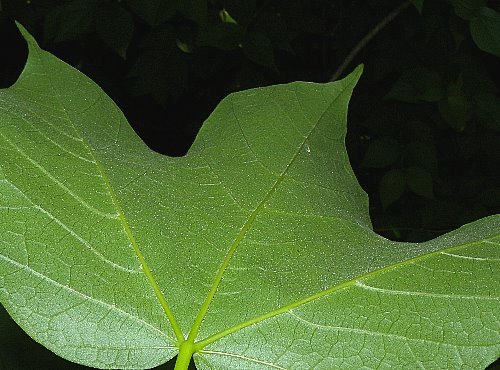
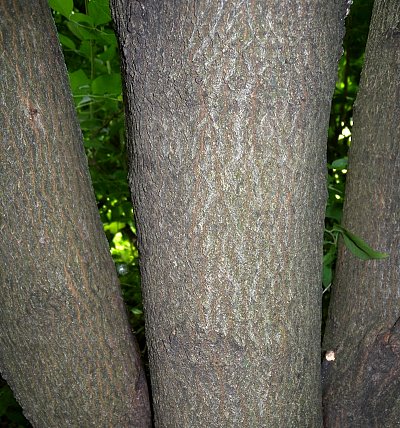
Comments: For commercial purposes, Black Maple is not distinguished from Sugar Maple: its sap is just as useful in making maple syrup, and its wood has very similar properties that make it useful in the construction of furniture and other wooden objects. Black Maple can be distinguished from Sugar Maple as follows: 1) Its leaves have drooping lobes, rather than the more even lobes of Sugar Maple, 2) the margins of its leaves have fewer to no teeth, 3) its leaves typically have 3 tapering lobes, rather than 5 parallel-sided angular lobes, 4) its leaf undersides are canescent or short-pubescent, rather than glabrous or nearly glabrous, and 5) on older trees, its trunk bark tends to be more black and furrowed. In Illinois, individual trees that display evidence of hybridization between these two species are fairly common. For this reason, Black Maple has been classified as a variety or subspecies of Sugar Maple by some taxonomists, or Acer saccharum nigrum. It is also possible to confuse Black Maple with the introduced Acer platanoides (Norway Maple), which is often cultivated as a street tree. Norway Maple can be identified by the milky sap that exudes from the base of a petiole after it has been broken off from a branch; in contrast, the sap of Black Maple is clear. Norway Maple also has paired samaras that are more divergent (forming an angle that exceeds 120º) and it has larger flowers in more erect clusters that are insect-pollinated.