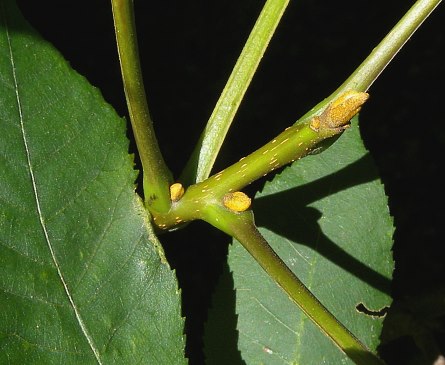
During most of the year, the terminal and lateral buds on young twigs and shoots are bright sulfur-yellow or yellow-orange from a powdery coating. Each bud has 2 valvate (non-overlapping) scales. Bitternut Hickory is monoecious with both male and female flowers produced on the same tree. The male flowers are arranged in greenish yellow catkins that are 3-5" long; these catkins are arranged in clusters of 3, drooping downward from either the tips of the previous year's twigs or at the base of the current year's twigs. Each tiny male flower has a 3-lobed calyx and several stamens. The female flowers are arranged in small short spikes at the tips of the current year's twigs. Each female flower is about 1/8" (3 mm.) long, consisting of an ovoid ovary with 4 prominent ridges and a pair of styles. The blooming period occurs from mid- to late spring for about 1-2 weeks. The flowers are cross-pollinated by the wind. Fertile female flowers are replaced by ovoid-globoid fruits (nuts with thin greenish husks) that become about 1" long at maturity during the autumn. Each husk has a smooth surface with 4 narrow ridges that extend from the outer tip inward to about one-half to two-thirds of the fruit's length. At maturity, the husk splits open along these ridges to partially release the nut. Each nut has a round circumference with a prominent beak; its shell is light brown, thin, and relatively smooth. The meat of the nut is very bitter. The root system has a taproot with spreading lateral roots.
Cultivation: The preference is full or partial sun, moist to dry-mesic conditions, and a fertile loamy soil, although less fertile gravelly soil is tolerated. Individual trees can live up to 200 years; they have to be at least 30 years old to produce nuts.
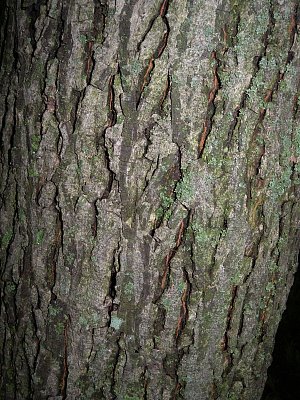
Range & Habitat: The native Bitternut Hickory occurs in every county of Illinois; it is fairly common (see Distribution Map). This tree is usually found in bottomland woodlands, protected river valleys, and even drier areas of swamps; it also occurs in upland woodlands, along the edges of rocky glades, woodland borders along roads, and edges of powerline clearances in wooded areas. It is somewhat vulnerable to fire and can be found in both degraded and higher quality woodlands.
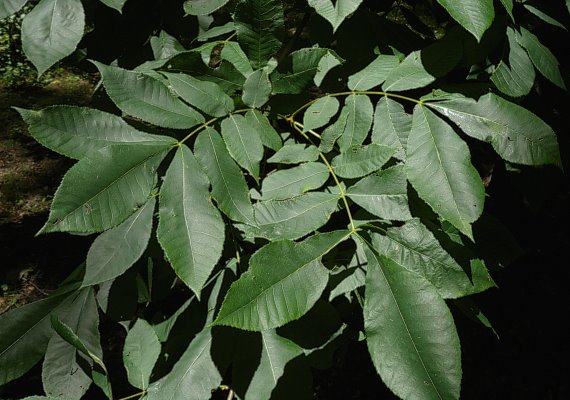
Faunal Associations: Many insects bore through the wood, suck plant juices, feed on the foliage, nuts, and other parts of Carya spp. (hickory trees). These insects include caterpillars of the butterflies Satyrium calanus falacer (Banded Hairstreak) and Satyrium caryaevorum (Hickory Hairstreak); this last insect has been observed to feed on Bitternut Hickory specifically. The caterpillars of Lophocampa caryae (Hickory Tussock Moth), Catocala nebulosa (Clouded Underwing), and other moths also feed on hickory trees; the monophagous moth, Catocala subnata (Youthful Underwing), is supposed to feed on the foliage of Bitternut Hickory exclusively. Other insects that feed on these trees include the larvae of wood-boring beetles, weevils, leaf beetles, larvae of gall flies, plant bugs, stink bugs, aphids, leafhoppers, treehoppers, scale insects, mealybugs, larvae of sawflies, walkingsticks, and thrips. A more detailed list of these insects can be found in the Insect Table.
Because Bitternut Hickory has nuts that are very bitter (as the common name suggests), thus mammals and birds make little use of them as a source of food. The Cottontail Rabbit sometimes feeds on the bark of saplings (Martin et al., 1951/1961). Because hickory trees attract a large number of insects, insectivorous birds often search for them among their branches and leaves. This includes the Scarlet Tanager, Yellow-billed Cuckoo, Carolina Chickadee, Cerulean Warbler, Northern Parula, Blue-gray Gnatcatcher, Red-eyed Vireo, and many others (Gabbe et al., 2002). These trees also provide protective cover and nesting sites for many birds. Mature hickory trees are used occasionally as summer roost sites for various bats, including the Eastern Red Bat, Northern Long-eared Bat, and Indiana Bat (Johnson et al., 2009; Magar & Nelson, 2001; Krynak, 2010).
Photographic Location: Along a roadside at Busey Woods and at the Arboretum of the University of Illinois in Urbana, Illinois.
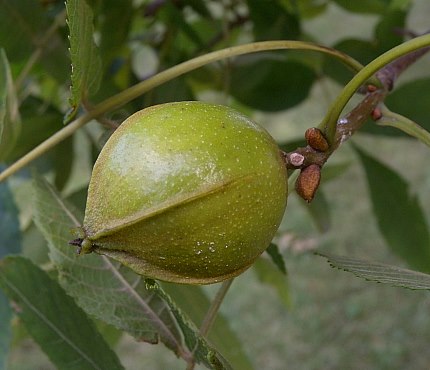
Comments: Bitternut Hickory has a wider range and it is found further north than any other hickory tree. It belongs to a group of hickories that are known as the 'Apocarya.' Hickories in this group have non-overlapping yellowish buds, strongly ridged fruits, abundant leaflets (typically 7-19 per leaf), and non-shaggy bark. Rather oddly, Bitternut Hickory is closely related to the Pecan (Carya illinoensis), even though their nuts are at opposite extremes in terms of their palatability (very bitter vs. mild & sweet). In Illinois, Bitternut Hickory can be distinguished from other hickory trees by its bright sulfur-yellow buds, which are covered by a powdery coating. It also has smaller fruits (husked nuts) than most hickory trees. Its nuts are rounded rather than angular, and they have large terminal beaks. While the husks of Bitternut Hickory have 4 narrow ridges that extend inward to about one-half to two-thirds the length of its fruits, other hickory trees have husks that either lack ridges or their ridges extend the complete length of their fruits. Pignut Hickory (Carya glabra) has fruits that are similar in size to those of Bitternut Hickory, but they lack conspicuous ridges; this tree also has fewer leaflets (usually 5) per compound leaf and its buds aren't yellow. The Pecan is also similar to Bitternut Hickory in several respects, but it has more leaflets (9-17) per compound leaf. Furthermore, Pecan has fruits with a more elongated shape, they are longer in length (exceeding 1"), and each of its fruits has ridges that extend from one end to the other.