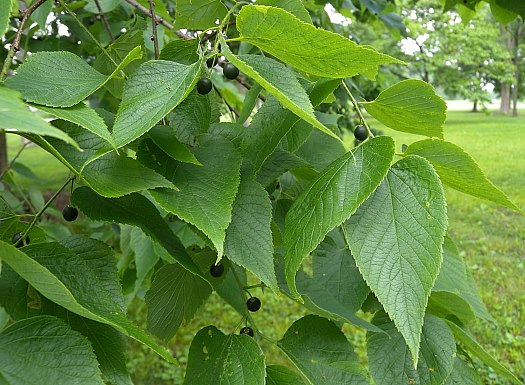
Common Hackberry is polygamo-monoecious, producing male (staminate), female (pistillate), and perfect flowers on the same tree. Individual flowers, regardless of type, are about ¼" across and predominately yellowish green; each flower has 4-5 oblong sepals that are connected together at the base. In addition to these characteristics, individual male flowers have 4-5 stamens with yellowish brown anthers, while individual female flowers have a green superior ovary that is ovoid in shape and tapers into 2 beaks. Originating from these beaks, is a pair of large brownish stigmata. Individual perfect flowers have both a superior ovary with a pair of stigmata and 4-5 stamens. These flowers are produced individually or in small clusters of 2-3 from the axils of the leaves; their slender pedicels are about 2/3" (16 mm.) long. The inconspicuous flowers are wind-pollinated. Female and perfect flowers are replaced by single-seeded drupes about 1/3" (8 mm.) across. These drupes are globoid to ovoid-globoid in shape; their color at maturity is either purple-black or orange-red to brown. The flesh of mature drupes is thin, firm, and sweet; it has a flavor that resembles dates. Each drupe has a large bony seed that occupies most of its interior. The root system consists of woody lateral roots that are wide-spreading and moderately deep. This tree spreads into new areas by reseeding itself. The deciduous leaves become greenish yellow to yellow during the fall.
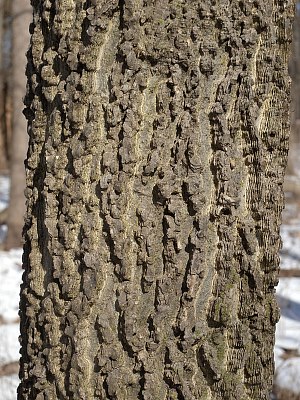
Cultivation: The preference is full or partial sun, moist to mesic conditions, and rich loamy soil. This tree will adapt to other kinds of soil, but its ultimate size at maturity will be smaller. Growth and development are fairly rapid. Longevity of individual trees can extend to 150-200 years. The foliage and twigs are often disfigured by psyllids and mites.
Range & Habitat: This common native tree has been found throughout Illinois (see Distribution Map); it occurs in every county. Habitats include moist to mesic floodplain woodlands, mesic upland woodlands, disturbed open woodlands, moist to mesic savannas, riverbanks, and fence rows. Common Hackberry is cultivated occasionally as a landscape tree.
Faunal Associations: The flowers of Common Hackberry are wind-pollinated. Several kinds of insects feed on the foliage, suck plant juices, bore through the wood, or consume other parts of this tree. They include such species as the larvae of metallic wood-boring beetles, larvae of long-horned beetles, larvae of leaf-miner flies, plant bugs, armored scale insects, mealybugs, and larvae of moths. The caterpillars of several butterflies feed on the foliage of this tree: Asterocampa celtis (Hackberry Emperor), Asterocampa clyton (Tawny Emperor), Libytheana carinenta bachmannii (Snout Butterfly), Nymphalis antiopa (Mourning Cloak), and Polygonia interrogationis (Question Mark). The leaves of Common Hackberry are often distorted by small galls caused by several Pachypsylla spp. (Hackberry Psyllids). The Insect Table has a more complete list of these species. This tree is often infested with one or more Eriophyes spp. (Hackberry Mites), which cause its twigs to proliferate in rosette-like patterns. The distortion of these twigs is commonly referred to as "Witch's Broom." The small globular fruit of this tree has a sweet thin flesh that surrounds a large hard seed. These fruits are eaten occasionally by various kinds of birds, including ducks, upland gamebirds, woodpeckers, pigeons, crows, and various songbirds (see Bird Table). Tree squirrels, such as the Fox Squirrel and Northern Flying Squirrel, also consume the fruits, possibly because of the large seeds (Martin et al., 1951/1961). Species of birds and bats that occasionally roost in Common Hackerry during the day include the Eastern Screech Owl, Evening Bat, and Tricolored Bat (Belthoff & Ritchison,1990; MuÌnzer, 2008; Veilleux et al., 2003). A turtle, Trachemys scripta (Slider), has been observed to feed on the leaves after they have fallen on the water surface (Ernst et al., 1994).
Photographic Location: The photographs were taken at various locations in Urbana, Illinois.
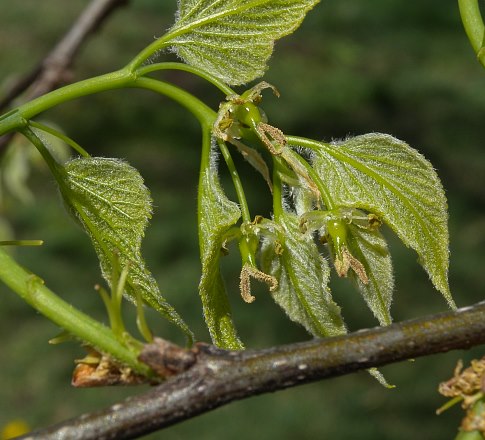
Comments: Common Hackberry is a rather variable species and some authorities, including Mohlenbrock (2002), recognize different varieties. Generally, these varieties are defined by such characteristics as leaf texture, leaf shape, color of fruit, and overall height of the tree. Because most of these varieties often intergrade with each other in the field, their value to taxonomic classification is dubious. One possible exception is Celtis occidentalis pumila (Small Hackberry), which is a straggly shrub about 2-15' tall. In many ways, this variety is similar, if not identical, to another species, Celtis tenuifolia (Dwarf Hackberry). Both Small Hackberry and Dwarf Hackberry are shrubs less than 20' tall, their leaves lack teeth or they have only a few teeth, their nutlets are nearly identical in size, and their mature drupes have similar colors (see Hill, 1900, for a description of Small Hackberry growing among the sand dunes near Lake Michigan). They differ from Common Hackberry by having 1) fewer or no teeth along their leaves, 2) slightly smaller drupes and seeds, 3) slightly smaller leaves, and 4) the growth habit of a shrub. Small trees or 'shrubs' with many teeth along their leaves and larger black-purple drupes may be depauperate specimens of Common Hackberry that result from local growing conditions. Another species in this genus that is found in Illinois, Celtis laevigata (Sugarberry), is a medium-sized tree that has more narrow leaves (lanceolate in shape) and smaller drupes (about ¼" across) than Common Hackberry. Its leaves have margins that are smooth or they have only a few teeth, while the leaf margins of Common Hackberry are serrated with abundant teeth.