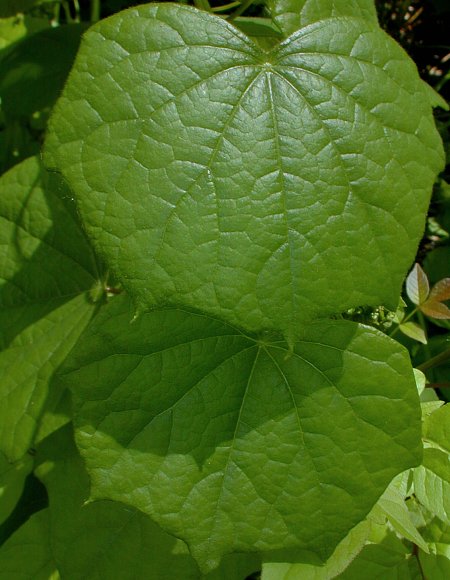
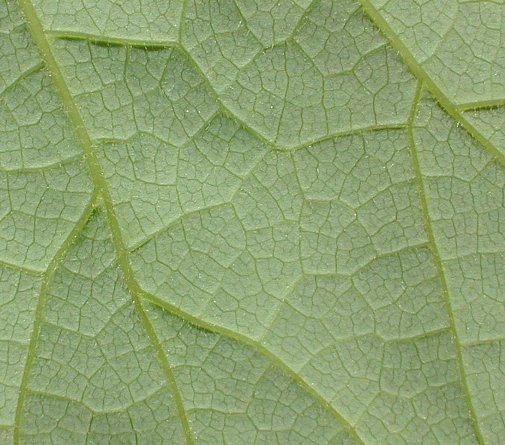
Description: This woody vine is about 8-20' long, climbing adjacent objects and vegetation by its twining stems. Young stems are green to brownish red and slightly hairy, while older stems become hairless and woody. The alternate leaves are up to 6" long, 8" across, and palmately lobed; their margins are smooth or undulate and they often bend downward. Individual leaves have 3-7 shallow lobes and they are somewhat angular; each lobe terminates in a short pointed tip. The upper leaf surface is dark green, hairless, and somewhat shiny, while the lower leaf surface is light green and slightly pubescent along the major veins. Young leaves are pubescent, but older leaves become mostly hairless. The leaves have long petioles that are light green and hairless (or nearly so); these petioles connect to the underside of their leaves near their margins. There are no tendrils.
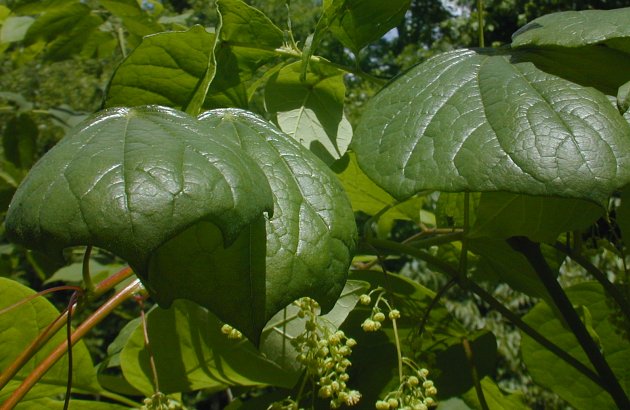
Occasionally, panicles of whitish to yellowish green flowers are produced along the non-woody stems. These panicles are up to 5" long and sometimes irregular in shape; they hang downward from the stems of this vine on long stalks (peduncles). Because Moonseed is dioecious, individual vines produce either all male (staminate) or all female (pistillate) flowers. Each male flower is 3-5 mm. (slightly less than ¼") across, consisting of 4-8 greenish white sepals, 4-8 greenish white petals, and 12-24 stamens. The sepals are longer than the petals, while the stamens have white filaments and yellow anthers. The female flowers are similar to the male flowers, except that they have pistils, rather than stamens. Each female flower has 2-4 pistils, and each pistil can develop into a separate drupe.
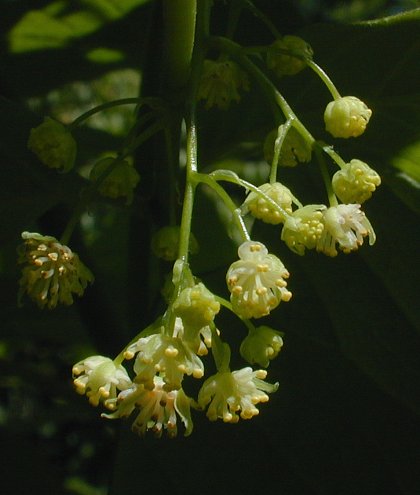
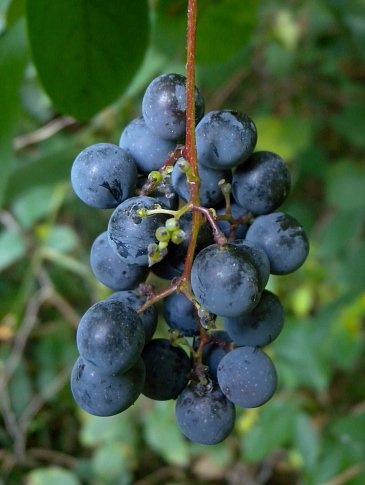
The blooming period occurs from late spring to early summer, lasting about 2 weeks. The male flowers wither away shortly after blooming, while the female flowers develop into fleshy drupes. Each drupe is up to 10 mm. (less than ½") across and globoid in shape, containing a single seed with a hard coat. Mature drupes become bluish black with a whitish bloom during the late summer or autumn; their flavor is rank and unpleasant. Individual seeds are shaped like a broad crescent moon (hence, the common name); they are somewhat flattened overall with a curved ridge and finely crested outer margins. The size of individual seeds is up to 7 mm. long, 6 mm. across, and 2 mm. deep. The root system is rhizomatous. This woody vine spreads by clonal offshoots from the rhizomes and by reseeding itself.
Cultivation:
The
preference is light shade to partial sun, moist to mesic conditions,
and a fertile loamy soil. Moonseed has few problems with disease and
insect pests.
Range & Habitat:
Moonseed is fairly common throughout Illinois (see Distribution
Map), where it is native. Habitats include open deciduous
woodlands, woodland borders, thickets, semi-shaded riverbanks,
powerline clearances in wooded areas, overgrown fence rows, and hedges.
Moonseed climbs over adjacent shrubs, the lower branches of small
trees, or fences. It is a pioneer species that prefers habitats where
there is some history of disturbance.
Faunal Associations: The flowers are cross-pollinated by insects, probably small bees and flies. Few insects appear to be feed on this woody vine. The caterpillars of Plusiodonta compressipalpis (Moonseed Moth) sever the leaves of this vine, feeding on them after they become dry. The larvae of a long-horned beetle, Hyperplatys aspersa, bore through its wood, where they are found underneath the bark (Covell, 1984/2005; Yanega, 1996). Mostly woodland birds eat the drupes, dispersing the seeds to new locations in the process. These species include the Wild Turkey, Cedar Waxwing, Brown Thrasher, Hermit Thrush, Gray-cheeked Thrush, Swainson's Thrush, American Robin, and Eastern Towhee (DeGraaf, 2002; Davison, 1967; Malmborg & Wilson, 1988). These drupes are toxic to humans, however. Both the roots and foliage are toxic to mammalian herbivores. The clambering stems and foliage provide cover and nesting habitat for birds.
Photographic
Location:
Along a powerline clearance in Busey Woods of Urbana, Illinois.
Comments:
The leaves of Moonseed superficially resemble those of Vitis
spp. (Wild Grapes), except the former are less deeply lobed
and lack serration along the margins; Moonseed also lacks the tendrils
of Wild Grapes. Two closely related species in the same family, Calycocarpum
lyonii (Cupseed) and Cocculus carolinus
(Snailseed), occur in southern Illinois. They differ primarily in the
appearance of their seeds and the shape of their leaves. As suggested
by their common names, the seeds of Cupseed are shaped like a flattened
cup, while the seeds of Snailseed are shaped like the shell of a snail.
Cupseed has palmate leaves that are deeply lobed, while Snailseed has
leaves that are about twice as long as they are wide.