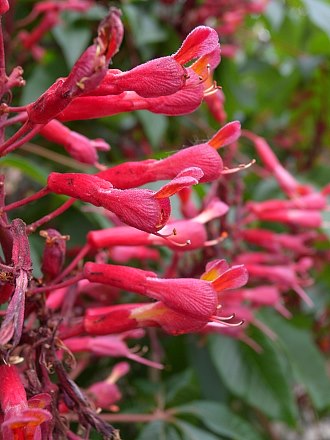
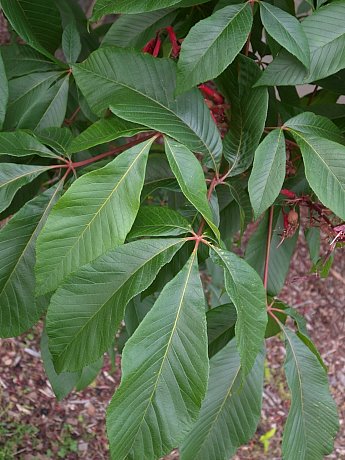
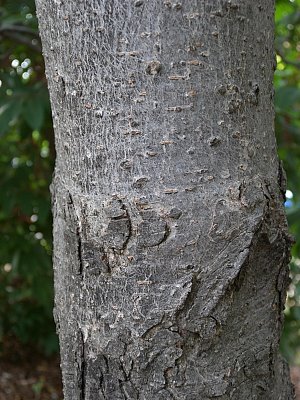
 of the lowest stems is similar to the trunk bark of young trees. Smaller woody stems and twigs are brown, relatively smooth, and slightly bumpy from scattered lenticels, while young shoots are green to reddish green and smooth. Pairs of opposite compound leaves occur at intervals along the twigs and young shoots. Individual compound leaves are palmate with 5 leaflets (rarely 7 leaflets). Individual leaflets are 3-6" long and 1-2¼" across; they are elliptic to elliptic-oblanceolate in shape, while their margins are serrated. The upper surface of the leaflets is dark green and smooth, while the lower surface is more pale and either completely glabrous, hairy along the veins, or short-pubescent. The slender petioles are 3-6" long, glabrous or short-pubescent, and either light green, red, or cream-colored. The petiolules (basal stalklets) of the leaflets are up to ¼" in length and similarly colored. Some shoots terminate in elongated clusters of red (rarely yellow) flowers about 4-10" long. In each cluster, staminate (male) flowers are produced above, while perfect (both male & female) flowers are produced below. Each flower is ¾-1½" long, consisting of a tubular calyx with 5 teeth and 4 oblanceolate petals that form a tubular shape. Perfect flowers have 6-8 slightly exerted stamens and a 3-celled pistil with an exerted style, while staminate flowers have only stamens as described above. The calyx is pale red to dark red, while the petals are usually red to dark red. Each flower has a pair of upper petals that function as a protective hood and a pair of lateral petals; the upper petals are longer than the lateral petals. The stamens extend slightly beyond the tips of the lateral petals. The central stalk and branches of the inflorescence are light green to dark red. The blooming period occurs during late spring for about 2 weeks. There is no noticeable floral scent. Afterwards, fertile perfect flowers develop into nut-like fruits that become 1½-2" across at maturity; they are globoid-ovoid in shape and their exteriors are smooth and brown. Each fruit contains 1-2 (rarely 3) large seeds. Individual seeds are more or less globoid in shape and smooth; except for the light tan coloration of their eyes, their exteriors are dark brown.
Cultivation: The preference is light shade to partial sun, mesic conditions, and a fertile loam with decaying organic matter. Red Buckeye is rarely bothered by either insect pests or disease organisms; it is hardy to Zone 4 or 5.
Range & Habitat: The native Red Buckeye occurs in southern Illinois, where it is rare (see Distribution Map). Illinois lies along the northern range limit of this species, which is found primarily in southeastern United States. Habitats consist of mesic upland woodlands, mesic areas of floodplain woodlands (above the flood zone), lower slopes of bluffs, and wooded areas along streams. In Illinois, Red Buckeye is found in deciduous woodlands, but elsewhere it can occur in mixed woodlands.
Faunal Associations: The Ruby-Throated Hummingbird sucks nectar from the showy flowers, cross-pollinating them in the process (Bertin, 1982). Relatively few insects are known to feed destructively on Red Buckeye. The thrips, Heterothrips aesculi, can be found on its flowers, while two scale insects, Diaspidiotus ostreaeformis (False San Jose Scale) and Pseudaulacaspis pentagona (White Peach Scale), have been observed on its bark. Both the bark and foliage of Red Buckeye are toxic to mammalian herbivores. Because the large seeds are also toxic, tree squirrels rarely consume them.
Photographic Location: Along a building on the campus of the University of Illinois in Urbana, Illinois.
Comments: Because of its attractive flowers and foliage, Red Buckeye is often cultivated as a landscape plant. Because of its showy red flowers and relatively small size, it is readily distinguished from other native Aesculus spp. (Buckeyes) occurring in Illinois. However, there exists in cultivation a very similar species, Aesculus sylvatica (Painted Buckeye), which is about the same size as Red Buckeye and can be confused with it. Painted Buckeye can be distinguished by the appearance of its flowers: they are usually yellowish pink and their stamens are inserted, rather than slightly exerted. However, some cultivars with pinkish red flowers may be hybrids of these two species. Red Buckeye is one of the parents of another cultivar, Aesculus × carnea (Red Horse Chestnut). This hybrid is a medium-sized tree with oblanceolate leaflets and it produces elongated clusters of pinkish red flowers.