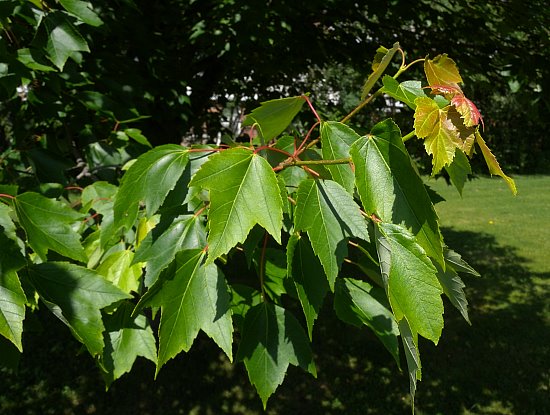
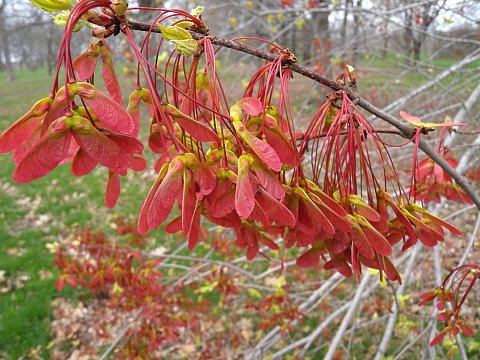
Individual trees of Red Maple can develop all male flowers, all female flowers, or both male and female flowers on the same tree. Male flowers occur in dense sessile clusters along last year's twigs; they are surrounded by short scaly bracts with ciliate margins. Individual male flowers are about 1/8" (3 mm.) long, consisting of 5 sepals, 5 petals, and several stamens. The sepals and petals are usually red (less often yellow) and very similar in appearance. The female flowers also occur in clusters along last year's branches (usually on separate branches when male flowers are present on a tree). These clusters are initially sessile, but the pedicels of the flowers soon become ½-2" long, resulting in drooping umbels. Individual female flowers are about 1/8" (3 mm.) long, consisting of 5 sepals, 5 petals, and a 2-celled ovary with a pair of divergent styles. The sepals and petals are usually red (less often yellow) and very similar in appearance. The flowers bloom during early to mid-spring for about 1-2 weeks. They are cross-pollinated by the wind. The female flowers are replaced by paired samaras that are arranged along the twigs in drooping umbels. Each pair of samaras forms a 45-90° angle. Each samara is ¾-1" long, consisting of a single-seeded body and an elongated membranous wing. The samaras can be yellow, red, or reddish brown. They become mature during late spring or early summer and are distributed by the wind. The root system consists of a taproot with lateral roots; they are variable in length, depending on the amount of moisture that is available. The deciduous leaves usually turn red during the autumn; less commonly, they become orange or yellow.
Cultivation: This tree is very adaptable, tolerating full sun to light shade, wet to dry conditions, and almost any kind of soil, although it prefers moist loamy soil that is mildly acidic. It grows moderately fast while young, bearing samaras in as little as 5 years. Longevity of mature trees is typically 75-150 years.
Range & Habitat: The native Red Maple is occasional to locally common in southern and NE Illinois, while in other areas of the state it is rare or absent (see Distribution Map). Habitats include floodplain woodlands in river valleys, swamps, sandy flatwoods, sand dunes, upland woodlands and wooded bluffs, acidic gravelly seeps, and forested bogs. Red Maple is typically associated with American Elm, Green Ash, Silver Maple, and other deciduous trees that occur in soggy woodlands, where it is occasionally dominant or codominant. Because of fire suppression, Red Maple has become more common in upland woodlands in some eastern states. It is often cultivated as a landscape tree.
Faunal Associations: Insects that feed on the leaves, plant juices, wood, and other parts of Red Maple (Acer rubrum) include larvae of gall flies, plant bugs, aphids, leafhoppers, treehoppers, scale insects, and larvae of moths. Red Maple is a preferred host plant for the larvae of two moths, Parallelia bistriaris (Maple Looper) and Macaria pustularia (Lesser Maple Spanworm). The Insect Table has a list of insect species that have been observed to feed specifically on Red Maple. The larvae of some beetles also bore through the wood Red Maple and other maples (Acer spp.); the Wood-boring Beetle Table lists some of these species.
Vertebrate animals use Red Maple and other maples as a source of food, nesting habitat, and cover. Some upland gamebirds (Ruffed Grouse, Wild Turkey, Bobwhite, etc.) and songbirds (Red-Breasted Nuthatch, Purple Finch, Evening Grosbeak, etc.) eat the seeds and buds, while the Yellow-Bellied Sapsucker drills holes into the bark to feed on sap (see Bird Table). Woodpeckers and other insectivorous songbirds often search for the many insects that feed on maples; these insects are especially important in feeding young nestlings. Twigs and sometimes the leaves of Red Maple are browsed by White-Tailed Deer and Elk, primarily during the winter when other foods are scarce; the leaves of this tree are reportedly toxic to cattle and horses. The Cottontail Rabbit sometimes eats the seedlings, while tree squirrels occasionally eat the seeds. The cavities of older trees are used as nesting habitat by some birds (Screech Owl, Pileated Woodpecker, Wood Duck, Northern Flicker, Tree Swallow) and tree squirrels (Fox Squirrel, Gray Squirrel, Red Squirrel); such cavities are also used by various tree-roosting bats.
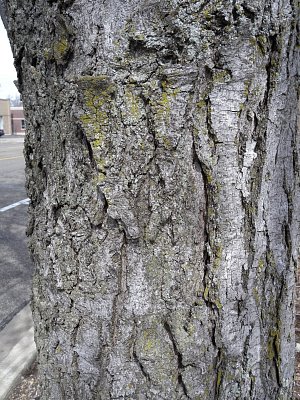
Photographic Location: The photographs were taken in the yard of the webmaster's apartment complex (leaves, flowers), along a city street (trunk bark), and at the Arboretum of the University of Illinois (samaras) in Urbana, Illinois.
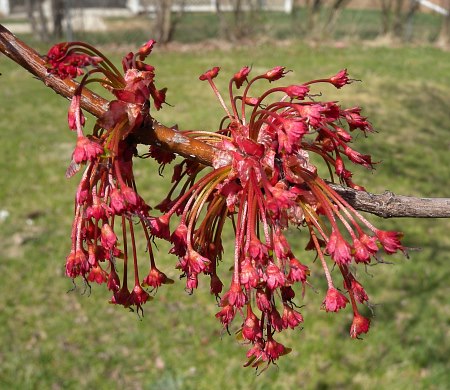
Comments: Because of its attractive leaves (red fall color, reddish petioles), attractive flowers and samaras (also often red), and contrasting silvery gray bark, this is one of the most attractive maples. In particular, the flowers of Red Maple tend to stand out from the background because they develop very early in the spring when both flowers and leaves are scarce. Its only other rival in this respect is Silver Maple (Acer saccharinum), which has less colorful flowers. Both of these maples develop earlier in the spring than other maples and their samaras become mature by early summer. The leaves of Silver Maple are more deeply lobed than those of Red Maple, and Silver Maple also has larger samaras. Because of its variability, different varieties of Red Maple have been described; these varieties occur primarily in the southeastern states. One variety that is found in southern Illinois, Drummond's Maple (Acer rubrum drummondii), occurs primarily in swamps and bottomland woodlands, sometimes in standing water. It differs from the typical variety of Red Maple (as described here) by having a dense coating of fine white hairs on the lower surface of its leaves. In addition, the petioles and twigs of Drummond's Maple are often pubescent, and it has larger samaras (1¼-2" long). Because of these differences, some authors (Mohlenbrock, 2002) have classified this tree as a distinct species, Acer drummondii.