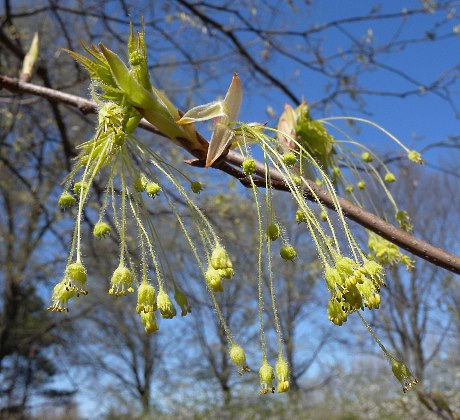
Sugar Maple is either dioecious or monoecious, producing separate male and female flowers on the same or different trees. Male flowers are produced in drooping umbels or sparingly branched corymbs about 3-4" long. Individual male flowers are about 1/8" (3 mm.) long, consisting of a yellowish green calyx with 5 teeth and a variable number of exerted stamens (usually about 6-8). Female flowers are also produced in drooping umbels or sparingly branched corymbs, but they are shorter (about 1-2" long). Individual female flowers are about 1/8" (3 mm.) long, consisting of a yellowish green calyx with 5 teeth and a 2-celled ovary with a divided style. Both male and female flowers can occur in the same inflorescence. The long slender pedicels of both male and female flowers are quite hairy. The flowers bloom during mid- to late spring as the leaves emerge (which are yellowish green at this time of year). Cross-pollination occurs by the wind during a 1-2 week period. Fertile female flowers are replaced by paired samaras that become mature during the fall. The paired samaras form a 60º to 90º angle with each other. Individual samaras are about 1" long, consisting of a single-seeded head with a membranous wing; they are distributed by the wind. The woody root system consists of much-branched lateral roots that are relatively shallow. During the autumn, the deciduous leaves assume brilliant shades of yellow, orange, or red.
Cultivation: The preference is full sun to light shade, well-drained mesic conditions, and a fertile loamy soil, although soil containing rocky material, sand-loam, silt-loam, or clay-loam is also tolerated. Young saplings of Sugar Maple are able to survive in moderately dense shade, although higher levels of light are preferred. Generally, this tree doesn't tolerate flooded conditions for any substantial length of time. Sugar Maple is somewhat susceptible to air pollution (including acid rain), road salt, ice damage, and wind-throw. It often casts a dense shade that kills turf grass and other vegetation.
Range & Habitat: The native Sugar Maple is a common tree that occurs throughout Illinois (see Distribution Map); it probably occurs in every county. Habitats include rich mesic woodlands, sandy woodlands, wooded bluffs and hills, north-facing wooded slopes, wooded areas in protected coves and river valleys, lower slopes or bottoms of rocky ravines and canyons, and edges of limestone glades. Sugar Maple is often cultivated as a landscape tree in parks and yards. This tree is often the dominant canopy tree in mesic woodlands, or it can be codominant with American Beech or American Basswood. As a result of the suppression of wildfires and higher amounts of rainfall during the past several decades, it has displaced oaks, hickories, and other native trees in many woodlands around the state.
Faunal Associations: While honeybees and other bees sometimes collect pollen from the male flowers of Sugar Maple, cross-pollination is not achieved because they fail to visit the female flowers, which offer neither nectar nor pollen as a floral reward (Robertson, 1929). The foliage, sap, wood, and other parts of Sugar Maple are sources of food to many insects; this includes the larvae of wood-boring beetles, plant bugs, aphids, leafhoppers, treehoppers, armored scales, mealybugs, and the larvae of various moths (see Insect Table). After the protective bark has been damaged during the spring, some insects feed on the copious sap flow of Sugar Maple. These sap feeders include honeybees, some adult butterflies (Mourning Cloak, Comma, & Red Admiral), and many kinds of adult flies: Syrphid flies, Tachinid flies, flesh flies, blow flies, Muscid flies, skipper flies (Piophilidae), and the sap-feeding fly Aulacigaster leucopeza (Robertson, 1929). Some spider mites also feed on the foliage of Sugar Maple, sometimes forming galls. This latter group of species includes Oligonychus aceris (Maple Spider Mite), Aceria elongatus (Red Pile Mite), Aceria modestus (Green Pile Mite), and Vasates aceriscrumena (Maple Spindle Gall Mite); see Wilhelm & Rericha (2017). Vertebrate animals also use Sugar Maple and other maples as a source of food and protective cover. Some upland game birds and songbirds eat the buds or seeds (see Bird Table), while the Yellow-bellied Sapsucker drills holes into the bark to feed on the sap. Birds also use these trees for protective cover or nesting habitat; this includes the Rose-breasted Grosbeak, Scarlet Tanager, Baltimore Oriole, Blue-gray Gnatcatcher, Black-throated Blue Warbler, Cerulean Warbler, Red-eyed Vireo, and such cavity-nesting birds as the Black-capped Chickadee, Northern Flicker, Pileated Woodpecker, and Screech Owl (Newell & Rodewald, 2011; DeGraaf, 2002; Steele, 1993). Among mammals, the Eastern Chipmunk, Fox Squirrel, Gray Squirrel, Red Squirrel, Prairie Vole, Meadow Vole, and White-footed Mouse eat the seeds (samaras). White-tailed Deer and Elk (the latter now extinct in the Midwest, except where it has been reintroduced) browse on the leaves and twigs, while the Beaver feeds on the wood and uses maple branches in the construction of their dams and lodges (Schneider et al., 2006; Martin et al., 1951/1961). The cavities of old maple trees also provide dens for various tree squirrels. Some species of bats use Sugar Maple and other maples for maternity colonies or daytime roosting sites either among the leafy branches, or inside cavities, or behind exfoliating bark These species include the Northern Long-eared Bat (Myotis septentrionalis), Little Brown Bat (Myotis lucifugus), Evening Bat (Nycticeius humeralis), Tricolored Bat (Perimyotis subflavus), and Eastern Red Bat (Lasiurus borealis); see Krynak (2010), Ford et al. (2006), MuÍnzer (2008), Veilleux et al. (2003), Mager & Nelson (2001), Bergeson (2012), and Johnson et al. (2009).
Photographic Location: The Arboretum of the University of Illinois in Urbana, Illinois.
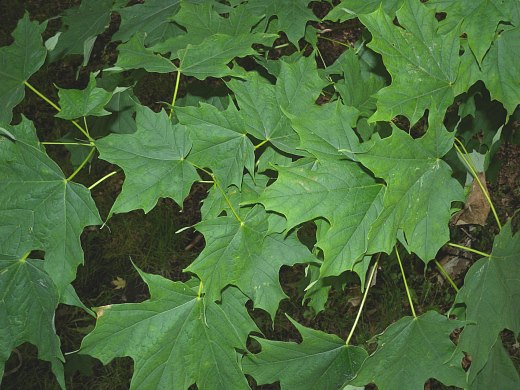
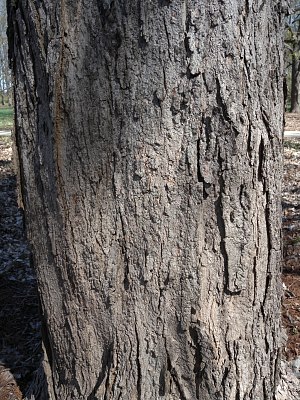
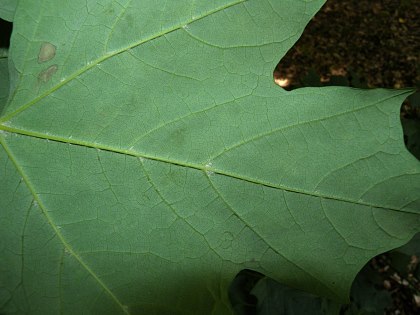
Comments: Sugar Maple is a tree of economic importance because it is the source of maple syrup. The wood of Sugar Maple is also important economically because it is used in the construction of furniture, paneling, flooring, veneer, gun stocks, tool handles, cutting blocks, woodenware, sporting goods, bowling pins, and musical instruments. This tree is very similar to another species, Black Maple (Acer nigrum), which is sometimes regarded as a subspecies of Sugar Maple. Black Maple differs by having 3-lobed leaves with fewer teeth and slightly drooping margins, canescent leaf undersides, and trunk bark that is more furrowed. Black Maple is also native to Illinois, but it is less common. Trees displaying some evidence of hybridization between these two species are fairly common. Another tree that is often cultivated, the introduced Norway Maple (Acer platanoides), has leaves closely resembling those of Sugar Maple. Norway Maple differs by exuding a milky sap from the base of its petiole (when broken off from a branch), rather than a clear sap. It also has paired samaras that are more divergent (forming an angle that exceeds 120º) and larger flowers in more erect clusters that are insect-pollinated.