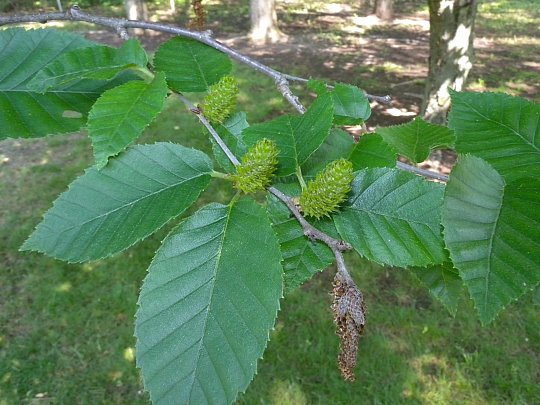
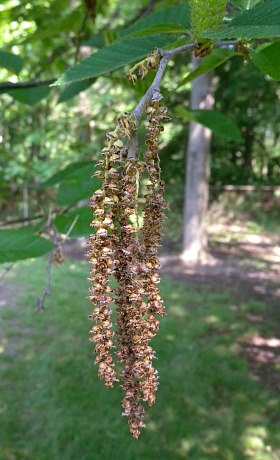
Yellow Birch is monoecious, forming male (staminate) and female (pistillate) catkins on the same tree. Male catkins occur at the tips of last year's twigs in groups of 3-6. During the blooming period, they droop downward and become 2½-4" long. At this time, the male catkins are narrowly cylindrical and yellowish purple. Each male catkin consists of numerous male florets and their bracts. Male florets occur in groups of 3 behind each bract; each male floret consists of 2 stamens. Each bract is oval-orbicular in shape and ciliate along its margins. Female catkins occur individually on short spur-twigs near the petioles of leaves; they are sessile or nearly so. The female catkins are upright, ovoid-oblongoid in shape, and greenish, ultimately becoming ¾-1¼" in length at maturity. Each female catkins consists of numerous female florets and their bracts. Female florets occur in groups of 3 behind each bract; each female floret consists of a naked ovary and a pair of styles. The bracts are ¼-½" long, 3-lobed and ciliate along their margins. The blooming period occurs during late spring for about 1 week. The florets are cross-pollinated by the wind. The female catkins turn brown as their winged seeds (samaras) ripen. Each seed body is about 1/8" (3 mm.) long, ellipsoid-ovoid in shape, and somewhat flattened. Membranous wings extend on opposite sides of each seed; they are a little less wide than the seed body. The woody root system is relatively shallow and widely spreading. This tree reproduces by reseeding itself.

Cultivation: The preference is full or partial sun, moist to mesic conditions, and soil containing loam or sandy loam. This tree is slow-growing and typically lives for about 150 years (unless it is prematurely killed by insects, disease, or other causes). However, the longevity of some trees can extend to 300 years or more. Hot dry weather during the summer can impair the health of this tree.
Range & Habitat: The native Yellow Birch is rare in Illinois, where it is restricted to the northern section of the state (see Distribution Map). It is state-listed as 'endangered.' Illinois lies along the southwestern range-limit of this tree, which prefers a cool moist boreal climate. Habitats consist of protected areas of bluffs, north-facing wooded slopes, and ravines where either mixed or hardwood forests occur. Because of its thin bark and poor resprouting capability, this tree is easily killed by wildfires.
Faunal Associations: Various insects feed on the foliage, bore through the wood, suck plant juices, or feed on the seeds of Yellow Birch and other birches (Betula spp.). These species include caterpillars of the butterflies Nymphalis antiopa (Mourning Cloak) and Nymphalis vau-album j-album (Compton Tortoiseshell), and the caterpillars of such moths as Acronicta betulae (Birch Dagger Moth), Peridea ferruginea (Chocolate Prominent), Venusia comptaria (Brown-Shaded Carpet), and other moths. Other insect feeders include Calaphis betulaecolens (Common Birch Aphid) and other aphids, Erythridula praecisa and other leafhoppers, the psyllid Cacopsylla hartigii, Corythucha pallipes (Birch Lace Bug), the plant bugs Lygocoris fagi and Orthotylus necopinus, the stink bug Banasa dimiata, Kleidocerys resedae (Birch Catkin Bug), the larvae of Agrilus anxius (Bronze Beech Borer) and other wood-boring beetles, the leaf beetles Altica betulae and Calligrapha ignota, the larvae of such sawflies as Arge pectoralis (Birch Sawfly) and Dimorphopteryx melanognathus (Fringed Birch Sawfly), and larvae of Oligotrophus betheli (Birch Seed Midge). See the Insect Table for a more complete listing of these species. Because of the thin bark, the Yellow-Bellied Sapsucker drills holes and feeds on the sap of Yellow Birch. The seeds, catkins, and buds are eaten by such birds as the Ruffed Grouse, Common Redpoll, Black-Capped Chickadee, Purple Finch, White-Winged Crossbill, and Slate-Colored Junco. Among mammals, the Red Squirrel feeds on the seeds, the White-Tailed Deer and Cottontail Rabbit browse on seedlings and saplings, and the Beaver gnaws on the bark and wood. Some vertebrate animals use birches and other trees as a source of cover and reproductive habitat. For example, such species as the Red Bat (Lasiurus borealis), Hoary Bat (Lasiurus cinereus), and Silver-Haired Bat (Lasionycteris noctivagans) use trees for summer roosting sites, maternity colonies, and hibernation.
Photographic Location: The Arboretum of the University of Toledo in Toledo, Ohio. The photographed tree is the southern variety of Yellow Birch, Betula alleghaniensis fallax.
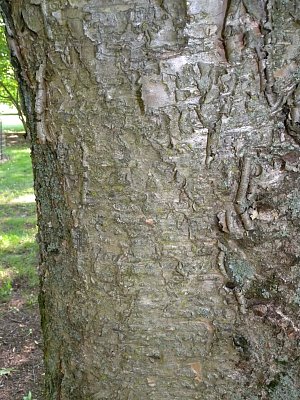
Comments: Among birches (Betula spp.) in eastern North America, Yellow Birch is considered the most important as a source of lumber. The wood of this tree is relatively strong, close-grained, and heavy; it has been used to make furniture, cabinetry, interior finish, paper pulp, boxes, charcoal, tool handles, toothpicks, wooden doors, and carved wooden items. Yellow Birch is one of the larger and longer-lived birches. It is similar to the eastern Betula lenta (Sweet Birch), except that the latter tree has inner bark with a strong wintergreen aroma and the bracts of its female catkins are hairless. The bark of Sweet Birch is more dark and doesn't exfoliate like the bark for the typical variety of Yellow Birch; it is more similar to the bark of the southern variety (var. fallax) of Yellow Birch. Another species, Betula nigra (River Birch), has exfoliating bark that resembles the bark for the typical variety of Yellow Birch. River Birch differs by having leaves with broadly wedge-shaped bottoms (rather than rounded) and by having its female catkins on peduncles exceeding ¼" in length. This latter tree is more southern in its distribution. A scientific synonym of Yellow Birch is Betula lutea.