Description:
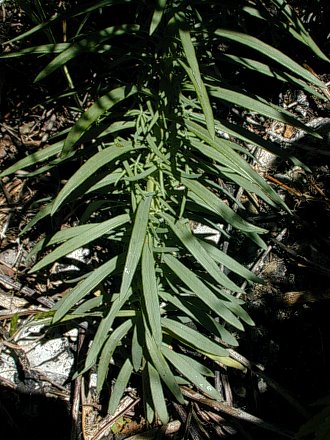
This perennial plant is 1-2' tall and little branched. The
alternate leaves are densely distributed all around the central stem,
appearing to be opposite or whorled; they very little in length. The
leaves are up to 2½" long and 1/6" (4 mm.)
across, bluish or grayish green, linear with smooth margins, and
hairless. Each leaf tapers to a petiole-like base and is sessile. The
central stem has a few hairs near its apex, but becomes glabrous or
slightly woody near its base.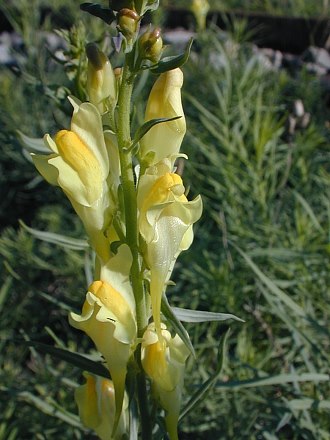 This stem terminates in a
spike-like
raceme of flowers that is several inches long. The flowers are
distributed all around this
raceme. Each flower is about 1" long and consists of a tubular corolla
with an upper and lower lip that is pale yellow; there is also
a long nectar spur at the end of the corolla that hangs downward. The
upper lip is divided into 2 lobes that are folded upward, while the
lower lip consists of 2 lobes that fold downward and an orange-yellow
palate that obstructs the opening to the throat of the corolla. At the
base of the flower, there is a small green calyx with 5 teeth and a
short pedicel. Usually the underside of the corolla is
cream-colored, in contrast to the bright orange-yellow of the palate.
The
blooming period occurs from early to mid-summer for about a month, and
intermittently thereafter until the early fall. Some colonies of plants
bloom later than others. Many plants in a colony may fail to bloom.
Each flower is replaced by a seed capsule that
contains numerous small seeds. Each seed is brown and flattened; it is
surrounded by a rather large papery wing with a small notch on one
side. Assisted by their papery wings, these seeds are blown about by
the wind. The root system consists of a long taproot and shallow
rhizomes that spread in all directions. This plant usually forms
clonal colonies by means of its rhizomes.
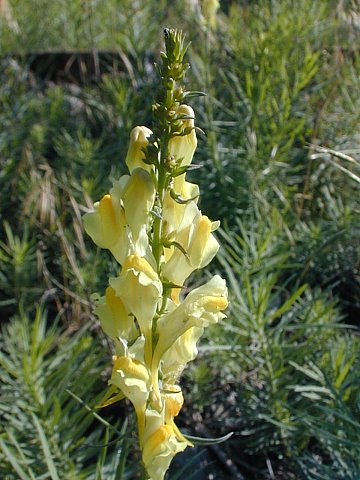
This stem terminates in a
spike-like
raceme of flowers that is several inches long. The flowers are
distributed all around this
raceme. Each flower is about 1" long and consists of a tubular corolla
with an upper and lower lip that is pale yellow; there is also
a long nectar spur at the end of the corolla that hangs downward. The
upper lip is divided into 2 lobes that are folded upward, while the
lower lip consists of 2 lobes that fold downward and an orange-yellow
palate that obstructs the opening to the throat of the corolla. At the
base of the flower, there is a small green calyx with 5 teeth and a
short pedicel. Usually the underside of the corolla is
cream-colored, in contrast to the bright orange-yellow of the palate.
The
blooming period occurs from early to mid-summer for about a month, and
intermittently thereafter until the early fall. Some colonies of plants
bloom later than others. Many plants in a colony may fail to bloom.
Each flower is replaced by a seed capsule that
contains numerous small seeds. Each seed is brown and flattened; it is
surrounded by a rather large papery wing with a small notch on one
side. Assisted by their papery wings, these seeds are blown about by
the wind. The root system consists of a long taproot and shallow
rhizomes that spread in all directions. This plant usually forms
clonal colonies by means of its rhizomes.
Cultivation:
The preference is full sun, dry conditions, and a barren soil that is
gravelly or sandy. Under these conditions, this plant can spread
aggressively because of the reduced competition from taller plants with
wider leaves. Soil with a high pH is readily tolerated.
Range & Habitat:
The non-native Butter-and-Eggs is a common plant in central and
northern Illinois, but it is less common or absent in southern
Illinois, particularly in the SE section of the state (see
Distribution
Map).
This wildflower was introduced into North America
from Eurasia (where it is native to the Mediterranean region) as an
ornamental
plant, and it is still offered for sale by the horticulture industry.
Habitats include pastures, old fields, gravelly or sandy areas along
railroads and roadsides, gardens, and sterile waste ground.
This
plant is typically found in disturbed areas, particularly along
railroads, although it is aggressive enough to invade dry sand
prairies and gravel prairies. Occasional wildfires and mowing are
not effective in controlling this plant. Butter-and-Eggs is more
invasive in the drier western areas of the United States.
Faunal
Associations:
The flowers are pollinated by bumblebees, which are strong enough to
push past the palate to enter the throat of the corolla. Other floral
visitors include other long-tongued bees, butterflies, and
skippers. According to Robertson (1929), the butterflies and skippers
are not effective pollinators of the flowers, however. Several insect
species have been introduced to control the spread of Butter-and-Eggs.
This includes Brachypterolus pulicarius, a small
black beetle that feeds on the tips of the shoots; Gymnaetron
antirrhini, a weevil that feeds on the seed capsules; and Calophasia
lunula (Toadflax Brocade), a moth with larvae that feed on
the foliage and
flowers. The foliage is not a preferred source of food among mammalian
herbivores and it is rarely eaten; it contains a glycoside that is
mildly toxic to cattle.
Photographic Location:
A gravelly area along a railroad in Urbana, Illinois, where a colony of
plants was found.
Comments: Butter-and-Eggs is another garden plant that has escaped into the wild to become a permanent resident. It has spread to all areas of the United States. The large and showy flowers resemble those of Antirrhinum majus, the cultivated Snapdragon of modern horticulture, although this latter species rarely escapes from cultivation. Another species, the introduced Linaria genistifolia dalmatica (Dalmatian Toadflax), is an uncommon plant that occurs in a few counties of northern Illinois. This latter species resembles Butter-and-Eggs somewhat, but its flowers are larger in size (about 1½" long) and the palate of its flowers is yellow, rather than orange-yellow. The leaves of Dalmatian Toadflax are much broader than those of Butter-and-Eggs, and they clasp the stem. The native Linaria spp. in Illinois are annual or biennials with smaller blue flowers. Another common name for Linaria vulgaris is Yellow Toadflax.