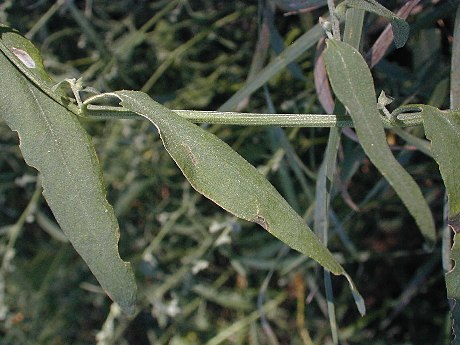
Description: This plant is a summer annual about 1½–3' long; it branches occasionally, especially near the base. The stems are erect, ascending, or sprawling (often the latter); they are light green, more or less white-mealy, and terete or angular. The larger stems often have white longitudinal veins. The lowest leaves are opposite, while the remaining leaves are alternate; they have slender petioles up to 1" long. The leaf blades are up to 3½" long and ¾" across, becoming gradually smaller as they ascend the stems; they are green, flat, and either smooth or slightly undulate along their margins. The leaf blades have different shapes, but they are usually lanceolate-ovate, lanceolate, or oblong-linear; some leaves may have 1 or 2 lobes toward the base of their blades. The upper surface of each blade is hairless or glabrous, while the lower surface is often white-mealy.
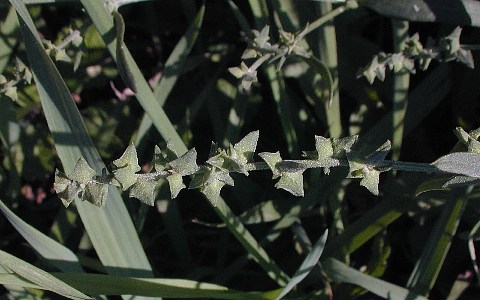
The upper stems
terminate in spikes or spike-like panicles of flowers; axillary spikes
also develop from some of the upper leaves. The flowers are arranged in
sessile clusters along the spikes or the branches of the panicles.
Common Orach is monoecious with separate male (staminate) and female
(pistillate) flowers on the same plant. Each male flower has 5 sepals
and 5 stamens; it is whitish green and about 1/8" (3 mm.) across. Each
female flower has an ovary with 2 styles and a pair of small bracts at
its base; it is green and about 1/8" (3 mm.) across. The male flowers
lack petals, while the female flowers have neither petals nor sepals.
The flowers and branches of each inflorescence are white-mealy. The
blooming period occurs during late summer into the fall. Pollination is
by wind. The bracts of the female flowers enlarge in size, becoming
triangular-hastate in shape and about 1/5" (5 mm.) in length; they form
a flattened fruit that encloses the developing seed. Mature seeds are
flattened, circular, and shiny black; each seed is covered by a thin
rough membrane that is difficult to remove. The root system consists of
a branching taproot. This plant spreads by reseeding itself.
Cultivation:
The preference is full sun to light shade, moist to mesic conditions,
and a fertile loamy soil. Toleration of salty alkaline conditions is
quite good, although in Illinois this species is usually found in
ordinary garden soil.
Range &
Habitat:
The adventive Common Orach occurs occasionally in central and northern
Illinois,
while in the southern part of the state it is uncommon (see Distribution
Map). This species is native to Eurasia and northern Africa.
Habitats include woodland borders, gardens, edges of yards, unmowed
areas around telephone poles and tree stumps, areas along railroads
and roadsides, dumps, and waste areas. Areas with a history of
disturbance are preferred. In Illinois, this species is not invasive of
natural habitats.
Faunal Associations:
Insects that feed primarily on the leaves of Atriplex spp.,
including Common Orach (Atriplex
patula), are larvae of a fly, Pegomya hyoscyami (Spinach
Leafminer); larvae of Emmelina
monodactyla (Morning Glory Plume Moth), Chrysoesthia drurella (Goosefoot
Leafminer Moth), and Chrysoesthia
lingulacella (Flamboyent Twirler Moth); adults of Chaetocnema concinna
(Brassy Flea Beetle); and Hayhurstia
atriplicis (Chenopodium Aphid). Because the foliage and
seeds of herbaceous Atriplex
spp. are similar to those of Chenopodium spp.,
they may have similar floral-faunal relationships in the eastern United
States. In particular, granivorous songbirds (e.g., various sparrows)
probably eat the seeds.
Photographic Location: The
photographs were taken near a vegetable garden in Urbana, Illinois, and
along the edge of a wooded area in Champaign County, Illinois.
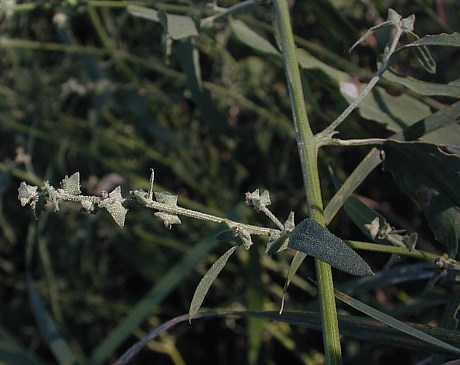
Comments: This plant has unusual arrowhead-shaped fruits. While other Atriplex spp. have such fruits, there are usually more lobes and other irregularities along the margins of their fruits. The foliage of Common Orach is very similar to the foliage of some Chenopodium spp. (Goosefoots). However, the latter have button-shaped fruits with 5 folded sepals. Because of the variability of its leaves, different varieties of Common Orach have been described. The typical variety (described here) has lanceolate leaves, while var. littoralis has linear leaves and var. hastata has triangular-hastate leaves. Some authorities consider these varieties to be different species (see Mohlenbrock, 2001). Common Orach should not be confused with Atriplex hortensis (Garden Orach), which is occasionally grown in gardens as either a potherb or ornamental plant. This latter species has fruits with nearly orbicular bracts that are conspicuously veined. In dry areas of the Western states, there are woody to semi-woody Atriplex spp. that are quite distinct. These are referred to as 'Saltbushes.'