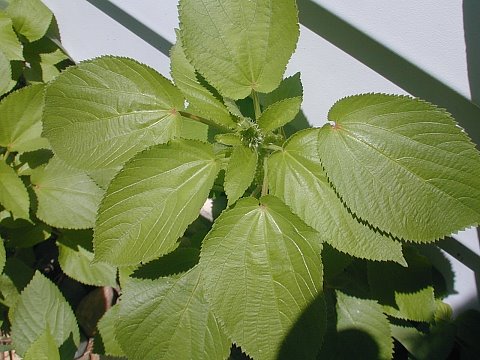
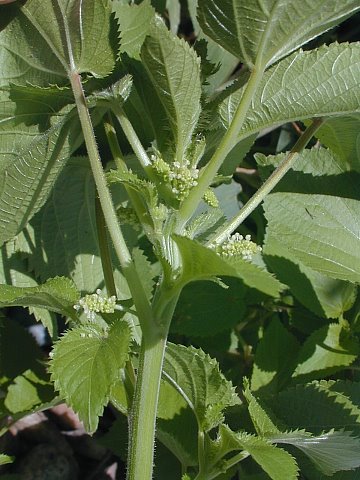
Description: This plant is a summer annual about 1–2½' tall, branching occasionally. The stems are terete or somewhat angular and they have spreading white hairs. The alternate leaves are up to 4" long and 2½" across. They are rather thin-textured and have raised veins on their undersides. The leaves are medium green, cordate or broadly ovate, and serrated along their margins. The long slender petioles often have spreading hairs like the stems. Hornbeam Mercury is monoecious with separate male and female flowers on the same plant. The male (staminate) flowers develop from the axils of the leaves in non-terminal spikes about ½–2" long. These cylindrical spikes are densely crowded with small flowers. Each male flower is about 1/8" (3 mm.) across, consisting of 4 sepals that are green or translucent white, several stamens that are white, and no petals. The spikes of female (pistillate) flowers terminate the upper stems; they are usually located above the male flowers. The pistillate spikes are also densely crowded with small flowers, but their appearance is less smooth and cylindrical than the staminate spikes because of the long styles and floral bracts. Each female flower is about ¼" across, consisting of several long branching styles that are white, a green ovary that is quite spiny in appearance, and no petals. At the base of each female flower, there is a surrounding floral bract with several narrow lobes. The blooming period occurs from mid-summer to early fall and lasts about 1-2 months. The flowers are cross-pollinated by the wind. Afterwards, the female flowers are replaced by 3-valved seed capsules; each valve of a capsule contains a single seed. The seeds are ovoid in shape, broader and rounder at one end than the other, and pitted or wrinkled across the surface. The root system consists of a taproot. This plant spreads by reseeding itself, and occasionally forms colonies.
Cultivation:
This
plant is typically found in full or partial sun, moist to mesic
conditions, and a fertile loamy soil. It also occurs in clay-loam and
stony soil. At locations that are too hot and dry, the foliage often
wilts.
Range & Habitat:
The native Hornbeam Mercury occurs occasionally in the southern half of
Illinois (see Distribution
Map). Habitats include thickets, riverbanks, lower slopes of
bluffs,
cropland, fallow fields, gardens, areas along buildings, and roadsides.
This native species prefers disturbed areas and it is a minor pest of
cropland in the southern half of the state.
Faunal Associations:
The flowers don't attract many insects because they are
wind-pollinated. Two flea beetles, Hornaltica
bicolorata and Margaridisa
atriventris, feed on Acalypha
spp.
The seeds are occasionally eaten by the Mourning Dove and probably
other granivorous birds. Deer browse on the foliage of these plants,
and possibly other mammalian herbivores do this as well. The foliage
may be mildly toxic to cattle because of excess nitrate accumulation.
Unlike many other members of the Spurge family, the native Acalypha
spp. lack a toxic white latex in their foliage.
Photographic
Location:
A few plants were growing along the foundation of the webmaster's
apartment complex in Urbana, Illinois.
Comments:
Hornbeam Mercury is a nondescript plant that is easily overlooked. Its
leaves are supposed to resemble the leaves of hornbeam trees
(e.g., Ostrya spp.),
hence the common name. Another common name is Rough-Podded Copperleaf,
which refers to the spiny-looking seed capsules and the tendency of the
foliage to turn reddish brown during the fall. Hornbeam Mercury differs
from other native Acalypha spp. by its monoecious
flowers (separate spikes of male and female flowers) and its broad
serrated leaves that are heart-shaped (cordate) at the base. The leaves
remind me of the foliage of woodland plants in the Nettle family, but
Hornbeam Mercury occurs in sunnier habitats and the female flowers are
surrounded by the lobed bracts that are typical of native Acalypha
spp. in Illinois.