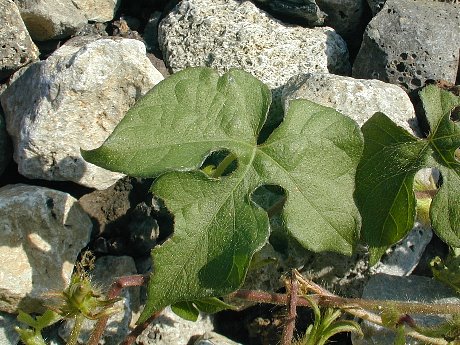
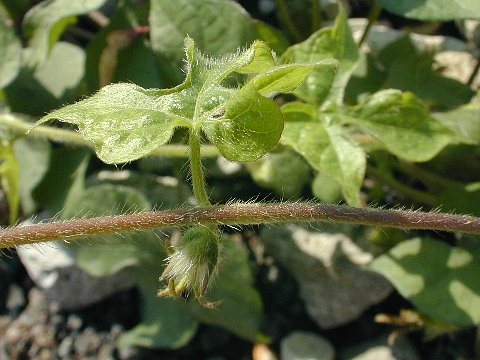
Description: This annual vine is up to 6' long, branching occasionally. The terete stems are light green to dull red, and more or less covered with white hairs. The stems twine about surrounding vegetation, or sprawl about haphazardly. The alternate leaves are up to 4" long and 3½" across; they are medium to dark green, deeply 3-lobed, and indented at their bases. Each lobe is widest in the middle and tapers to a blunt tip. The margins of the leaves are smooth and somewhat undulating, while the upper surface is sparsely hairy. The petioles are light green to dull red, terete, sparsely to moderately hairy, and about one-half of the length of the leaves.
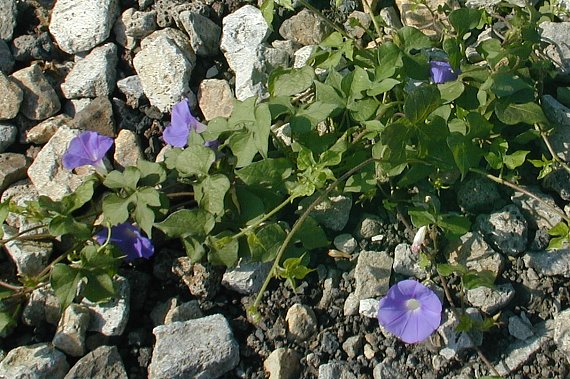
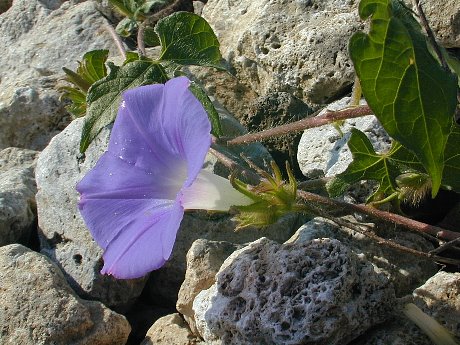
The flowering stalks develop from the axils of the leaves and are quite short (¼" or less), producing 1-3 flowers. The corollas of the flowers are funnelform and about 2" across; they are initially blue-violet, fading to pale purplish pink with age. Deep within its throat, the corolla is white. The hairy green calyx is about ½" long; it is divided into 5 teeth that are linear-lanceolate. These teeth often curl outward at their tips. The flowers bloom only during the mornings on sunny days, although they may remain open longer on cloudy days. Although each flower lasts only a few hours, the blooming period typically lasts about 2 months (from mid-summer into fall). Each flower is replaced by a 3-celled capsule containing 4-6 seeds. The rather large seeds are brown to black and wedge-shaped; their surfaces are dull. The root system consists of a slender taproot. This vine spreads by reseeding itself.
Cultivation:
The
preference is full or partial sun, mesic conditions, and fertile loamy
soil, although it will adapt to other kinds of soil.
The seeds don't germinate until the soil becomes warm during early
summer. This plant can spread aggressively in open areas with exposed
ground.
Range & Habitat:
Ivy-Leaved
Morning Glory is common in most areas of
Illinois, except the NW section of the state, where it is less common
or absent (see Distribution
Map). This vine was introduced into North America from South
America as an
ornamental plant, and it is probably still spreading throughout the
state. Habitats include fields, abandoned fields, areas along roadsides
and railroads, gardens, and miscellaneous waste areas. So far this
plant hasn't invaded native habitats to any significant degree, but it
is quite common in disturbed areas, especially along the edges of
cultivated fields.
Faunal Associations: The flowers of Ivy-Leaved Morning Glory are pollinated by bumblebees and other long-tongued bees. Some oligolectic visitors of the flowers include Melitoma taurea (Mallow Bee), Peponapis pruinosa pruinosa (Squash & Gourd Bee), and Cemolobus ipomoeae (Morning Glory Bee). Various tortoise beetles feed on the foliage, including Chelymorpha cassidea (Argus Tortoise Beetle), Charidiotella bicolor (Golden Tortoise Beetle), Deloyala guttata (Mottled Tortoise Beetle), and Jonthonata nigripes (Black-Legged Tortoise Beetle). Another species, Chaetocnema confinis (Sweet Potato Flea Beetle), feeds on both the foliage (adults) and the roots (larvae). The larvae of a long-horned beetle, Phaea monostigma, bore through the stems of Ipomoea spp. The caterpillars of some moths also feed on these vines, including Agrius cingulatus (Pink-Spotted Hawk Moth), Bedellia somnulentella (Morning Glory Leafminer), and Emmelina monodactyla (Morning Glory Plume Moth). The large seeds are rarely eaten by birds, although the Ring-Necked Pheasant and Bobwhite Quail utilize them as a food source to a limited extent. Similarly, the foliage is rarely eaten by mammalian herbivores.
Photographic
Location:
The photographs were taken of a branching vine that was growing on
railroad ballast in Champaign, Illinois.
Comments:
The short-lived flowers are beautiful. Ivy-Leaved Morning
Glory is easily distinguished from other Ipomoea spp.
(Morning Glory species) and Calystegia
spp. (Bindweed species) because of its
distinctive 3-lobed leaves. There is some
variability in the hairiness of the stems and foliage across different
local populations.