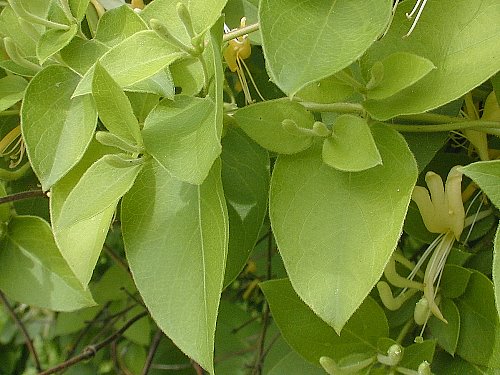
Description: This perennial vine becomes woody with age and can reach 60' in length. Japanese Honeysuckle can climb adjacent woody vegetation, otherwise it has a tendency to sprawl across the ground in disorderly heaps. The young stems are green, pubescent, and terete, becoming purplish brown and more glabrous with age. The opposite leaves are up to 3" long and 2" across. They are oval or ovate, smooth along their margins, and evergreen. Young leaves are somewhat pubescent and ciliate, while older leaves are more glabrous. Each leaf has a short petiole that is also pubescent while it is young.
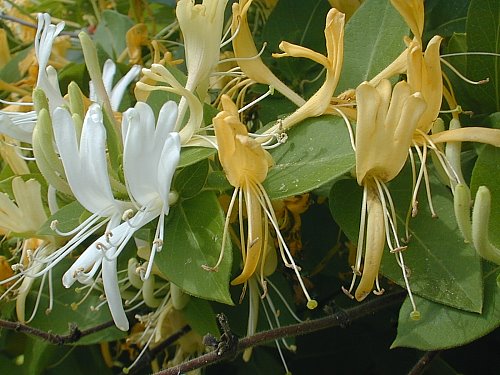
Flowers
develop from axils of the leaves either individually or in pairs
(usually the latter); they have short pedicels. Each flower is about
1–1½" long, consisting of a corolla with well-defined upper and lower
lips, 5 strongly exerted white stamens, a pistil with a strongly
exerted white style, and a pubescent green calyx that is much shorter
than the corolla. The tip of each style has a globular green stigma.
The corolla is initially white, but it becomes
yellowish tan with age. It has a long upper lip that curls upward and
terminates into 4 narrow lobes, and a long lower lip that curls
downward
and terminates into a single narrow lobe. The narrowly tubular base of
the corolla is finely pubescent along its outer surface. Underneath
each flower, there is a pair of leafy bracts; each bract is up to 2"
long, ovate, and slightly pubescent. The blooming period usually occurs
during the summer and lasts about 2 months. The flowers have a
delightful honeysuckle fragrance that is quite strong. Each flower is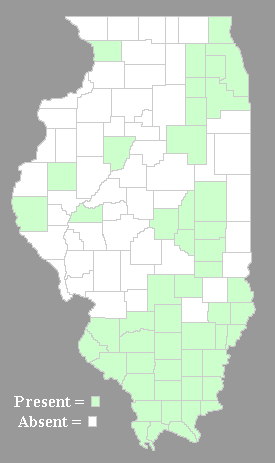 replaced by a black berry about ¼" across that contains 2-3 seeds.
The seeds are compressed (flattened) and ovoid in shape. The root
system produces rhizomes that enable this plant to spread
vegetatively.
replaced by a black berry about ¼" across that contains 2-3 seeds.
The seeds are compressed (flattened) and ovoid in shape. The root
system produces rhizomes that enable this plant to spread
vegetatively.
Cultivation:
The
preference is partial sun, moist to mesic conditions, and a fertile
loam to support the rampant growth. This vine is very aggressive; it
can easily smother shrubs and small trees.
Range & Habitat:
The non-native Japanese Honeysuckle is common in southern Illinois,
occasional to locally common in NE and east-central Illinois, and
uncommon or absent elsewhere. It was introduced into the United States
from east Asia as an ornamental vine. Habitats include floodplain
woodlands, thickets, seeps, limestone glades, power-line clearances in
woodland areas, semi-shaded areas along roadsides and railroads, and
edges of yards. Because of the attractive flowers, Japanese Honeysuckle
is often cultivated in residential areas. This vine occurs in both
disturbed and higher quality natural areas, and it has the capacity to
displace many native species of plants.
Faunal Associations:
The nectar of the flowers attracts Ruby-Throated Hummingbirds,
swallowtails and other butterflies, and Sphinx moths (including the
Hummingbird Clearwing, Hemaris
thysbe). Moth larvae, aphids, and other insects are known
to feed on the foliage and other parts of native honeysuckle vines (Lonicera spp.),
although it is unclear to what extent they also feed on Japanese
Honeysuckle. Two polyphagous leafhoppers, Empoasca chelata
and Empoasca recurvata,
are known to feed on this introduced vine, however (Dmitriev &
Dietrich, 2010). The foliage of Japanese
Honeysuckle is eaten by many mammalian herbivores, including the
Cottontail Rabbit and White-Tailed Deer. Its evergreen leaves are
especially important to them during the winter, when other sources of
food are more scarce. Various upland gamebirds and songbirds
occasionally eat the berries, including the Wild Turkey, Bobwhite,
Eastern Bluebird, Purple Finch, Eastern Goldfinch, Slate-Colored Junco,
and Hermit Thrush. These birds distribute the seeds far and wide. Dense
tangles of this leafy vine help to provide cover for various mammals
and nesting habitat for some species of songbirds.
Photographic Location:
Edge of a yard in Urbana, Illinois, where the vine smothered a shrub.
Comments: While the flowers and foliage are quite attractive, Japanese Honeysuckle is one of the worst invaders of open woodland areas and thickets. On the positive side, it is moderately valuable to various mammals and birds. It is easy to distinguish Japanese Honeysuckle from other Lonicera spp. (honeysuckles) in Illinois, as the latter are either shrubs or much shorter vines. The branches of other honeysuckle vines terminate in small clusters or interrupted spikes of flowers. The terminal leaves (or bracts) below their inflorescences surround the stems and merge together (they are connate). In contrast, Japanese Honeysuckle usually produces axillary flowers. Japanese Honeysuckle can also be distinguished by its black berries, while the berries of other honeysuckle vines in Illinois are orange to red.