Description: This plant is a summer annual that is ½–2' tall and more or less erect, although individual plants may sprawl. The stems are usually light green, round, and glabrous or slightly pubescent. The alternate leaves are up to 6" long and 1" across, although usually smaller. They are lanceolate or linear-lanceolate, hairless, smooth along the margins, and sometimes slightly ciliate. Each leaf has a short petiole or it is nearly sessile; there is a membranous sheath (ochrea) that wraps around the stem at the base of each petiole. This sheath may have a few longitudinal veins and there are deciduous bristles along its upper rim that may exceed 1 mm. in length. The upper surface of a leaf often has a black smudge that is oval or triangular-shaped; this smudge may be dark and conspicuous or faint and barely perceptible.
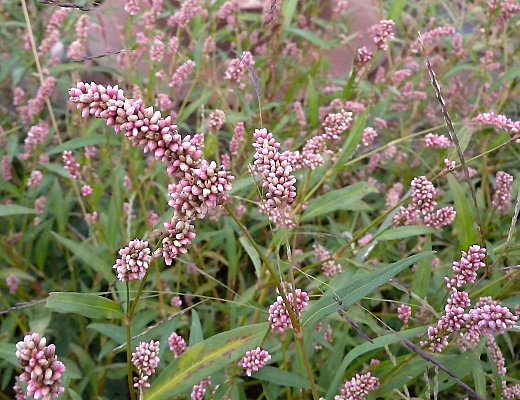
Each upper stem
terminates in 1 or 2 spike-like racemes of flowers; there are often
shorter racemes that develop from the axils of the upper leaves on
peduncles. Each raceme is
about ½–1½" long, more or less erect, and oblongoid in shape from the
crowded whorls of small flowers. The sepals of the flowers may be pink,
red, greenish
white, or purple, even on the same raceme; usually pink flowers are the
most common. Each flower is about 1/8" (3 mm.) long and shy to open; it
consists of 5 sepals, 6 stamens (usually), a style that is divided into
2-3 parts toward the middle, and no petals. The sepals are not
glandular-punctate, and the stamens are not exerted beyond the sepals.
The blooming period can occur from late spring to early fall; a colony
of
plants will typically bloom for 1-2 months during the summer. There is
no noticeable floral scent. Each flower is replaced by a seed that
ovoid, flattened or slightly 3-angled, black, and shiny. The shallow
root system doesn't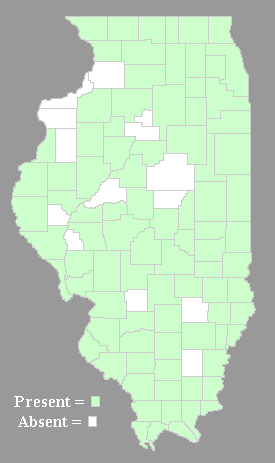 produce rhizomes. This plant
often forms colonies,
particularly in disturbed wetland areas, or it may occur in drier areas
as scattered plants. Reproduction is by seed only.
produce rhizomes. This plant
often forms colonies,
particularly in disturbed wetland areas, or it may occur in drier areas
as scattered plants. Reproduction is by seed only.
Cultivation:
The
preference is full sun or partial sun, wet to mesic conditions, and
fertile soil with organic matter. However, this adaptable plant will
also grow in light shade and poor soil containing clay, gravel, or
sand. After the seeds germinate, it develops quickly and may bloom
while only a few inches tall.
Range & Habitat:
The non-native Lady's Thumb is a common plant that has been observed in
most counties
of Illinois; it probably occurs in every county of the state. Habitats
include marshy areas, edges of streams and drainage canals, mudflats,
roadside ditches, moist weedy meadows, vacant lots, fallow fields and
edges of cultivated fields, edges of yards and gardens, moist areas
along railroads, and waste areas. This species prefers disturbed areas,
but it can invade higher quality wetlands to a limited extent. Lady's
Thumb is native to Europe.
Faunal Associations:
The nectar of the flowers attracts Halictid bees, wasps, Syrphid
flies, and bee flies (Bombyliidae) primarily. Less common visitors include small butterflies and
bumblebees. Halictid bees also collect pollen occasionally. The foliage
and other parts of Lady's Thumb (Persicaria maculosa) are eaten by many
insects, including Chaetocnema concinna (Brassy Flea Beetle), Galerucella nymphaeae (Waterlily Leaf Beetle), Aspidaphis adjuvans (Wrinkly Knotgrass Aphid), and larvae of a moth, Homophoberia apicosa (Black
Wedge-spot); see Clark et al. (2004), Thomas (1877), and Covell
(1984/2005). Other insects that feed on smartweeds (Persicaria spp.)
include flea beetles, weevils, stink bugs, plant bugs, several aphids,
larvae of sawflies, larvae of several moths, larvae of copper
butterflies (Lycaena spp.), and grasshoppers (Paroxyna spp.). The Insect Table
has a more complete list of these insects. The seeds of smartweeds are
an important source of food to many upland gamebirds, waterfowl, rails,
and granivorous songbirds, including the Greater Prairie Chicken,
Bobwhite Quail, Wood Duck, Northern Pintail, Mallard, Sora, Virginia
Rail, Mourning Dove, Red-winged Blackbird, and Swamp Sparrow (see Bird Table).
Mammalian herbivores usually don't feed on the foliage of Lady's Thumb
because the foliage is
pungent, peppery, and slightly bitter. However, White-tailed Deer may
feed on the foliage of young plants or chomp off the flowering stalks
upon occasion, as they spread the seeds of Lady's Thumb and other
smartweeds in their droppings (Myers et al., 2004). Canada Geese also
chomp off their flowering stalks (personal observation). Small rodents,
such as the White-footed Mouse, House Mouse, Franklin's Ground
Squirrel, and Least Chipmunk eat the seeds of smartweeds when they
occur in upland areas (Whitaker, 1966; Andersen & Fleharty, 1967;
Martin et al., 1951/1961). In wetland areas, the Snapping Turtle,
Painted Turtle, and Slider feed on the foliage occasionally (Ernst et
al., 1994).
Photographic Location:
Disturbed open ground at the Arboretum of the University of Illinois in
Urbana, Illinois.
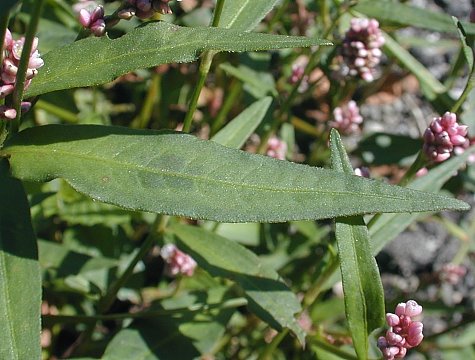
Comments: Lady's Thumb (Persicaria maculosa) is probably the most common and adaptable smartweed in Illinois. It occurs in both wetland habitats and surprisingly dry habitats. I have even found small plants of this species flowering underneath the shade of lawn trees. It is fairly easy to distinguish Lady's Thumb from other Persicaria spp. (smartweeds) because its leaves often have black smudges on their upper surfaces. Sometimes these black smudges aren't produced, however. The spike-like racemes of Lady's Thumb are somewhat distinctive: they are rather stout, erect, and densely crowded with small flowers; these flowers tend to have conspicuously different colors on the same raceme. Other smartweeds often have racemes that are more slender, nodding, and less densely crowded with flowers. For these latter species, the flowers of individual plants are more likely to be homogeneously colored. Scientific synonyms of Lady's Thumb include Persicaria vulgaris and Polygonum persicaria.