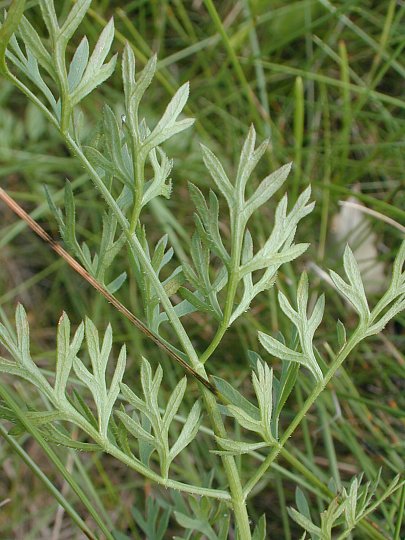
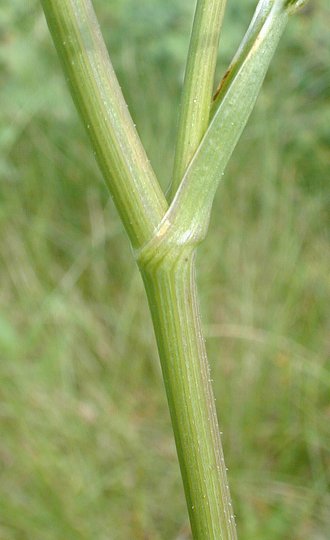
Description: This biennial herbaceous plant consists of a rosette of basal leaves during the first year, bolting upward during the second year to produce flowering stalks. The basal leaves are arching-spreading; their blades are up to 5" long and 2½" across, while their slender petioles are up to 5" long. Mature second-year plants are 2-5' tall. The central stem of second-year plants is light green (sometimes tinted red), vertically veined, terete, hollow, nearly glabrous to spreading-hairy, and sparingly branched. Alternate leaves occur sparingly along the central stem and any lateral stems of second-year plants; their blades are up to 4" long and 2" across. Instead of true petioles, alternate leaves are attached to sheaths that become partially detached from the stems. These sheaths are up to 2" long, light green, nearly glabrous, and trough-shaped. The blades of both basal leaves and alternate leaves are bipinnate-pinnatifid or pinnate-bipinnatifid in structure; their ultimate leaf segments are 3-10 mm. long, 1-4 mm. across, oblong-linear or narrowly rhombic in shape, and sometimes sparsely ciliate along their margins. The upper surface of these leaf segments is light-medium green and glabrous, while the lower surface is light green and glabrous to sparsely hairy. The rachises of the compound leaf blades and leaflets are narrowly furrowed above, convex or V-shaped below, and nearly glabrous to spreading-hairy. Overall, the appearance of compound leaves for this plant is rather lacy or fern-like. The foliage has a bitter-soapy aroma that is typical of carrots.

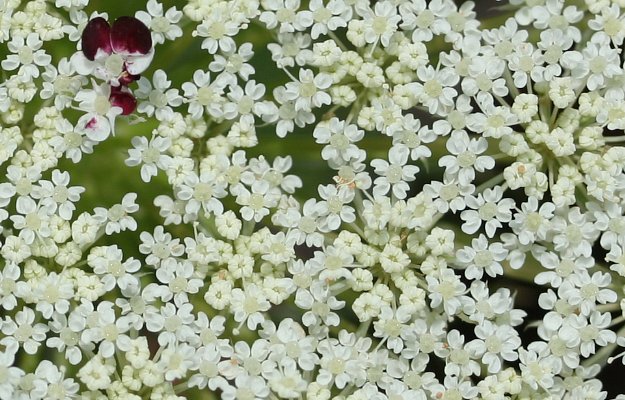
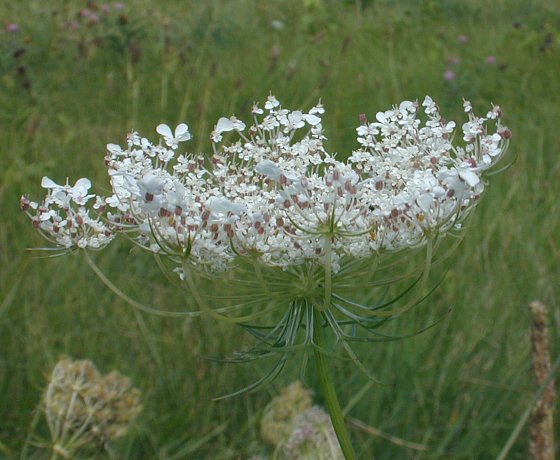
The upper stems terminate in solitary compound umbels of flowers on long naked stalks. These stalks are 4-20" long and similar to the stems, except they are more slender and and tend to be more hairy. The compound umbels of flowers are 2-5" across and flat-topped to slightly dome-shaped. Each compound umbel consists of 20-90 umbellets, and each umbellet has 15-60 flowers. Each flower is about 2-3 mm. across, consisting of 5 white petals, an insignificant calyx, a reddish bristly ovary with a white stylopodium at its apex, 5 white stamens, and a pair of white styles. The tips of the petals are incurved. Sometimes the petals of a flower in the middle of the compound umbel are reddish purple; very rarely are the petals of all flowers reddish purple. Pedicels of the flowers are light green and angular. The stalklets (rays) of the umbellets are light green, angular, and slightly hairy or pubescent. At the base of each umbellet, there are a small number of bractlets that are medium green and linear in shape (or they uncommonly have a few linear lobes). At the base of compound umbel, there are several bracts that are ½–2½" long, medium green, and pinnatifid with linear lobes (or they are uncommonly linear without lobes). The blooming period occurs from mid-summer to early autumn, lasting about 2 months. In the absence of insect cross-pollination, the flowers are self-fertile; they have no noticeable fragrance.
Afterwards,
the flowers are replaced by 2-seeded fruits (schizocarps) that are
about 3-4 mm. long and 2 mm. across; they are broadly ellipsoid,
slightly flattened, reddish, and quite bristly. At this stage, the
compound umbel of fruits folds
into itself to form a spheroid-like shape. After becoming separated
from its flowering stalk, the mature umbel can be blown by the wind and
roll across the ground, distributing its fruits in the process. Each
fruit eventually divides into 2 carpels (each one containing a seed).
Mature seeds are yellowish brown to gray, flat on one side, and convex
on the other side. Along the convex side of each seed, there are
several longitudinal ribs with lines of bristles and stiff hairs. The
root system consists of brownish white to white taproot that is
somewhat
woody and bitter. This plant reproduces by reseeding itself.
Cultivation:
The preference is full sunlight, mesic to
dry conditions, and soil that contains either loam or clay-loam with a
slightly acidic to alkaline pH. However, Wild Carrot will also adapt to
partial sun, moist conditions, and other kinds of soil. This plant can
spread aggressively in some situations and it can be difficult to
destroy, often surviving occasional mowing and hand-pulling. The deep
taproot makes this plant difficult to remove and it is able to store
considerable energy to initiate new growth.
Range &
Habitat:
The non-native Wild Carrot is a very common plant that occurs in every
county of
Illinois (see Distribution
Map). It was introduced into the United States from Europe.
Habitats include overgrown thickets, degraded
prairies, weedy meadows, areas along railroads, grassy roadsides,
lawns,
pastures, abandoned fields, fence rows, vacant lots, junk yards, and
other waste areas. Fire is not very effective in removing this plant
from natural areas, however it tends to decline spontaneously in such
areas when there is an absence of disturbance.
Faunal Associations:
The nectar and pollen of the flowers attract primarily small bees,
wasps, flies, and beetles. Wild Carrot Wasps (Gasteruption spp.)
are among these floral visitors. Other insects feed destructively on
the foliage, roots, and other parts of Wild Carrot (Daucus carota).
These species include root-feeding larvae of Listronotus oregonensis
(Parsley Weevil), root-feeding larvae of Ligyrus gibbosus
(Carrot Beetle), root-feeding larvae of Psila rosae (Carrot
Rust Fly), foliage-eating larvae of the moth Melanchra picta
(Zebra Caterpillar), and foliage-eating larvae of the butterfly Papilio polyxenes asterius
(Black Swallowtail); see O'Brien (1997), Arnett & Jacques
(1981),
Cranshaw (2004), Wagner (2005), and Bouseman & Sternburg
(2001).
Another insect, Melanoplus
bivittatus (Two-striped Grasshopper), feeds on the
foliage, while Allonemobius
allardi (Allard's Ground Cricket) feeds on the umbels of
flowers (Gangwere, 1961).
Wild Carrot is a summer host for such aphids
as Cavariella aegopodii
(Willow-Carrot Aphid), Dysaphis apiifolia
(Hawthorn-Parsley Aphid), Hyadaphis
foeniculi (Honeysuckle-Fennel Aphid), and Hyadaphis passerinii
(Blackman & Eastop, 2013; Cranshaw, 2004). Among vertebrate
animals, seeds of Wild Carrot are eaten by the Ring-necked Pheasant,
Ruffed Grouse, and Pine Mouse (Martin et al., 1951/1961). The aromatic
and somewhat bitter foliage of this plant is browsed sparingly by
mammalian herbivores. Occasionally White-tailed Deer will
chomp off the upper half of flowering plants during the summer, while
the Cottontail Rabbit occasionally eats the lower leaves (personal
observation). The burry fruits containing the seeds can cling to the
fur of some mammals and the clothing of humans, thereby introducing
them to new locations (Lacey, 1981). The foliage
of Wild Carrot is preferred as nesting material by the European
Starling. Because of the antibacterial and insecticidal properties of
the
foliage, this appears to benefit the health of hatchlings by reducing
the number of nest lice and other parasites (Clark & Mason,
1985; Clark & Mason, 1988).
Photographic Location:
A weedy meadow at Judge Webber Park in Urbana, Illinois.
Comments:
Wild Carrot is an ubiquitous plant that many people can recognize. It
is possible, however, to confuse this introduced species with other
white-flowered members of the Carrot family (there are many). Wild
Carrot doesn't begin
to bloom until mid-summer and usually occurs in mesic to dry areas,
rather than wetlands. The presence of a single reddish purple flower in
the middle of a compound umbel is a distinctive characteristic,
although it is not always present. Unlike many other species in the
Carrot family, the fruits of Wild Carrot are very bristly and reddish
while they are immature. There is a similar species, Small Wild Carrot (Daucus
pusillus), that occurs in two counties of
southern Illinois. This latter species may be either native or
adventive from the southwest. In addition to being a somewhat smaller
and more hairy plant, the floral bracts underneath the compound umbels
of Small Wild Carrot are more leafy in appearance than those of the
introduced Wild Carrot. While the flowers of Wild Carrot have reddish
ovaries that are white on top, the flowers of Small Wild Carrot have
ovaries that are greenish throughout. According to most authorities,
Wild Carrot is the source of the cultivated carrot. While the most
poplar form of cultivated carrot has orange taproots, some older forms
of cultivated carrot have reddish purple or white taproots. Another
common name of Daucus
carota is Queen Anne's Lace.