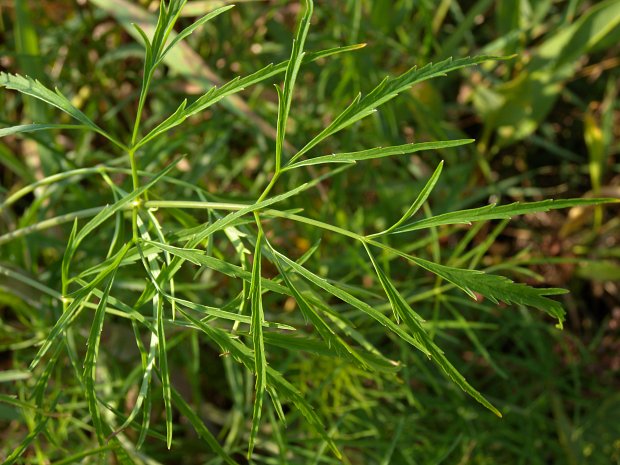
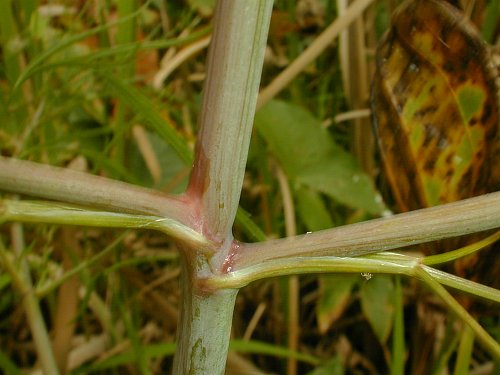
Description: This perennial plant is 1½–3½' tall, branching occasionally. The stems are light green or light reddish green, glabrous, and glaucous. The compound leaves are up to 1' long and 8" across (excluding their petioles), becoming smaller as they ascend the stems; they are alternate, green, and glabrous. The lower leaves are double-pinnate, while the upper leaves are often simple-pinnate. The petioles of the lower leaves are long, while those of the upper leaves are much shorter or absent. The leaflets are up to 3" long and 1/3" (8 mm.) across; they are linear to lanceolate-linear, dentate, and sometimes cleft into narrow lobes. The axils of the upper leaves often have sessile clusters of ovoid bulblets. The upper stems terminate in compound umbels of small white flowers.
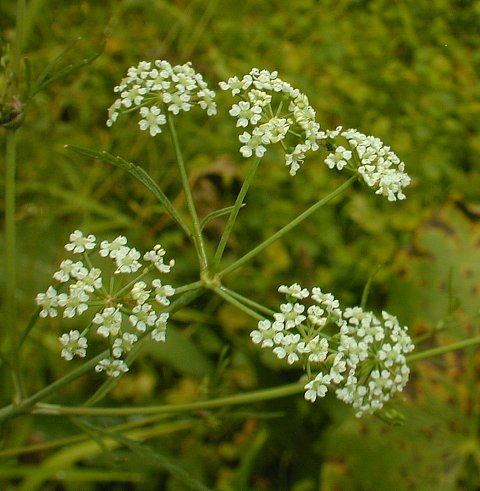
Each compound umbel spans about 2-4" across and it consists of about 8 umbellets. Each umbellet has about 16 flowers. There are neither bracts nor bractlets at the base of the compound umbel and its umbellets, although a small sessile leaf may occur near the base of the compound umbel. Each flower spans about 1/8" (3 mm.) across or a little less, consisting of 5 white petals, 5 stamens, 2 styles, and an ovary. The blooming period occurs during late summer to early autumn and it lasts about one month. There is no noticeable floral scent. A pair of seeds are contained in each fruit (schizocarp). These fruits are about 1/8" (3 mm.) long; they are somewhat flattened, ovoid-oblongoid in shape, and slightly notched at their apices. The root system consists of a cluster of elongated fleshy roots. The foliage, seeds, and fleshy roots are toxic (especially the latter). This plant reproduces by seeds and aerial bulblets.
Cultivation: The
preference is light shade to full sun, wet conditions, and a mucky or
mossy soil. This plant requires soil that is saturated with moisture
throughout the year.
Range & Habitat: The
native Bulblet-Bearing
Water Hemlock is an uncommon plant that occurs primarily in the
northern half of Illinois, especially in the NE area of the state (see Distribution
Map). Habitats include both sandy and non-sandy marshes,
swamps, and borders of lakes
and ponds. This species is normally found in high quality wetlands.
Faunal
Associations:
Like other members of the Carrot family, the nectar of the flowers is
accessible to insects with short mouthparts, therefore they will
attract such
visitors as flies, wasps, beetles, and small bees. Some of these
insects may collect or feed on the pollen as well. The caterpillars of
a butterfly, Papilio polyxenes asterias (Black
Swallowtail), feed on the foliage. Other insects that feed on water
hemlock species (Cicuta
spp.) include stem-boring larvae of a weevil (Apion pensylvanicum),
flower- and fruit-eating larvae of an Epermeniid moth (Epermenia cicutaella),
flower- and fruit-eating nymphs and adults of Orthops scutellatus
(Carrot Plant Bug), Cavariella
aegopodii (Carrot-Willow Aphid) and other Cavariella spp.,
and Hyadaphis foeniculi
(Honeysuckle-Fennel Aphid); see Majka et al. (2007), Covell
(1984/2005), Wheeler et al. (1983), Blackman & Eastop (2013),
and Pepper (1965). The poisonous seeds are not eaten by
birds, while the poisonous foliage and roots are usually avoided by
mammalian herbivores. Consumption of the fleshy roots and other parts
of this plant by either mammalian herbivores or humans can cause
convulsions and death.
Photographic Location:
A sandy marsh at the Heron Boardwalk in Vermilion County, Illinois.
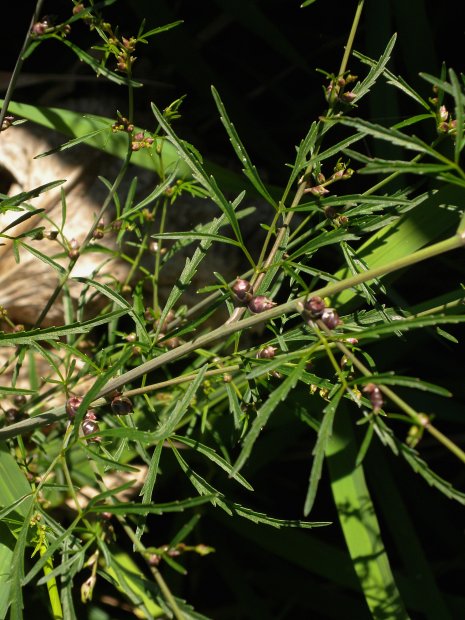
Comments: Bulblet-Bearing Water Hemlock is highly unusual because it bears clusters of bulblets in the upper leaf axils. With the exception of Ranunculus ficaria (Lesser Celandine), I can think of no other plant in Illinois that has this characteristic. Some Allium spp. (Onions) produce bulblets instead of flowers in their umbels, but their bulblets are not produced from the axils of leaves. Another species that occurs within the state, Cicuta maculata (Water Hemlock) is more common. Water Hemlock is a larger plant than Bulblet-Bearing Water Hemlock and it has broader leaflets (more than 1/3" or 8 mm. across). Water Hemlock blooms during mid-summer before Bulblet-Bearing Water Hemlock begins to bloom. Another white-flowered member of the Carrot family, Sium suave (Water Parsnip), often blooms at the same time as Bulblet-Bearing Water Hemlock and it occurs in the same wetland habitats. Water Parsnip has about 3 lanceolate bracts at the base of its compound umbels and its leaves are always simple-pinnate. Another similar species that blooms late, Oxypolis rigidior (Cowbane), also has leaves that are simple-pinnate. In contrast, the lower leaves of Bulblet-Bearing Water Hemlock are double-pinnate.