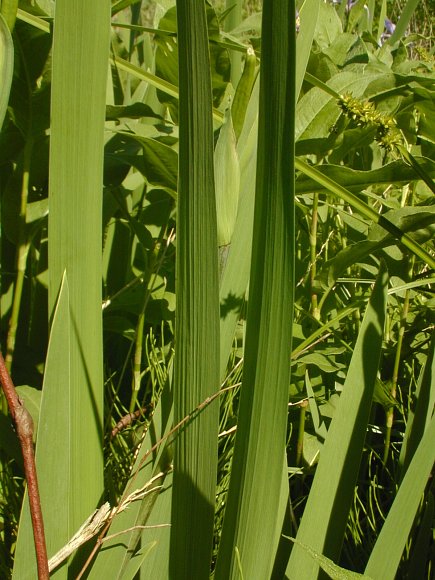
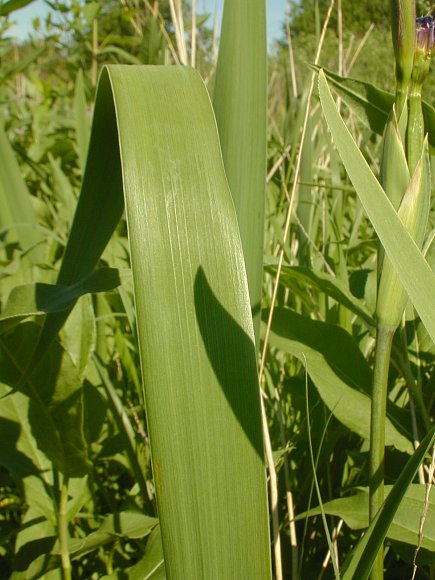
Description: This perennial plant is 2-3' tall. It produces clumps of basal leaves that are sword-shaped and up to 3' long; they are mostly erect, although some of the larger leaves may become arched. These leaves are bluish green to green and glabrous. Individual leaves are up to 1" across near their bases, tapering very gradually to pointed tips. Leaf margins are smooth (entire) and leaf venation is parallel. The flowering stalks are either unbranched or sparingly branched and up to 3' tall; they are green, terete, and glabrous. Each stalk produces one or more small alternate leaves that are erect and sword-like. From the axil of each alternate leaf, there develops 1-2 flowers on pedicels 1-5" in length. Both the flowering stalks and pedicels are terete and glabrous. Each pedicel is enfolded by a pair of sword-like spathes that become chaffy with age.
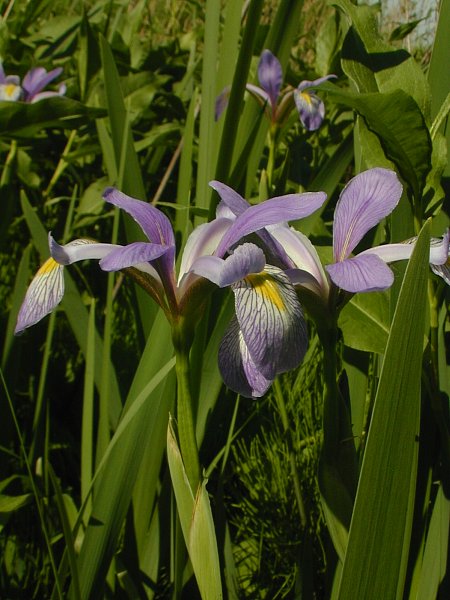
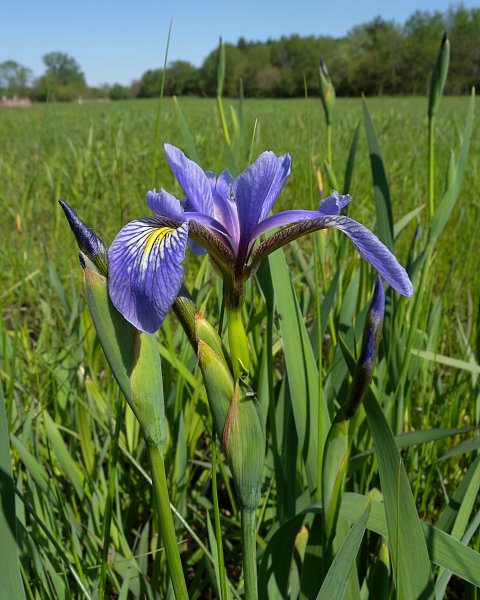
The blue-violet flowers are up to 3½" across, consisting of 3 sepals, 3 petals, 3 stamens, 3 style-branches with stigmata, and a green ovary that is elongated and angular. The petaloid sepals are oblanceolate in shape and spread outward from the center of the flower; they are blue-violet with prominent patches of yellow and white with fine purple veins. The sepals are without tufted hairs. Extending directly above the sepals, are the shorter petaloid style-branches; they are blue-violet and oblong in shape with upturned tips, forming open tubular structures with the sepals. The ascending petals are blue-violet and oblanceolate in shape with darker purple veins. The blooming period is late spring to early summer, and lasts about a month for a colony of plants, although individual flowers are short-lived. There is a pleasant floral fragrance. Afterwards, the flowers are replaced by oblongoid capsules that are 3-angled. These capsules are about 1½–2" long and ½" across; they contain rows of tightly stacked seeds. After the capsules split open, the seeds can float on water, spreading to new areas via water currents. The root system consists of fleshy rhizomes with coarse fibrous roots. Colonies of plants often develop from the rhizomes.
Cultivation:
The preference is wet to moist conditions, partial to full sun, and a
rich organic soil. In light shade, this plant often fails to flower,
and it tends to decline in abundance if conditions become too dry. The
foliage is rarely bothered by disease. To maintain the
viability of the seeds, they should not be allowed to dry out – store
them with some moist sand.
Range
& Habitat: The native Blue
Flag Iris is surprisingly common in most areas of Illinois, except for
some southern and western counties where it is uncommon or absent (see Distribution
Map).
Habitats include wet to moist black soil prairies, prairie swales,
soggy meadows along rivers, open bottomland woodlands,
swamps, fens, seeps, edges of ponds and streams, ditches, and
low-lying ground along railroads and roadsides. Declining remnant
populations can be found in some low woodland areas where fire has been
surpressed.
Faunal Associations: The flowers are cross-pollinated by bumblebees and long-horned bees (Synhalonia spp.); butterflies and skippers also visit the flowers occasionally, but they are less effective at cross-pollination. These insects suck nectar from the flowers primarily, although some of the bees also collect pollen. Some insects feed on Blue Flag Iris and other Iris spp. destructively. They include such species as the weevil Mononychus vulpeculus (larvae feed inside seed capsules), the Agromyzid fly Cerodontha magnicornis (larvae mine leaves), the Syrphid fly Eumerus tuberculatus (larvae feed on rhizomes), the mealybug Rhizoecus falcifer (feeds on rhizomes), the aphid Dysaphis tulipae (feeds on foliage & rhizomes), and the thrips Frankliniella occidentalis (feeds on flowers). Caterpillars of such moths as Ctenucha virginica (Virginia Ctenucha), Spilosoma congrua (Agreeable Tiger Moth), and Macronoctua onusta (Iris Borer Moth), also feed on these plants. Mammalian herbivores rarely bother this plant because the foliage and rootstocks are somewhat toxic, causing irritation of the gastrointestinal tract.
Photographic
Location:
The photographs were taken at a wet prairie along an abandoned
railroad near Urbana, Illinois, and at a prairie swale in Meadowbrook
Park of the same city.
Comments:
This attractive plant is more typical of wetlands than true prairies,
but it sometimes spreads into adjacent sunny areas that are moist.
Cultivars of Iris X germanica (German Iris) have
beards (numerous hairs) on their sepals, while the Blue Flag Iris is
beardless. The Blue Flag Iris resembles another native species, Iris
brevicaulis (Blue Marsh Iris), but this latter species has
6-angled capsules and flowering stalks that are slightly zigzag.
Another native species, Iris
versicolor
(Northern Blue Flag), is very similar in appearance to the Blue Flag
Iris, but it has a more northern distribution (the upper Great Lakes
and NE USA,
including northern Wisconsin). Another scientific name for the Blue
Flag Iris is Iris shrevei; another common name for
this species is the Southern Blue Flag.