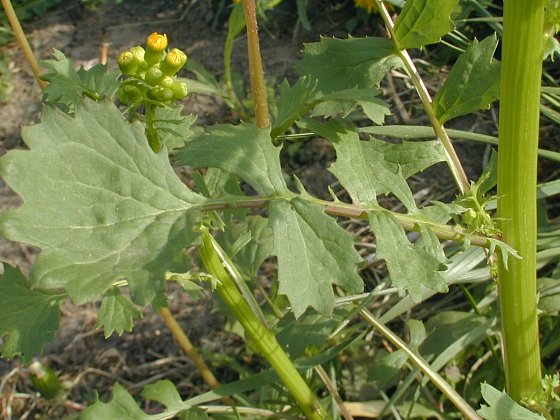
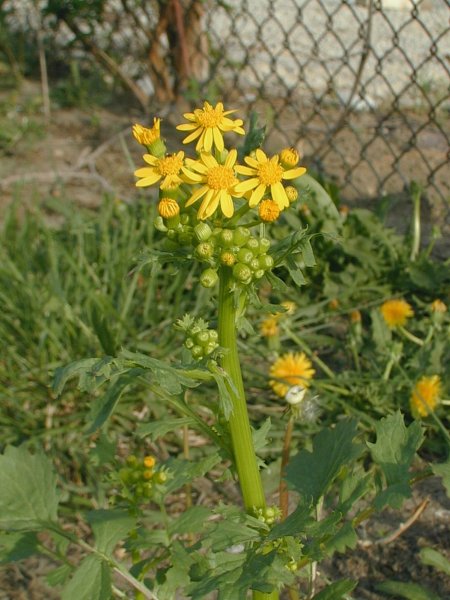
Description: Butterweed is a winter annual or biennial that initially forms a low rosette of basal leaves. During the spring, this plant bolts to become 1-3' tall; it is unbranched, except for short flowering stems in the axils of some upper leaves along the central stem. The hollow central stem is stout, light green or reddish green, and glabrous; it has conspicuous longitudinal veins. The alternate leaves are up to 10" long and 2½" across, becoming smaller as they ascend the central stem and any lateral stems. These leaves are either simple-pinnate or deeply pinnatifid, usually with a larger terminal leaflet (or lobe) and smaller lateral leaflets (or lobes). These leaflets or lobes are highly irregular in shape, although the lateral leaflets or lobes tend to be obovate in shape, while the terminal leaflet or lobe tends to be orbicular in shape. In addition to the irregular leaflets or lobes, the leaf margins are coarsely dentate, providing the leaves with a ragged appearance. Leaf surfaces are mostly pale green and glabrous, although the leaf midribs are often reddish green. The central stem and any lateral stems terminate in flat-headed panicles of flowerheads. These flowerheads are bunched together initially, but they become more spread out with age, forming an inflorescence up to 6" across.
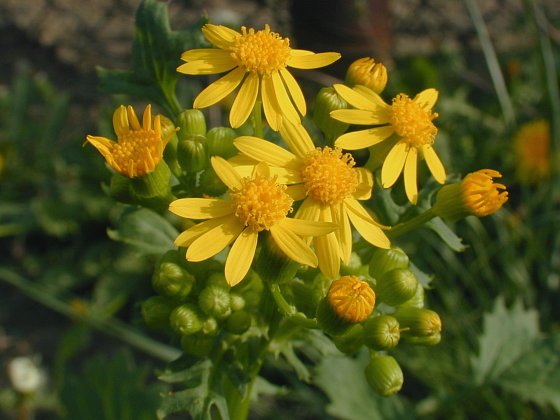
Each flowerhead is
about ½" across, consisting of 5-15 ray florets that surround numerous
disk florets in the center. The petaloid rays of the flowerhead are
yellow and narrowly oblong in shape, while the tiny tubular corollas of
the disk florets are golden yellow. Around the base of each flowerhead,
there are floral bracts (phyllaries) in a single series. These bracts
are light green, linear in shape, and glabrous. The blooming
period occurs from mid-spring to early summer, lasting about 1-2
months. The pleasant floral scent of the flowerheads resembles the
fragrance of buttercups. After the blooming period, the flowerheads are
replaced by achenes with small tufts of white hair. These achenes are
distributed by the wind and probably water. By mid- to late summer,
Butterweed dies down. The root system is shallow and fibrous.
Cultivation:
The preference is full to partial sun, wet to moist
conditions, and a rich loamy soil. This plant is easy to grow, and it
can volunteer in unexpected places. Most growth and development occurs
during the moist cool weather of spring. This plant will survive
temporary flooding. It is somewhat weedy.
Range &
Habitat:
Butterweed is native to southern Illinois, but after several decades it
has migrated northward, becoming established in central Illinois. As a
result, this plant is common in southern and central Illinois, but it
is still uncommon or absent in the northern section of the state (see Distribution
Map). Habitats include wet to moist areas in open floodplain
forests, soggy meadows along rivers, prairie swales, low areas
along ponds and streams, swamps and seeps, ditches,
agricultural fields, grassy areas that are not regularly mowed,
and waste areas. Sometimes, this plant can form large colonies
in disturbed areas, especially in agricultural fields during a wet
spring (which delays the planting of crops). Butterweed is more common
in wetland areas than either prairies or woodlands.
Faunal Associations:
Primarily
small bees and various flies visit the flowers for nectar or pollen.
Less common visitors include small butterflies and skippers. An
Andrenid bee, Andrena
gardineri, is a specialist pollinator, or oligolege, of Packera spp.
The larvae of a moth, Phyllocnistis
insignis, are serpentine miners of the leaves. Other
insect feeders include a seed bug, Neacoryphus
bicrucis,
and an aphid, Aphis
lugentis. Like other Packera
spp., the
foliage of Butterweed probably contains pyrrolizidine alkaloids, which
are highly toxic to the mammalian liver. White-Tail Deer seem to
avoid this plant, while domestic livestock sometimes consume it,
thereby poisoning themselves. The Cottontail Rabbit usually avoids this
plant, although it may nibble on the lower leaves occasionally during
the spring.
Photographic
Location:
The photographs were taken of a plant growing in the lawn of the
webmaster's apartment complex in Urbana, Illinois.
Comments:
Butterweed (Packera
glabella) is the weediest Packera spp.
in
Illinois. It is more tall and coarse in appearance than these other
species, which are short-lived perennials. In particular, the hollow
central stem of Butterweed stands out as being more stout. Because
Yellow Rocket (Barbarea
vulgaris) is sometimes abundant in agricultural fields
during the spring, it is possible to confuse this plant with
Butterweed, especially when such plants are viewed from a distance. The
inflorescences of Butterweed are more flat-topped and its flowerheads
are a deeper shade of yellow, while the inflorescences of Yellow Rocket
have a more vertical structure and its flowers are pale yellow. These
two plants are not closely related, as Yellow Rocket is a member of the
Mustard family (Brassicaceae). A scientific synonym of Butterweed is Senecio glabellus.