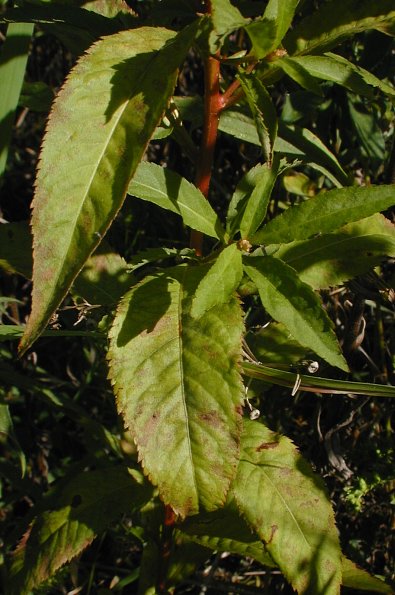
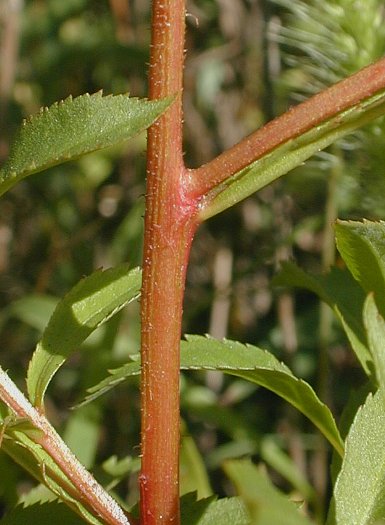
Description: This herbaceous perennial plant is about 1-2' tall. It is either unbranched or branches occasionally in the upper half. The stems are light green to red, terete or angular, and glabrous to slightly hairy. The alternate leaves are up to 4" long and 1" across. They are elliptic or narrowly ovate, finely serrated along the margins, and glabrous. The leaves have prominent midveins, and their petioles are either absent or they are short and slender. The upper leaf surface varies from yellowish green to medium green, depending on the stage of development and environmental conditions.
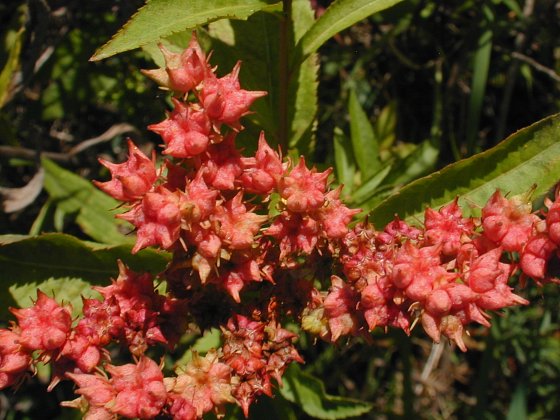
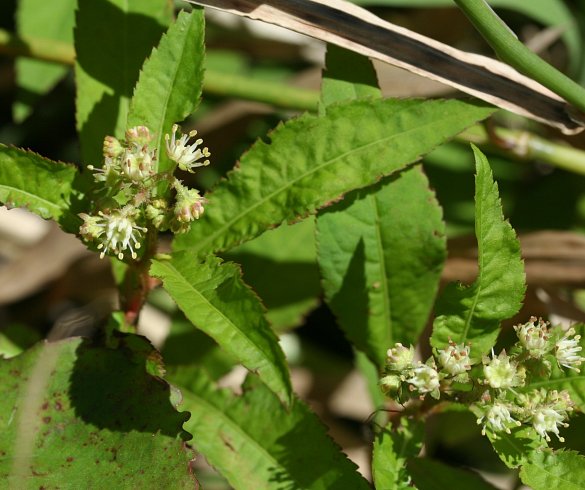
The upper stems terminate in cymes of flowers or cyme-like panicles of flowers that are about 1-3" across. Each cyme has 2-4 flowering stalks that spread outward; the flowers are aligned along the upper sides of these stalks. Sometimes shorter stalks of flowers develop from the primary stalks. Each flower is about ¼" across, consisting of 5 green spreading sepals, 10 stamens, and 5 beaked carpels that are joined together in the center. Petals are not usually present. The flowers are yellowish green to white. The blooming period occurs during the summer and lasts about a month. During the autumn, the carpels turn red and develop into seed capsules. Each of these capsules contain numerous small seeds. Individual seeds are narrowly oblongoid, tapering at one end. The surface of each seed is covered with tiny bumps. The root system produces rhizomes or stolons, which enables this plant to form clonal colonies.
Cultivation:
The
preference is partial to full sun, wet conditions, and a mucky soil
that retains moisture. This plant often develops in shallow standing
water. It tolerates conditions that are consistently moist, but the
leaves will turn yellow and shrivel should the soil dry out.
Range & Habitat:
The native Ditch Stonecrop is fairly common and occurs in every county
of Illinois
(see Distribution
Map). However, it is possible that populations of this
species have declined somewhat as a result of the destruction of
wetlands throughout the state. Habitats include openings in floodplain
and bottom forests, swamps, marshes, muddy shores along rivers or
ponds, prairie swales, and ditches along roadsides and railroads.
Faunal
Associations:
Information about floral-faunal relationships for this species is
currently unavailable. More research needs to be done in this area.
Photographic Location:
A prairie swale at Meadowbrook Park in Urbana, Illinois. The
photographs were taken during the flowering period of summer and the
fruiting period of autumn.
Comments: Some authorities assign Ditch Stonecrop to the Stonecrop family (Crassulaceae) or Saxifrage family (Saxifragaceae). However, it can be considered sufficiently unique to be assigned to its own family, which also includes a few Asiatic species. The flowers are not particularly showy while in bloom, but during the autumn the developing seed capsules become an attractive red. Ditch Stonecrop resembles some Sedum spp. (Stonecrops), except that its leaves are not fleshy and succulent. An unusual feature of Ditch Stonecrop consists of the angular carpels (or seed capsules) and their spreading beaks. These beaks are the pistils of the flowers.