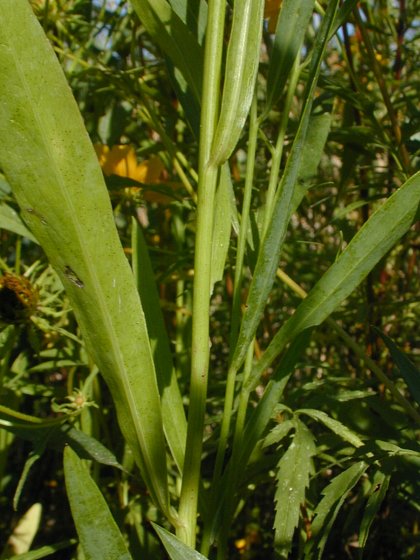
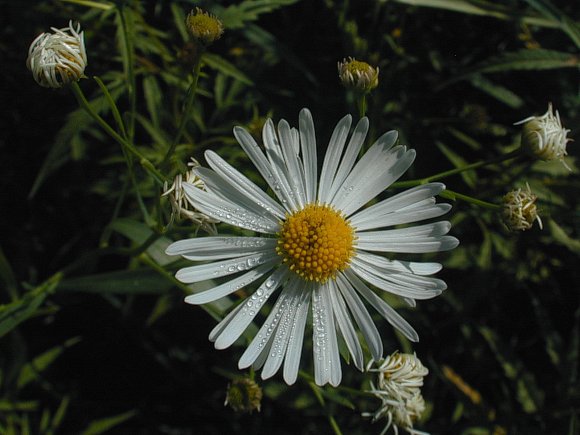
Description: This perennial plant is about 3-5' tall, branching frequently in the upper half. The green stems are glabrous, terete, and slightly ribbed. The alternate leaves are up to 6" long and ¾" across, becoming smaller and more narrow as they ascend the stems. They are narrowly lanceolate to oblanceolate, smooth along their margins, and glabrous; the uppermost leaves are linear. Each leaf tapers gradually to a short petiole-like base. The upper stems terminate in showy panicles of flowerheads; these flowerheads are produced in abundance. Each daisy-like flowerhead is about ¾" across, consisting of about 60 ray florets that surround numerous disk florets. The petaloid rays of the flowerheads are bright white and linear in shape (less often, they are slightly pink or slightly purple), while the tiny tubular corollas of the disk florets are bright yellow. Flowerheads have bases that are shallow and spreading, rather than cylindrically shaped; these bases are covered with overlapping floral bracts (phyllaries) that are light green and narrowly lanceolate in shape. The branching stalks of the panicle are similar to the stems and largely naked, except for narrow leaf-like bracts up to 1" long.
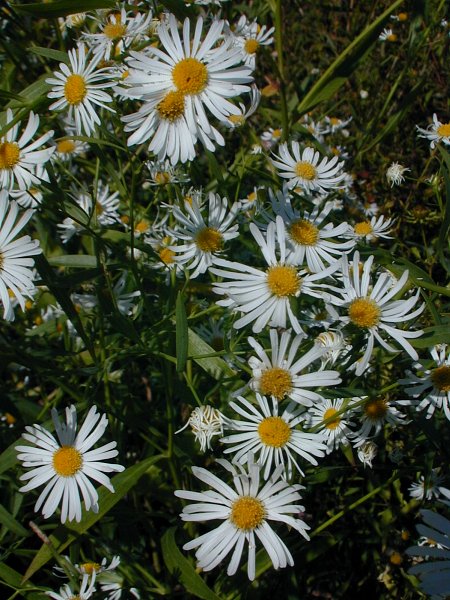
The blooming
period occurs from late summer into the fall and lasts about 1 month.
The florets are replaced by oblongoid achenes that are
somewhat flattened; they are slightly broader at their apices
than their bottoms. The apex of each achene has minute scales and a
pair of bristles, although the bristles are not always present. The
achenes usually fall only a short distance from the mother plant,
unless they are carried about by water. The root system sometimes
produces stolons that form plantlets at their tips.
Cultivation:
The preference is partial or full sun, wet to moist conditions, and a
fertile loamy soil. This plant can tolerate standing water for short
periods of time and doesn't seem to be bothered by foliar disease to
the same extent as many Aster spp. (Asters).
Range &
Habitat:
The native False Aster occurs occasionally in most areas of Illinois;
it is slightly more common in southern Illinois than other areas of the
state (see Distribution
Map). Habitats include openings in floodplain forests, soggy
thickets, alluvial meadows, prairie swales, marshes, and ditches.
Faunal Associations:
The flowerheads attract many kinds of insects because their nectar and
pollen are readily accessible. These insect visitors include
long-tongued bees, short-tongued bees, wasps, flies, butterflies,
skippers, moths, and beetles. A dagger bee, Perdita boltoniae,
is an oligolege of Boltonia spp. Another bee that
is somewhat oligolectic of these species is the long-horned bee, Melissodes
boltoniae, which also visits the flowerheads of some Aster
spp. False Aster is one of the host plants of a beetle, Microrhopala xerene,
whose larvae mine the leaves. The ecological relationships of Boltonia spp. to
vertebrate animals are probably similar to those of Aster spp. in
wetland areas.
Photographic
Location:
A prairie swale at Meadowbrook Park in Urbana, Illinois.
Comments:
False Aster has attractive foliage and flowers. Different varieties of
False Aster have been described; the one that is typically encountered
in the state, var. recognita, has flowerheads about
¾" across. In Cook County, var. microcephala also
occurs, which has flowerheads that are ½" across or less. While Boltonia
spp. (false asters) closely resemble Aster spp.
(asters) in appearance, they differ from each other in the following
characteristic: The achenes of false asters have minutes scales and/or
a pair of bristles at their apices, while the achenes of asters have
tufts of hair. As a result, the achenes of asters are carried more
readily by the wind into new areas. The other false asters in Illinois
are uncommon and differ from Boltonia asteroides by
their leaves: Boltonia diffusa interior has linear
leaves throughout, while Boltonia decurrens has
leaves that are decurrent against their stems (i.e., the base or basal
margins of each
leaf lies along the surface of the stem).