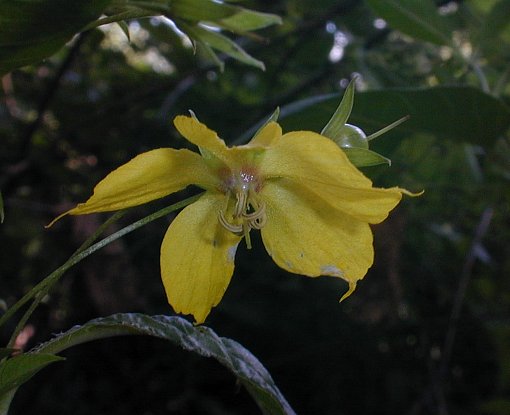
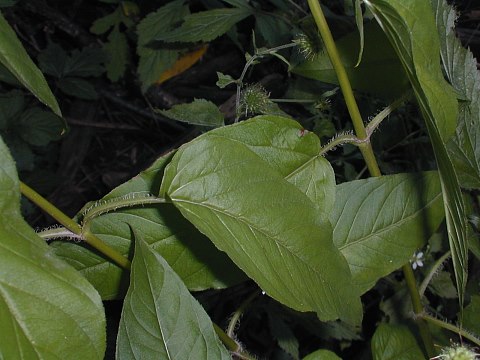
Description: This herbaceous perennial wildflower is 1-4' tall, unbranched or sparingly branched, and more or less erect. The central stem is light green, angular or terete, and glabrous. Pairs of opposite leaves occur at intervals along the length of each stem. The leaf blades are up to 6" long and 2½" across; they are medium green, lanceolate to ovate, hairless, and smooth along their margins. The petioles of the leaves are up to 1½" long and conspicuously ciliate. Along the axils of the middle to upper leaves, individual flowers occur on pedicels up to 3" long; they usually nod downward. These pedicels are slender, light green, and hairless. Each flower is ½–1" across; it has a green hairless calyx with 5 lanceolate teeth and a corolla with 5 widely spreading petal-like lobes. The petal-like lobes are obovate in shape, tapering to slender pointed tips; they are often reddish near the center of the flower, where the reproductive organs occur. Each flower has 5 stamens and a slender style. The blooming period occurs from mid-summer to early fall and lasts about 1½ months. Usually, only a few flowers are in bloom at the same time. Each flower is replaced by a globoid seed capsule that is green and shiny; it is surrounded by the spreading teeth of the persistent calyx. Each capsule contains several seeds. The root system consists of a taproot and rhizomes. This wildflower reproduces by its seeds or vegetatively through its rhizomes.
Cultivation:
The
preference is full sun to light shade, wet to moist conditions, and a
fertile loamy soil with organic matter.
Range & Habitat:
The native Fringed Loosestrife occurs occasionally in most areas of
Illinois (see Distribution
Map). As compared to the past, populations of this species
appear to be declining. Habitats include moist to wet areas of
deciduous woodlands, swamps, soggy thickets, wet prairies, marshes,
seeps, and borders of streams. This wildflower can be found in sun or
shade.
Faunal Associations:
The floral oil and pollen of the flowers attract the Melittid bee, Macropis
steironematis. This bee is a specialist visitor (oligolege)
of Lysimachia spp. It collects the floral oil and
pollen for its larvae. In addition, the Halictid bee Lasioglossum
versatus
has been observed collecting pollen from the flowers of Fringed
Loosestrife. Insects that feed destructively on various parts of
Fringed Loosestrife and other Lysimachia
spp. include the leafhopper Rossmoneura carbonata,
larvae of the sawfly Monostegia
abdominalis, larvae of Dasineura lysimachiae
(Loosestrife Bud Gall Midge), larvae of the moth Nola cilicoides
(Blurry-Patched Nola), and leaf-mining larvae of the moth Phyllonorycter lysimachiaeella.
Many of these insects are oligophagous. Little appears to be
known about this wildflower's relationships with birds and mammals.
Photographic
Location:
A damp wooded area along a railroad in Urbana, Illinois.
Comments:
This is one of the more common Lysimachia spp.
(Loosestrife species). As a group, they are not closely related to Lythrum
spp. (Purple Loosestrife species). Fringed Loosestrife can be
distinguished from other Lysimachia spp. by the
conspicuous hairs on its petioles. It tends
to be more robust and have wider leaves than other species in this
genus. Most Lysimachia spp. in Illinois have
similar yellow flowers that produce floral oil, although these flowers
sometimes differ in size. Another species, Lysimachia thyrsiflora
(Tufted Loosestrife), has flowers with very narrow petaloid lobes that
are bunched together into dense clusters. This provides it with a
distinctive appearance.