Description: This perennial plant is 1-4' tall. It is erect and usually remains unbranched. The central stem is light to medium green, terete or angular, and glabrous to sparsely hairy. The alternate leaves are up to 5" long and 2" wide; they are oblanceolate, obovate, ovate, or broadly elliptic in shape, and their margins are serrated. The lower leaves clasp the central stem, while the upper leaves are sessile. The upper surfaces of leaves are medium to dark green and sparingly covered with short hairs. The central stem terminates in a spike-like raceme of flowers about ½-2' long.
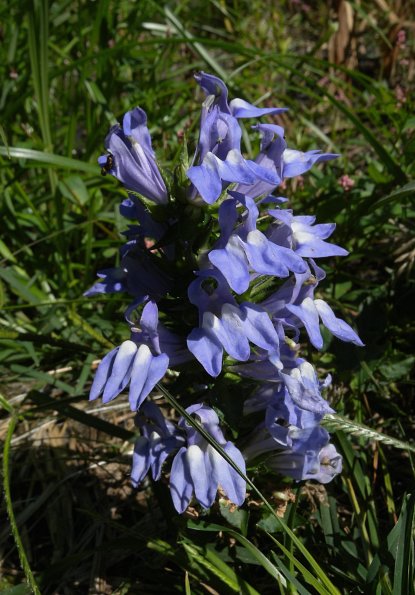
The flowers are
1-1½" long, angled upward, and
densely distributed along the raceme. Each flower has a blue-violet
corolla (rarely white) that is narrowly bell-shaped (campanulate) and
2-lipped. The upper lip has 2 slender erect lobes that curve slightly
inward or backward, while the lower lip has 3 descending lobes that are
oblong-lanceolate. Near the throat of the flower at the base
of the lower lobes, there is a pair of small white
patches. The
green calyx is deeply divided into 5 linear-lanceolate teeth; it
is conspicuously hairy. The calyx teeth are long and spreading.
The blooming period occurs from late summer into fall, lasting about 2
months. Afterwards, the flowers are replaced by capsules containing
small seeds. These seeds are probably distributed by wind or water to
some extent. The root system consists of a central taproot, from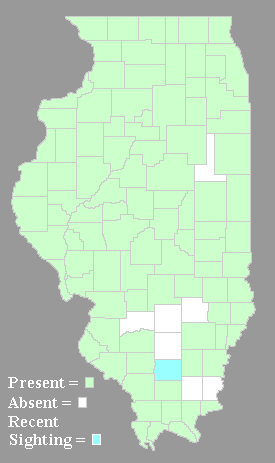 which
occasional basal offshoots are produced.
which
occasional basal offshoots are produced.
Cultivation:
The preference is wet to moist soil and partial sun. Full sun is
tolerated if the soil is consistently moist, and light shade is also
acceptable. The soil should be fertile and loamy. This plant withstands
occasional flooding, but it will become muddy and ragged-looking if it
receives too much abuse. The small seeds require light to germinate.
Great Blue Lobelia can be highly variable in height, depending on
environmental conditions and its stage of development.
Range & Habitat:
The native Great Blue Lobelia occurs throughout Illinois, except for a
few counties in southern Illinois. It is occasional to locally common.
Typical habitats include moist
black soil prairies, soggy meadows near rivers, low areas along rivers
and ponds, floodplain and bottomland woodlands, woodland borders,
bottoms of sandstone canyons along streams, swamps, fens, gravelly
seeps and springs, ditches, and moist areas of pastures.
Great Blue Lobelia can be found in both disturbed areas and high
quality
habitats.
Faunal Associations:
The nectar and pollen of the flowers attract primarily bumblebees and
other long-tongued bees (Anthophora
spp., Melissodes
spp., Svastra
spp.). Less common visitors include the Ruby-Throated
Hummingbird,
large butterflies, and Halictid bees. The Halictid bees collect pollen
only and they are non-pollinating. The caterpillars of a moth, Enigmogramma basigera (Pink-washed
Looper Moth), feed on the foliage of Great Blue Lobelia (Schweitzer
& Roberts, 2007). Most mammalian herbivores don't eat
this plant because the foliage contains several toxic alkaloids, chief
among them being lobeline and lobelanine. These toxic substances
produce symptoms that resemble nicotine poisoning. However, it has been
reported that deer occasionally eat this plant, perhaps enjoying
greater immunity to these toxic substances than other animals. The
seeds are too small to be of much value to birds.
Photographic Location:
The photographs were taken at a garden of the Anita Purves Nature
Center in Urbana, Illinois.

Comments: Great Blue Lobelia is a lovely plant that produces some welcome diversity with its violet-blue flowers during late summer or fall, when forbs with yellow flowers are typically dominant. Unfortunately, its value to wildlife is rather limited. Among the Lobelia spp. with bluish flowers in Illinois, Great Blue Lobelia has the largest flowers and they are usually a more deep shade of blue-violet, making it easy to identify.