
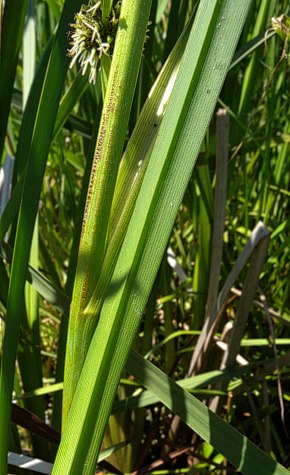
The central stem terminates in an inflorescence that is usually branched. On each branch of the inflorescence, there are 1-6 pistillate (female) flowerheads and 0-20 staminate (male) flowerheads. Except when a single pistillate flowerhead occurs on a short stalk, these flowerheads are sessile. The staminate flowerheads are located above the pistillate flowerheads on the same branches; all flowerheads are separated at intervals from each other. The branches of the inflorescence are medium green, glabrous, and terete; they have a tendency to bend where the pistillate flowerheads occur. The pistillate flowerheads are about ¾-1¼" across, globoid in shape, greenish, and prickly in appearance; the pistillate flowers are packed densely together in each head. Each pistillate flower consists of an ovary, several scale-like sepals (or sepaloid connectives), and a a style with 2 white stigmata (atypically with a single stigma). The
 greenish sepals are narrowly
oblanceolate and either rounded or somewhat disintegrated along their
upper margins. The staminate flowerheads are somewhat smaller in size
than the pistillate flowerheads; they are
globoid in shape, pale yellow
during the bud stage, becoming bright white while blooming. The
staminate flowers are packed densely together in each head; each
staminate flower has 5 stamens with white filaments and yellow to brown
anthers. At the base of each branch of the inflorescence, there is an
ascending leafy bract that resembles the leaves, except it is more flat
and smaller. Both the leaves and leafy bracts have basal
sheaths. The blooming period occurs during the summer and lasts 2-3
weeks. The flowers are wind-pollinated. The pistillate flowers are
replaced by achenes that become brown at maturity. Each achene has an
obconic-angular body (5-10 mm. in length) with a beak at its apex (2-4
mm. in length). The root system is fibrous and rhizomatous; small
tubers may occur as well. This plant reproduces by seed or by forming
clonal offsets. Small colonies of plants are often produced.
greenish sepals are narrowly
oblanceolate and either rounded or somewhat disintegrated along their
upper margins. The staminate flowerheads are somewhat smaller in size
than the pistillate flowerheads; they are
globoid in shape, pale yellow
during the bud stage, becoming bright white while blooming. The
staminate flowers are packed densely together in each head; each
staminate flower has 5 stamens with white filaments and yellow to brown
anthers. At the base of each branch of the inflorescence, there is an
ascending leafy bract that resembles the leaves, except it is more flat
and smaller. Both the leaves and leafy bracts have basal
sheaths. The blooming period occurs during the summer and lasts 2-3
weeks. The flowers are wind-pollinated. The pistillate flowers are
replaced by achenes that become brown at maturity. Each achene has an
obconic-angular body (5-10 mm. in length) with a beak at its apex (2-4
mm. in length). The root system is fibrous and rhizomatous; small
tubers may occur as well. This plant reproduces by seed or by forming
clonal offsets. Small colonies of plants are often produced.Cultivation: The preference is full or partial sun, wet conditions (including 1-2' of water), and soil that is muddy, sandy, or gravelly. Locations with strong currents or wave action should be avoided.
Range & Habitat: The native Giant Bur-reed (Sparganium eurycarpum) is occasional in most areas of Illinois, except the southeast, where it is absent (see Distribution Map). Habitats include marshes, fens, swamps, borders of ponds and slow-moving rivers, and sloughs. Generally, Giant Bur-reed is found in less disturbed wetlands with fertile soil or mineral-rich water.
Faunal Associations: Bur-reed species (Sparganium spp.) are a source of food to some insects. These insect feeders include several leaf beetles (Donacia spp.), Water Lily Aphid (Rhopalosiphum nymphaeae), Cattail Billbug (Sphenophorus australis), larvae of the Bur-reed Borer Moth (Capsula laeta), and larvae of other moths. See the Insect Table for a more detailed list of these species. The seeds of Giant Bur-reed (Sparganium eurycarpum) and other Bur-reed species are readily consumed by various wetland birds, especially ducks; these species include the Wood Duck, Mallard, Ring-necked Duck, Sandhill Crane, American Coot, and King Rail. See the Bird Table for a more detailed list of these species. Muskrats will consume the entire plant, and sometimes the foliage is browsed by White-tailed Deer.
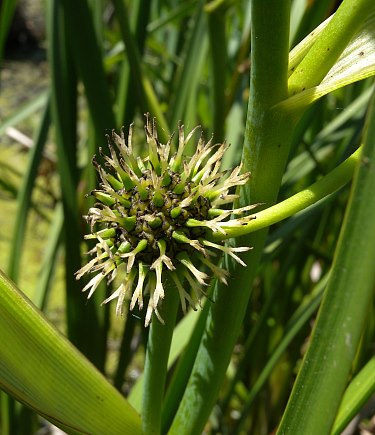
Photographic Location: Cowle's Bog at the Indiana Dunes National Lakeshore in NW Indiana. This wetland is actually a fen.
Comments: Giant Bur-reed (Sparganium eurycarpum) is one of the larger and the most common Bur-reed (Sparganium) in Illinois. It is also easy to identify during the flowering period because each one of its pistillate flowers usually has 2 styles, rather than a single style. Its achenes are also distinctive because of their obconic-angular shape; other Bur-reed species within the state have achenes that are more ellipsoid or spindle-shaped. This interesting plant should be used in wetland restorations more often.