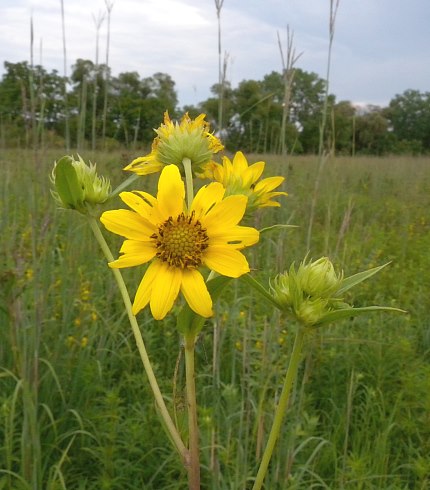
The upper stems terminate in one or more flowerheads about 2-3" across. Each flowerhead has 10-20 yellow ray florets that surround a dense circular cluster of yellow disk florets in the center. The petaloid extensions of the ray florets are oblong and slightly notched at their tips. The tiny disk florets are tubular in shape with 5 spreading to ascending lobes. The disk florets are perfect, while the ray florets are sterile. At the base of each flowerhead, there are floral bracts (phyllaries) that are loosely arranged in several series; they are ascending to widely spreading when the flowerhead is in bloom. Individual floral bracts are medium green, narrowly linear-lanceolate, and covered with stiff minute hairs; their margins are often ciliate. The peduncles (up to 6" long) of the flowerheads are similar to the stems, except they are usually light green. The blooming period occurs from mid-summer into the fall, lasting about 2 months. The disk florets are replaced by small achenes that are oblongoid and slightly flattened in shape; each achene has a truncate apex with a pair of membranous awns that soon become detached. The root system has fleshy fibrous roots and shallow rhizomes. Small colonies of plants often develop from the rhizomes.
 Cultivation:
The preference is full sun, wet to moist conditions, and sandy soil.
The size of individual plants is highly variable, depending on the
level of moisture, nutrients, and competition from other plants.
Cultivation:
The preference is full sun, wet to moist conditions, and sandy soil.
The size of individual plants is highly variable, depending on the
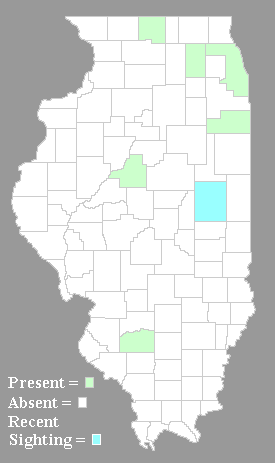
level of moisture, nutrients, and competition from other plants.Range & Habitat: The native Giant Sunflower is largely restricted to NE Illinois, where it is rare and state-listed as 'endangered.' It is more common in areas further to the north and east of Illinois. Habitats consist of wet sand prairies, sandy swales, calcareous fens, sedge meadows, and Tamarack bogs. This wildflower is found in higher quality wetlands.
Faunal Associations: The nectar and pollen of the flowerheads attract honeybees, bumblebees, little carpenter bees (Ceratina spp.), leaf-cutting bees (Megachile spp.), green metallic bees and other Halictid bees, Andrenid bees, Syrphid flies, butterflies, and beetles. The bees suck nectar and/or collect pollen, flies and beetles suck nectar and/or feed on pollen, while butterflies suck nectar only. Other insects feed on the foliage, stalks, roots, and other parts of Giant Sunflower and other sunflowers (Helianthus spp.). These insects include various weevils, leaf beetles, billbugs (Sphenophorus spp.), larvae of long-horned beetles (Cerambycidae), larvae of leaf-mining flies (Agromyzidae), larvae of gall flies (Cecidomyiidae), larvae of fruit flies (Tephritidae), plant bugs (Miridae), aphids (Aphididae), leafhoppers (Cicadellidae), treehoppers (Membracidae), grasshoppers, thrips, larvae of moths, and larvae of such butterflies as the Gorgone Checkerspot (Chlosyne gorgone), Silvery Checkerspot (Chlosyne nycteis), and Painted Lady (Vanessa cardui). The Insect Table provides a more detailed list of these species. The seeds of sunflowers are eaten by many birds during the fall and winter, including the Mourning Dove, White-Winged Crossbill, Eastern Goldfinch, Black-Capped Chickadee, White-Breasted Nuthatch, Tufted Titmouse, Bobwhite Quail, and various sparrows (see Bird Table). The foliage of sunflowers is palatable to White Tailed Deer and other hoofed grazing mammals, while the seeds are eaten by the Meadow Vole and other small rodents. Because Giant Sunflower occurs in wetlands, its large stalks are sometimes used by beavers in the construction of their dams and lodges. This tall colonial plant also provides protective cover for many kinds of wildlife.
Photographic Location: A prairie at Meadowbrook Park in Urbana, Illinois.
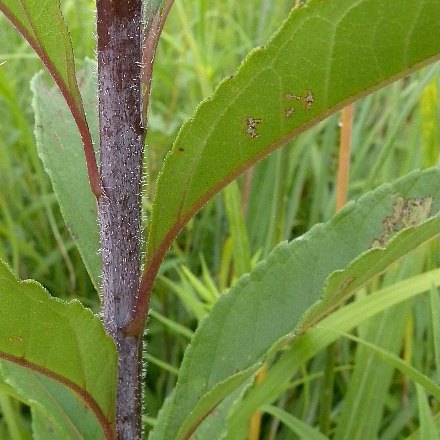
Comments: This attractive sunflower can be distinguished from other sunflowers in Illinois by its relatively narrow leaves, alternation of its leaves along the stems, spreading hairs of its stems, yellow disk florets, and long slender phyllaries (floral bracts). Other narrow-leaved species of sunflowers within the state include Helianthus grosseserratus (Sawtooth Sunflower) and Helianthus pauciflorus (Prairie Sunflower). Sawtooth Sunflower can be distinguished by its hairless glaucous stems, while the Prairie Sunflower can be distinguished by its stouter phyllaries and reddish purple disk florets. Another species, Helianthus tuberosus (Jerusalem Artichoke), has hairy stems like Giant Sunflower, but the leaves of Jerusalem Artichoke are wider and its petioles are longer. Yet another species, Helianthus hirsutus (Hairy Sunflower), also has hairy stems like Giant Sunflower, but the leaves of Hairy Sunflower are arranged oppositely along its stems, rather than alternately.