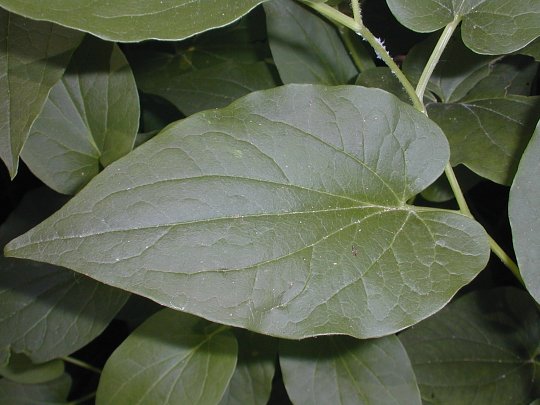
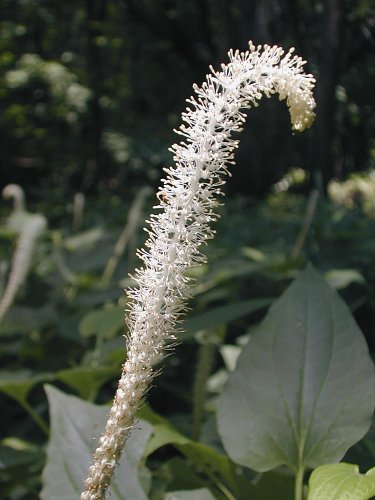
Description: This perennial plant is 1½–3' tall, branching occasionally. It is erect or semi-erect, often leaning on neighboring plants for support. The slender stems are light green and terete, becoming glabrous with age; young stems are sometimes pubescent, or they have tufts of soft white hairs. The alternate leaves are up to 6" long and 3½" across; they are cordate, smooth or slightly wavy along their margins, and glabrous. The upper leaf surface is medium to dark green and slightly shiny; palmate veins are clearly visible on this surface. The slender petioles are light green, terete, and glabrous; they are shorter than the leaf blades. From the axils of upper leaves, individual spikes of white flowers are produced on long stalks. The floral spikes are about 4-7" long and semi-cylindrical in shape from dense whorls of flowers; they often nod at their tips. The central stalk of each spike is white while the flowers are blooming.
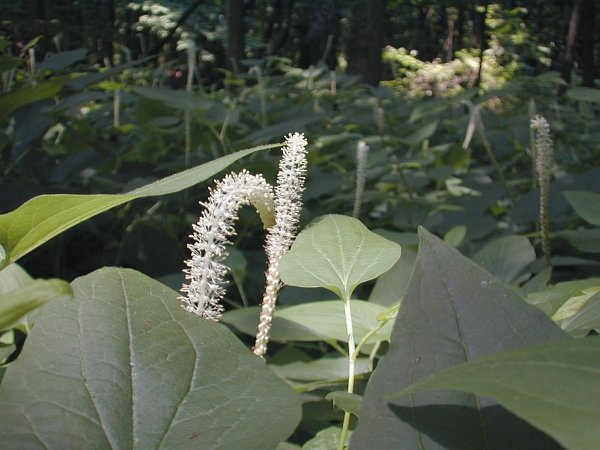
Each flower is up to ¼"
long, consisting of 6-8 white stamens and 3-4 white carpels at its
center. There are neither petals nor sepals. The flowers bloom in
succession from the bottom to the top of each spike. The blooming
period
occurs during the summer and lasts about 1 month or slightly longer.
There is a pleasant floral fragrance. As the fleshy carpels begin to
dry, their surfaces become wrinkled in appearance; they are joined
together at the base. Each carpel contains a single seed. The root
system produces abundant rhizomes, enabling vegetative reproduction.
This plant often forms colonies at favorable sites.
Cultivation:
The preference is light shade to partial sun and wet mucky soil to
shallow water. The foliage is rarely bothered by disease or insect
pests. Too much sunlight will cause the leaves to turn yellowish green.
Range &
Habitat:
The native Lizard's Tail is occasional to locally common in
southern, central, and NE Illinois; it is largely absent from
the NW section of the state (see Distribution
Map). Habitats include soggy openings in floodplain
and bottomland woodlands, shallow vernal pools in wooded areas, swamps,
seeps and springs in semi-shaded areas, shallow slow-moving streams,
and ditches along wooded areas. Although it can spread aggressively at
some sites, Lizard's Tail is usually found in higher quality wetland
habitats where there is some shade.
Faunal Associations:
Very limited information is available. The larvae of Parapamea
buffaloensis (Buffalo Moth) feed on the roots of this plant.
The foliage is toxic and avoided by mammalian herbivores. Because
Lizard's Tail often forms dense colonies of plants, it provides
significant cover for various kinds of wildlife in wetland areas.
Photographic
Location:
A Buttonbush swamp at Busey Woods in Urbana, Illinois, where there
was wet mucky soil and shallow water.
Comments:
Lizard's Tail has attractive foliage and flowers. The leaves of this
plant resemble those of some tropical Philodendron spp. (Philodendrons),
which are cultivated indoors as houseplants. However, they are not
closely related. This distinctive
plant is easy to identify; no other member of the
Lizard's Tail family occurs in the eastern half of the United States.
The common and scientific names refer to the nodding spikes of flowers,
as 'Saurus' means lizard and 'cernuus' means nodding. Another common
name for this species is 'Water Dragon.' While Lizard's Tail has few
enemies
among the vertebrate and invertebrate fauna, it is sometimes attacked
by
wetland species of dodder (Cuscuta
spp.); these are unusual parasitic vines that resemble
tangled masses of yellow string.