 Description:
This aquatic perennial plant consists of a submerged branching stem
about 2-8' long that has both submerged and floating leaves. The
branching stem is light green to pale yellow, terete to slightly
compressed, and glabrous. Along its length, there are alternate
submerged leaves about 1-5" long and ½-1¼" across. These submerged
leaves
are narrowly oblong-elliptic to lanceolate-elliptic, tapering gradually
toward both their tips and their bases; their margins are smooth. The
submerged leaves have 7-15 parallel veins. The petioles of the
submerged leaves are ¾-5½" long. At the bases of the submerged
petioles, there are linear-lanceolate stipules about 1-3½" long. The
submerged leaves and stipules are green or brown and hairless; they
eventually disintegrate as new leaves are produced. Toward the tips of
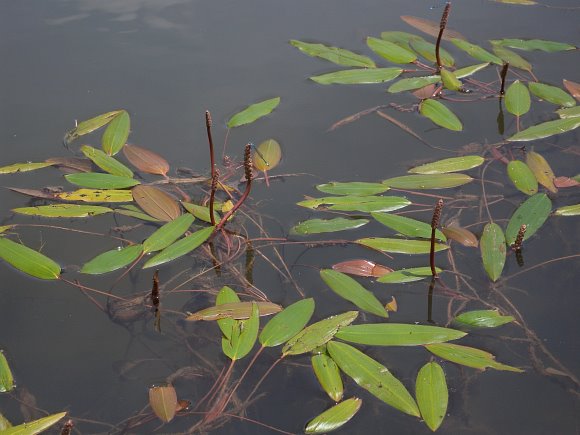
the stems, there are alternate or opposite floating leaves about 2-6"
long and ¾-1¾" across. The floating leaves are oblong-elliptic in
shape, tapering to wedge-shaped or narrowly rounded bottoms
and flat tips. The floating leaves have 9-17 parallel veins
and smooth margins; their upper surfaces are green, hairless, and
shiny. The petioles of these leaves are 1½-10" long; at the bases of
these petioles, are stipules that are similar to those of the submerged
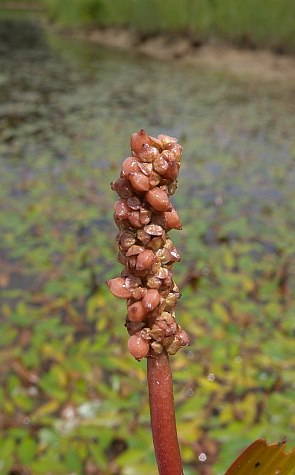
leaves. From the axils of floating leaves, spikes of flowers are
produced that are exerted above the surface of the water. These floral
spikes are ¾-2" long, olive green to reddish brown, and cylindrical in
shape. The peduncles of these flowers are 1½-6" long, hairless, and
terete. The flowers are packed densely together along the sides of each
spike. Each greenish flower is about 1/8" across, consisting of 4
rounded sepals that taper to narrow bases, 4 stamens, and a pistil with
a single style. The blooming period can occur from late spring to late
summer and lasts about 2 weeks. Afterwards, the flowers are replaced by
reddish brown seeds about 3-4 mm. long and 2.5-3 mm. across. Each
chunky seed has a keel on one side and a pair of parallel ridges along
the opposite side; there is a short beak at its apex. The root system
is fibrous and rhizomes. Colonies of plants often develop in shallow
water.
Description:
This aquatic perennial plant consists of a submerged branching stem
about 2-8' long that has both submerged and floating leaves. The
branching stem is light green to pale yellow, terete to slightly
compressed, and glabrous. Along its length, there are alternate
submerged leaves about 1-5" long and ½-1¼" across. These submerged
leaves
are narrowly oblong-elliptic to lanceolate-elliptic, tapering gradually
toward both their tips and their bases; their margins are smooth. The
submerged leaves have 7-15 parallel veins. The petioles of the
submerged leaves are ¾-5½" long. At the bases of the submerged
petioles, there are linear-lanceolate stipules about 1-3½" long. The
submerged leaves and stipules are green or brown and hairless; they
eventually disintegrate as new leaves are produced. Toward the tips of
the stems, there are alternate or opposite floating leaves about 2-6"
long and ¾-1¾" across. The floating leaves are oblong-elliptic in
shape, tapering to wedge-shaped or narrowly rounded bottoms
and flat tips. The floating leaves have 9-17 parallel veins
and smooth margins; their upper surfaces are green, hairless, and
shiny. The petioles of these leaves are 1½-10" long; at the bases of
these petioles, are stipules that are similar to those of the submerged
leaves. From the axils of floating leaves, spikes of flowers are
produced that are exerted above the surface of the water. These floral
spikes are ¾-2" long, olive green to reddish brown, and cylindrical in
shape. The peduncles of these flowers are 1½-6" long, hairless, and
terete. The flowers are packed densely together along the sides of each
spike. Each greenish flower is about 1/8" across, consisting of 4
rounded sepals that taper to narrow bases, 4 stamens, and a pistil with
a single style. The blooming period can occur from late spring to late
summer and lasts about 2 weeks. Afterwards, the flowers are replaced by
reddish brown seeds about 3-4 mm. long and 2.5-3 mm. across. Each
chunky seed has a keel on one side and a pair of parallel ridges along
the opposite side; there is a short beak at its apex. The root system
is fibrous and rhizomes. Colonies of plants often develop in shallow
water.Cultivation: The preference is full sun, warm standing water up to 4' deep, and a mucky bottom. This plant can spread aggressively in shallow water.
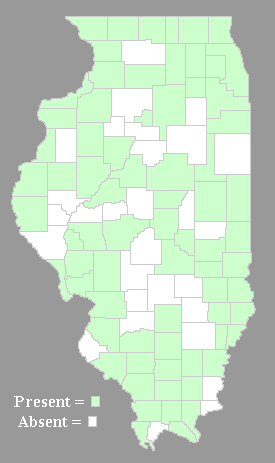
Range & Habitat: The native Long-Leaved Pondweed is common throughout Illinois. In addition to North America, this plant occurs in South America and Eurasia. Habitats consist of ponds, quiet harbors of lakes, slow-moving streams, and deep ditches with standing water.
Faunal Associations: Insects that feed on the leaves and other parts of this pondweed (Potamogeton nodosus) and other pondweeds (Potamogeton spp.) include the Water Lily Aphid (Rhopalosiphum nymphaeae) and Pond Lily Planthopper (Megamelus davisi). Both the larvae and adults of leaf beetles (Donacia spp., Neohaemonia spp.) and weevils (Bagous spp.) feed on these plants, as do the larvae of lake flies (Cricotopus spp., Polypedilum spp.) and shore flies (Hydrellia spp.). Some shore flies (Glyptotendipes spp.) bore into the submerged parts of pondweeds, where they are filter-feeders. The larvae of several Crambid moths (Parapoynx spp., Munroessa spp.) feed on the foliage. Another group of insects, the larvae of some Long-horned Caddisflies (Triaenodes spp.) feed on the submerged foliage of these plants. See the Insect Table for a more complete list of these species. Such wetland birds as
 ducks, swans, rails, and sandpipers feed on the foliage and/or
seeds of
pondweeds. These bird species include the Green-winged Teal, Redhead,
Canvasback, Wood Duck, Ring-Necked Duck, Mallard, Trumpeter Swan,
American Coot, Virginia Rail, Wilson's Snipe, and Short-billed
Dowitcher
(see the Bird Table
for a
more complete listing of these species).
Pondweeds are also eaten by many turtles (Lagler, 1943; Moll, 1976;
Ernst, Barbour, & Lovich, 1994); this includes the Snapping
Turtle (Chelydra
serpentina), Painted Turtle (Chrysemys picta),
Blanding's Turtle (Emys
blandingii), Ouachita Map Turtle (Graptemys
ouachitensis), False Map Turtle (Graptemys pseudogeographica), Musk
Turtle (Sternotherus
odoratus), and Slider (Trachemys
scripta).
The American Moose feeds on the foliage of these aquatic plants, while
the Muskrat feeds on their lower stems (Hamerstrom & Blake, 1939).
Pondweeds provide
protective cover for fish and other forms of aquatic wildlife.
ducks, swans, rails, and sandpipers feed on the foliage and/or
seeds of
pondweeds. These bird species include the Green-winged Teal, Redhead,
Canvasback, Wood Duck, Ring-Necked Duck, Mallard, Trumpeter Swan,
American Coot, Virginia Rail, Wilson's Snipe, and Short-billed
Dowitcher
(see the Bird Table
for a
more complete listing of these species).
Pondweeds are also eaten by many turtles (Lagler, 1943; Moll, 1976;
Ernst, Barbour, & Lovich, 1994); this includes the Snapping
Turtle (Chelydra
serpentina), Painted Turtle (Chrysemys picta),
Blanding's Turtle (Emys
blandingii), Ouachita Map Turtle (Graptemys
ouachitensis), False Map Turtle (Graptemys pseudogeographica), Musk
Turtle (Sternotherus
odoratus), and Slider (Trachemys
scripta).
The American Moose feeds on the foliage of these aquatic plants, while
the Muskrat feeds on their lower stems (Hamerstrom & Blake, 1939).
Pondweeds provide
protective cover for fish and other forms of aquatic wildlife.Photographic Location: A pond at the Arboretum of the University of Illinois in Urbana, Illinois.
Comments: Long-Leaved Pondweed belongs to a group of conspicuous pondweeds (Potamogeton spp.) that produce relatively broad floating leaves. Other pondweeds produce leaves that are narrow (linear in shape) or all of their leaves are normally submerged. Among the pondweeds with broad floating leaves, Long-Leaved pondweed has floating leaves that are longer than most (often exceeding 3" in length) and their bases are wedge-shaped or narrowly rounded, rather than broadly rounded or cordate. Furthermore, the submerged leaves of this species, when they are present, are useful in identification. They have relatively long petioles for submerged leaves (sometimes exceeding 3" in length) and in shape they are a more narrow version of the floating leaves of this species. Other pondweeds have submerged leaves with shorter petioles, or their submerged leaves are linear in shape, or they are more broad in shape. This common pondweed has been referred to as Potamogeton americanus (American Pondweed) in the past.