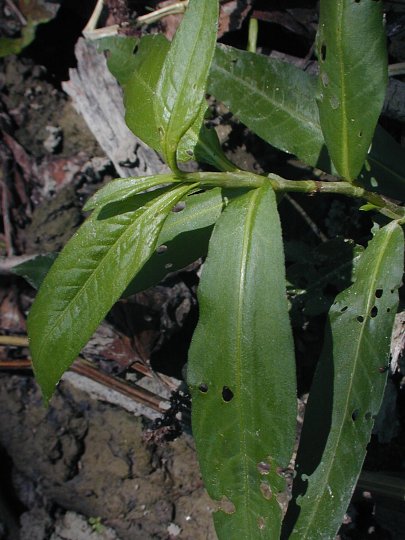
Description: This perennial plant is about 2-3' long and erect to sprawling; it branches occasionally. The light green stems are terete and hairless. The lower stems of individual plants are often decumbent along the ground; rootlets often develop at the nodes of these decumbent stems where the sheaths occur. The alternate leaves are up to 7" long and ¾" across, becoming smaller along the upper stems; mature leaves are spaced about ½–2" apart along each stem. They are green to dark green, oblong-lanceolate, smooth along the margins, and hairless or mostly hairless. Sometimes the leaf margins are slightly ciliate. The petioles of the leaves are short and slender. At the bases of petioles, there are membranous sheaths (ocreae) that wrap around the stems. These ring-like sheaths often have lines of short appressed hairs, while the upper rims of these sheaths usually lack bristles (when such bristles are present, they are less than 1 mm. in length). Each upper stem often terminates into 1-3 narrow racemes of flowers. Each raceme is up to 6" long and ascending to erect; the flowers and their buds are distributed somewhat sparsely along its length.
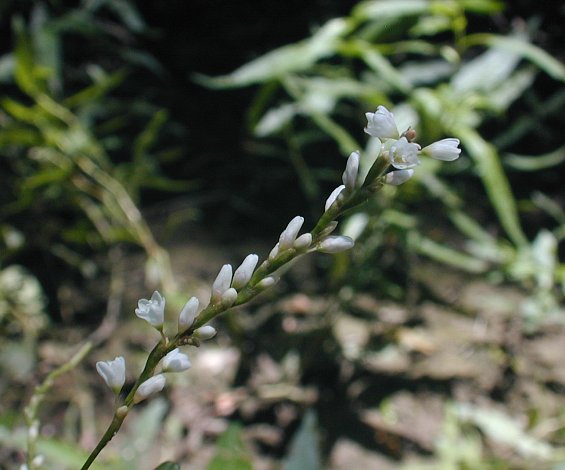
Each flower is up
to 1/8" (3 mm.) across, consisting of 5 tepals, 8 stamens, and a
tripartite
style. The tepals are white or light pink and they lack glandular dots.
Usually, only a few flowers are in bloom at the same time on a raceme.
At the bases of flowers, there are small sheaths (ocreoleae);
these sheaths have relatively few bristles (less than 1 mm. in
length) along their upper rims, or none. The blooming period occurs
from mid-summer to early fall and lasts about 1–1½ months. Afterwards,
the flowers are replaced by shiny black seeds (one seed per
flower) that are ovoid and bluntly 3-angled. The root system is fibrous
and rhizomatous. Clonal colonies of plants are often formed from the
rhizomes and/or rootlets of decumbent stems.
Cultivation:
Full or partial sun, wet to moist conditions, and muddy soil are
preferred. Wet soil containing sand or gravel is also tolerated. This
plant is often found in shallow water and it almost qualifies as an
emergent-aquatic species.
Range &
Habitat:
The native Mild Waterpepper (Persicaria hydropiperoides) occurs in most counties of Illinois, where
it is occasional to locally common (see Distribution
Map). Habitats include swamps, sunny to partially shaded
seeps, edges of ponds, and ditches. These habitats can be either sandy
or non-sandy. This perennial smartweed is more often found in higher
quality wetlands than many other Persicaria spp.
(Smartweeds), especially those that are weedy annuals. However, Mild
Waterpepper can adapt to disturbed wetlands as well. It displays
greater tolerance of shade than some of the other smartweeds.
Faunal Associations:
The nectar of the flowers attracts various insects, including small
bees, wasps, flies, and beetles. The caterpillars of the butterflies Lycaena
helloides (Purplish Copper) and Lycaena hyllus
(Bronze Copper) feed on Persicaria spp.
(Smartweeds), as do the caterpillars of Homophoberia apicosa (Black Wedge-spot) and other moths. Other insect feeders of these plants include Galerucella nymphaeae (Waterlily Leaf Beetle) and other leaf beetles, weevils, plant bugs, stink bugs, Rhopalosiphum nymphaeae (Waterlily Aphid) and other aphids, larvae of sawflies, and grasshoppers (see Insect Table for a more complete listing of these species). The seeds of
smartweeds are eaten by many ducks, rails, and granivorous songbirds
(see Bird Table for a listing of these species). Because the foliage of
Mild Waterpepper (Persicaria hydropiperoides) has little or no peppery flavor, it may be eaten by White-tailed Deer and other
mammalian herbivores to a greater extent than the foliage of other
smartweeds.
Photographic Location:
A buttonbush swamp in Busey Woods of Urbana, Illinois.
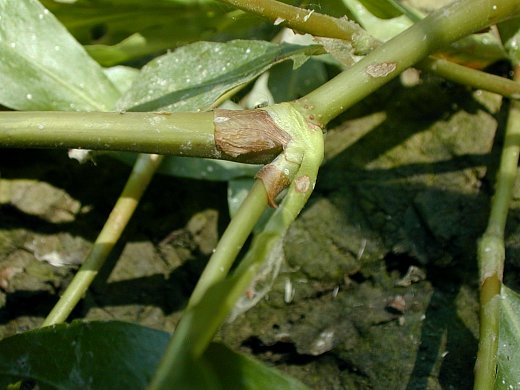
Comments: This is one of the native species of smartweed and somewhat unusual because it is reliably perennial. Mild Waterpepper (Persicaria hydropiperoides) is a member of a complex of species that are very similar to each other. Other members of this complex include Persicaria opelousana and Persicaria setacea, which are largely restricted to southern Illinois. Some authorities regard these latter two species as variants of Mild Waterpepper rather than distinct species, and there may be some merit to this view. The species Persicaria opelousana has flowers with greenish white tepals and its ochreoleae (small sheaths underneath the flowers) have abundant long bristles (greater than 1 mm. in length). The species Persicaria setacea has leaves that are conspicuously pubescent on both their upper and lower surfaces and its ochreae (sheaths at the bases of petioles) have long hairs and bristles. In contrast, Mild Waterpepper has hairless leaves (or nearly so), only short appressed hairs along its ochreae, and usually no bristles along the upper rims of its ochreae. It is also possible to confuse Mild Waterpepper with Persicaria punctata (Dotted Smartweed) and Persicaria hydropiper (Waterpepper). Dotted Smartweed has glandular dots on its tepals (which may be difficult to see without magnification) and its mature leaves are more widely spaced along the stems (about 1–3½" apart). Waterpepper has ochreoleae that lack bristles, and it has more widely spaced flowers on nodding racemes. The leaves of both Dotted Smartweed and Waterpepper have a more peppery flavor than those of Mild Waterpepper. Another scientific name that refers to Mild Waterpepper is Polygonum hydropiperoides.