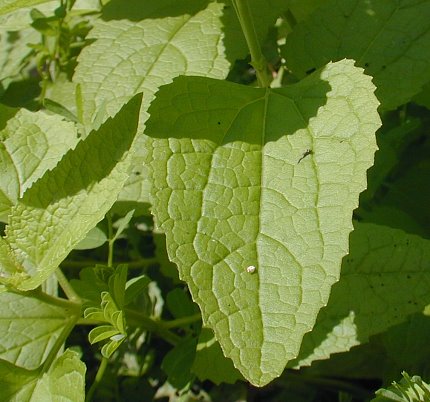
Description: This perennial plant is 1-2½' tall, branching occasionally to abundantly. The stems are light green, terete, and appressed-pubescent. The opposite leaves are up to 3" long and 2" across; they have short slender petioles. The leaf blades are oval-cordate, oval, or ovate in shape, while their margins are dentate or dentate-crenate. The upper blade surface is light green and glabrous with a conspicuous network of veins. The upper stems terminate in flat-topped clusters of flowerheads. Each cluster of flowerheads spans about 1-3" across. Each flowerhead has about 40-50 disk florets that are pink, lavender, or blue. Each floret has a tiny tubular corolla with 5 spreading lobes and a strongly exerted style that is divided into two filiform parts. Around the base of each flowerhead, there are several floral bracts (phyllaries) that are arranged in 1-2 series; they are light green and linear in shape. The branches underneath each flowerhead cluster are light green and terete.
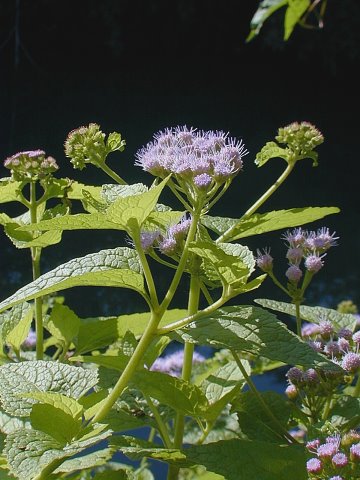
The blooming
period occurs from mid-summer to early autumn, lasting about 1-2
months.
There is no noticeable floral scent. Afterwards, the florets are
replaced by achenes with small tufts of hair; they are distributed by
the wind. The root system
is highly rhizomatous; this plant readily forms colonies.
Cultivation:
The preference is full sun to light shade, moist conditions, and soil
containing loam or silt. There should
be sufficient organic material in the soil to retain moisture. This
plant can spread aggressively in moist open ground, otherwise it
presents few problems. Drought tolerance is poor. Propagation is
by seed or division of the rhizomes.
Range &
Distribution:
The native Mistflower occurs in the southern half of Illinois and the
Chicago area
(see Distribution
Map).
It is fairly common in southern Illinois, but
uncommon or absent elsewhere. This plant was introduced into the
Chicago area. Some local populations in the wild are probably
the result of seeds or plants that have escaped cultivation. Habitats
include river-bottom prairies, moist open woodlands, gravelly seeps,
borders of lakes and rivers, moist meadows in wooded areas, bases of
bluffs, and ditches. This plant usually occurs in poorly
drained areas and near sources of water.
Faunal Associations:
The flowers attract long-tongued bees, butterflies, and skippers. Other
occasional visitors include short-tongued bees, various
flies, moths, and beetles. These insects seek nectar
primarily, although the bees often collect pollen. Insects that feed on
Eupatorium spp.
(Bonesets) may also feed on Mistflower. Insect feeders of this group of
plants include the caterpillars of such moths as Haploa
clymene (Clymene
Moth; eats foliage), Phragmatobia lineata (Lined
Ruby Tiger Moth; eats foliage), Carmenta bassiformis
(Eupatorium Borer Moth; bores into roots), and Schinia
trifascia (Three-Lined Flower Moth; eats florets &
developing seeds). Mammalian herbivores rarely consume Mistflower
because of its bitter foliage.
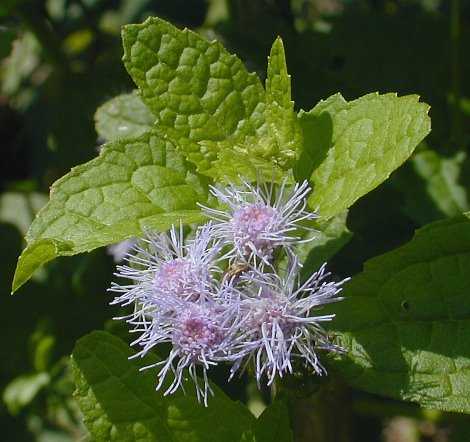
Photographic
Location:
The photograph was taken along a drainage canal at Kaufman Lake Park in
Champaign, Illinois.
Comments:
Mistflower has attractive delicate flowers that are colored in pastel
shades of pink, lavender, or blue. For this reason, it is often grown
in flower gardens. This plant is closely related to the white-flowered
Bonesets (Eupatorium spp.), and sometimes it is
still referred to
as Eupatorium coelestinum. Mistflower can be
distinguished from the Bonesets primarily by its colorful flowers,
relatively short stature, and broad opposite leaves that are heavily
veined. While species of Joe-Pye Weed (Eupatoriadelphus spp.)
have similar colorful flowers, they are taller plants with whorled
leaves. All of these species are similar in that their flowerheads
consist entirely of disk florets.