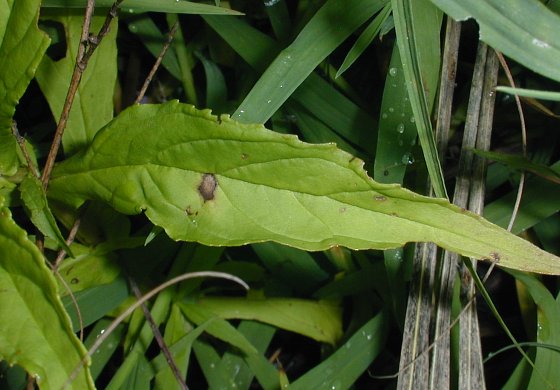
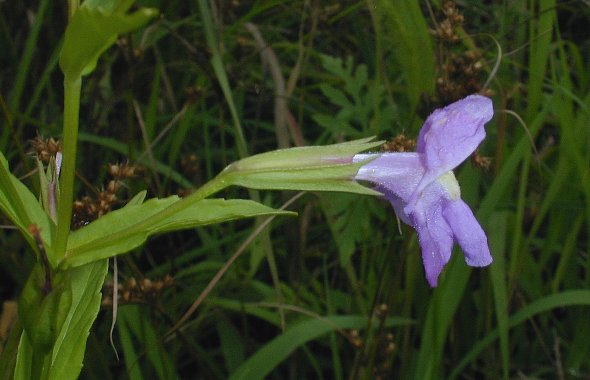
Description: This perennial plant is 1-3' tall, branching occasionally to frequently. The light green stems are glabrous and bluntly 4-angled, but they are not conspicuously winged. The opposite leaves are up to 4" long and 1" across; they are light to medium green, lanceolate or elliptic-oblanceolate in shape, glabrous, and serrated to sparingly serrated along their margins. The leaves are sessile or they clasp the stems; petioles are absent. Leaf bases are round to slightly cordate, while their tips are slender and pointed. Individual flowers develop from the leaf axils of the middle to upper stems. These flowers are about 1" long, and they have two-lipped corollas that are usually pale blue-violet (less often pink or white).

The upper lip of the corolla has 2 erect lobes, while the lower lip has 3 rounded lobes. The inner surface of the lower lip often has 2 small ridges. The throat of the corolla has a patch of yellow and it is barely open because of an abundance of fuzzy hairs. The tubular calyx is light green with 5 linear-lanceolate teeth; it also has 5 longitudinal ridges along its sides. The pedicels of the flowers are at least ½" in length; they are slender, glabrous, and terete. The blooming period occurs from mid-summer to early fall, lasting about 1–1½ months. There is no floral scent. Each flower is replaced by a rounded seed capsule that contains numerous tiny seeds with reticulated outer surfaces. These seeds are dispersed by wind or water. The root system is rhizomatous. Although this plant can spread vegetatively, it isn't a strong colonizer.
Cultivation:
The
preference is full or partial sun, rich loamy soil, and wet conditions.
This plant will also grow in soil that is consistently moist,
particularly in partially shaded situations. The foliage isn't bothered
by foliar disease to any significant degree, although it will turn
yellow and shrivel away in response to droughty conditions. The size of
a plant is strongly influenced by moisture conditions and soil
fertility.
Range & Habitat:
The native Monkey Flower is widely distributed throughout most of
Illinois (see Distribution
Map). This plant is fairly common in the central and northern
areas of the state, but it is less common in the south. Habitats
include floodplain and bottomland forests (particularly in partially
sunny areas), swamps, seeps, muddy borders of small streams or ponds,
drainage ditches, prairie swales, and wet meadows. It typically occurs
in areas that are prone to occasional flooding or standing water.
Faunal
Associations:
Bumblebees visit the flowers for nectar. They are one of the few
insects that are strong enough to force their way into the partially
closed throat of the corolla. The caterpillars of the moth, Elaphria
chalcedona
(Chalcedony Midget), and caterpillars of the butterfly, Junonia coenia
(Buckeye), feed on the foliage. In the northern half of Illinois, where
Chelone glabra
(White Turtlehead) is the primary host plant, later instars of
the butterfly Euphydryas phaeton (Baltimore)
sometimes migrate to feed on Monkey Flower and other wetland plants. An
oligophagous aphid, Aphis
mimuli,
uses Monkeyflower as a summer host plant. Little appears to be known
about this plant's ecological relationships with vertebrate animals,
although it is sometimes large enough to provide protective cover in
wetlands.
Photographic Location:
The photographed plants were growing in a prairie swale at Meadowbrook
Park in Urbana, Illinois.
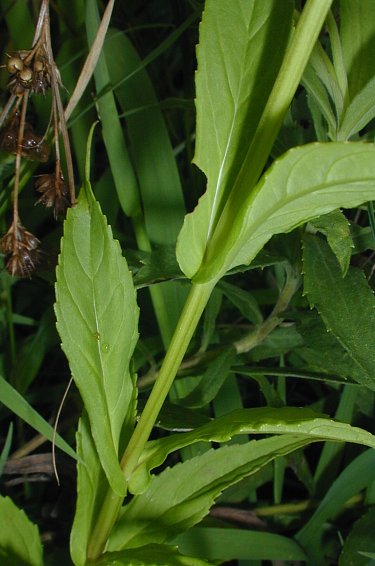
Comments: Both the foliage and flowers of this plant are quite attractive. The common name comes from the fancied resemblance of the flower to a monkey's face when it is squeezed by the fingers. The Mimulus spp. in Illinois are either yellow-flowered or blue- to pink-flowered. In the latter group, there are only two species: Mimulus ringens (Monkey Flower) and Mimulus alatus (Winged Monkey Flower). The former has flowers on pedicels that are longer than the tubular calyx (½" or more), leaves that are sessile or clasping, and stems that are 4-angled, but not conspicuously winged. The latter species has flowers with pedicels that are nearly zero to ½" in length, leaves that have distinct petioles, and stems that are both 4-angled and conspicuously winged. In my experience, Monkeyflower usually has pale blue-violet flowers, while Winged Monkeyflower has pink flowers, but this distinction is not always reliable.