 Description:
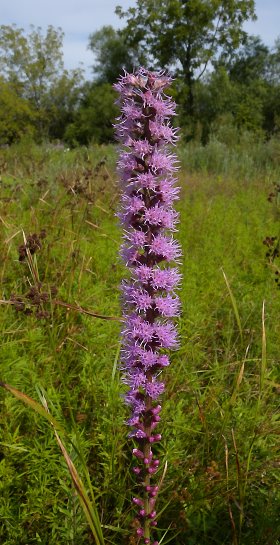
This perennial plant is 2-5' tall and unbranched. The central
stem is light green to purplish green, terete or slightly ridged,
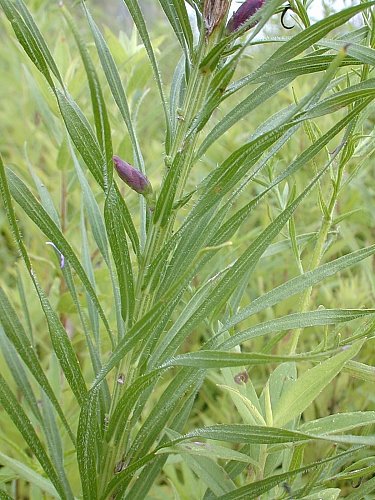
and glabrous to sparsely pubescent. The alternate leaves are
up to
10" long and about 1/3" (8 mm.) across, becoming smaller as they ascend
the stem. Because of their dense distribution, they appear almost
whorled. The leaves are linear in shape and their margins are smooth
(entire). Each leaf has a distinct central vein. Both the upper and
lower leaf surfaces are light to medium green and glabrous to sparsely
hairy. The central stem terminates in a wand-like spike of flowerheads
about 4-18" in length. These flowerheads are densely crowded along the
spike, facing in all directions; they bloom at the top of the spike
first, opening later below. Each flowerhead is about 1/3" (8 mm.)
across, consisting of 4-10 disk florets and no ray florets. The corolla
of each disk floret is pink to purplish pink (rarely white) and
narrowly tubular. The upper corolla divides in 5 small lobes that are
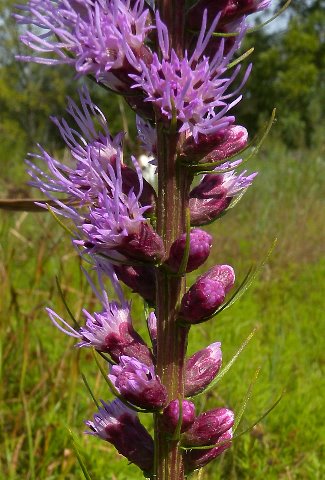
lanceolate in shape and somewhat recurved. A deeply divided style is
strongly exerted from the corolla; it is white to light
pink, filiform, and sometimes slightly twisted or curved.
Around the base of each flowerhead, there are appressed floral bracts
(phyllaries) that are overlapping. These floral bracts are
green to purple, glabrous, and oval in shape. The blooming period
occurs from mid- to late summer, lasting about 3 weeks. There is no
noticeable floral scent. Afterwards, the florets are replaced by small
achenes with stiff bristles at their apices; these bristles are light
brown. The root system consists of a corm with shallow fibrous roots.
Colonies of plants are often formed by means of clonal offsets that
involve the production of new corms.
Description:
This perennial plant is 2-5' tall and unbranched. The central
stem is light green to purplish green, terete or slightly ridged,
and glabrous to sparsely pubescent. The alternate leaves are
up to
10" long and about 1/3" (8 mm.) across, becoming smaller as they ascend
the stem. Because of their dense distribution, they appear almost
whorled. The leaves are linear in shape and their margins are smooth
(entire). Each leaf has a distinct central vein. Both the upper and
lower leaf surfaces are light to medium green and glabrous to sparsely
hairy. The central stem terminates in a wand-like spike of flowerheads
about 4-18" in length. These flowerheads are densely crowded along the
spike, facing in all directions; they bloom at the top of the spike
first, opening later below. Each flowerhead is about 1/3" (8 mm.)
across, consisting of 4-10 disk florets and no ray florets. The corolla
of each disk floret is pink to purplish pink (rarely white) and
narrowly tubular. The upper corolla divides in 5 small lobes that are
lanceolate in shape and somewhat recurved. A deeply divided style is
strongly exerted from the corolla; it is white to light
pink, filiform, and sometimes slightly twisted or curved.
Around the base of each flowerhead, there are appressed floral bracts
(phyllaries) that are overlapping. These floral bracts are
green to purple, glabrous, and oval in shape. The blooming period
occurs from mid- to late summer, lasting about 3 weeks. There is no
noticeable floral scent. Afterwards, the florets are replaced by small
achenes with stiff bristles at their apices; these bristles are light
brown. The root system consists of a corm with shallow fibrous roots.
Colonies of plants are often formed by means of clonal offsets that
involve the production of new corms.
Cultivation:
The preference is full sun, moist conditions, and sandy loam.
Other soil types, such as loam and gravelly loam, are readily tolerated
in cultivation. The soil should possess sufficient organic material to
retain moisture. The height of this plant can vary considerably,
depending on its maturity, soil moisture, and soil fertility. During
hot dry weather, the lower leaves may wither away, otherwise this plant
presents few problems.
Range & Habitat:
The native Marsh Blazingstar occurs in NE Illinois and a few scattered
counties elsewhere (see Distribution
Map). It is an uncommon plant in
the wild. Habitats include moist black soil prairies, moist sand
prairies, prairie swales, edges of marshes and bogs, grassy fens,
calcareous seeps, moist alkaline sandflats, and areas along railroads.
This blazingstar is found primarily in higher quality natural areas,
especially where it is sandy.
Faunal
Associations:
The flowerheads are cross-pollinated by bumblebees, long-horned
bees (Melissodes spp.),
leaf-cutting bees (Megachile
spp.),
butterflies, and skippers. These insects suck nectar, although some of
the bees also collect pollen for their larvae. Two uncommon prairie
insects feed on Liatris
spp. (blazingstars): caterpillars of Schinia sanguinea
(Liatris Flower Moth) feed on the florets and developing seeds, while
caterpillars of Carmenta
anthracipennis (Liatris Borer Moth) bore through the
stems. Mammalian herbivores eat this and other blazingstars readily;
groundhogs and rabbits favor younger plants, while deer and livestock
are more likely to browse on mature plants. The corms are eaten by the
Prairie Vole and Meadow Vole. An overpopulation of these animals
can make the establishment of this plant difficult in some
areas.
Photographic Location:
The photographs were taken at a moist prairie in Meadowbrook Park,
Urbana, Illinois.
Comments: Marsh Blazingstar is a very attractive plant while in bloom, resembling a magic wand. It is more common in flower gardens than in the wild, although some cultivated plants may be hybrids with similar species. Among the various Liatris spp. (blazingstars) that are native to Illinois, Prairie Blazingstar (Liatris pycnostachya) probably resembles Marsh Blazingstar the most. However, this latter plant has floral bracts (phyllaries) that are strongly recurved, while the floral bracts of Marsh Blazingstar are appressed together and relatively smooth. Other blazingstars within the state are either shorter in height or they have larger flowerheads with more disk florets per head. While other blazingstars are typically found in mesic prairies and various upland habitats, Marsh Blazingstar is unusual in its preference for wetter habitats.