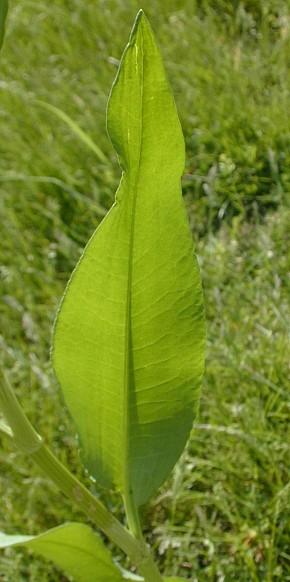
Description: This perennial plant is 1½-4' tall and either unbranched or sparingly branched. The stout central stem is light green, terete, and glabrous; longitudinal veins may be visible as fine lines of medium to dark green. The alternate leaves are up to 10" long and 3" across, becoming smaller as they ascend the stems. The leaves are lanceolate or oblong-lanceolate in shape and short-petioled, while their margins are smooth (entire) and non-wavy. The leaves are yellowish green or green, glabrous, and their upper surfaces are often shiny, rather than dull. At the apex of the plant occurs an erect inflorescence about 4-12" long that branches occasionally. This inflorescence has dense whorls of small green flowers on drooping pedicels. Each flower is about 1/8" (3 mm.) long and it has 6 green sepals, sometimes with yellowish or reddish overtones.
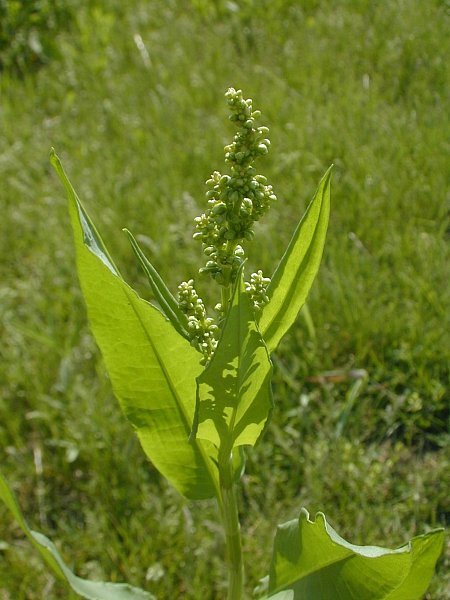
The blooming period usually occurs
during early summer and lasts about 2 weeks. If a disturbance lops off
the central stem, this plant may bloom later in the year. There is no
floral scent. The flowers are cross-pollinated by the wind. Afterwards,
the flowers are replaced by tripartite achenes that are initially
green, but they later become brown. Each achene is about 1/8" (3 mm.)
long with 3 membranous wings and a tubercle in its center. When viewed
from the side, any two wings of an achene form a cordate-oval shape
with smooth outer margins, while an elongated tubercle extends more
than half-way down the middle of the achene. The membranous wings
provide the achenes within sufficient buoyancy that they can be
dispersed by wind or water. The nutlets within the tubercles can
remain viable in the ground for 10 years, if not substantially longer.
The root system consists of a long branching taproot. Colonies of
plants are sometimes formed.
Cultivation:
The preference is full to partial sun and wet to mesic conditions.
Growth is best in rich fertile soil, but the presence of some clay or
gravel is tolerated. Established plants can tolerate some drought
because of their deep taproots.
Range & Habitat:
The native Pale Dock occurs throughout most of Illinois, and it is
quite common
(see Distribution
Map). Habitats include moist black soil prairies, clay
prairies, prairie swales, moist meadows around woodlands and streams,
thickets, riverbanks, low areas around lakes and ponds, roadsides
ditches, areas along railroads, pastures, and waste areas. This plant
favors moist disturbed areas.
Faunal
Associations:
Pale Dock is wind-pollinated, therefore the flowers attract few
insects. Occasionally, various beetles can be found lurking in or
around the inflorescence. The caterpillars of some Copper butterflies
feed on the foliage of this and other docks (Rumex spp.),
including Lycaena dione (Gray Copper), Lycaena
hyllus (Bronze Copper), and Lycaena helloides
(Purplish Copper). The caterpillars of some moths feed on Pale Dock,
including Pseudeustrotia
carneola (Pink-Barred Pseudeustrotia), Calothysanis
amaturaria (Cross-Lined Wave; adults often fly during the
day), and Luperina passer (Rustic Dock; larvae feed
on roots). Other insect feeders include Gastrophysa cyanea
(Green Dock Beetle), the larvae of Lixus
concavus (Rhubarb Curculio, bores through stems), the
larvae of Contarinia
rumicis (Dock Seed Midge), Dysaphis radicola
(Apple-Dock Aphid, feeds on roots of dock), and the larvae of Ametastegia glabrata
(Dock Sawfly, feeds on foliage). It is possible that some birds and
small mammals eat the seeds. Mammalian herbivores, such as rabbits and
livestock, occasionally browse on the foliage, but it is not a
preferred food source. The leaves of mature plants can contain high
amounts of such toxic substances as nitrates and oxalic acid.
Experimental studies have shown that the seeds remain viable after
passing through the digestive tracts of horses, cattle, sheep, and
swine. Thus, these animals may help to spread the seeds into new areas.
Photographic Location:
The photographs were taken at Meadowbrook Park in Urbana,
Illinois, and along a railroad in Champaign, Illinois.
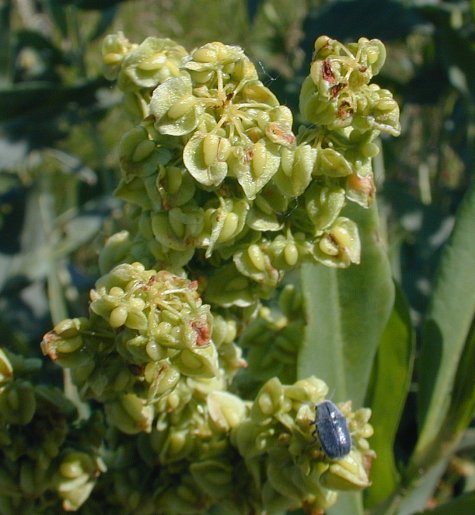
Comments: Pale Dock is easily confused with the Eurasian docks. However, the native docks, as a group, tend to have shinier leaves with less wavy margins than the Eurasian docks. To identify a specimen with a specific species, it is necessary to examine the shape and structure of the mature achenes very carefully. Like other docks, Pale Dock is widely regarded as an unattractive weed and often destroyed. In general, species of the Smartweed family suffer from a lack of appreciation by members of the public (and even professional ecologists). However, Pale Dock is a native plant that occurs frequently in natural habitats, and it is a potentially important food source for some insects, particularly Copper butterflies, as indicated above.