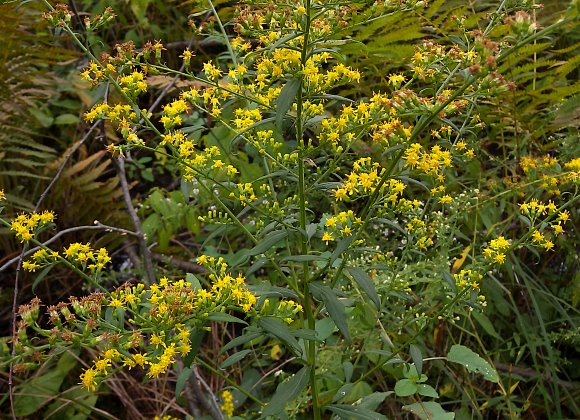
The central stem terminates in an open panicle of flowerheads up to 1½' long and 2' across. On a robust plant, this panicle has long primary branches that are ascending to widely spreading; they are often recurved. Each primary branch of the panicle is divided into short secondary and tertiary branches that terminate in clusters of erect flowerheads (see photo of Flowering Branch). The branches of the panicle are hairless or sparsely short pubescent. Leafy bracts up to 1" long and ½" across occur along these branches. Individual flowerheads are about 1/8" across, consisting of 5-12 ray florets that surround 5-15 disk florets. Individual ray florets have yellow corollas that are petal-like; they are pistillate and fertile. Individual disk florets have yellow corollas that are narrowly tubular with 5 spreading lobes; they are perfect and fertile. At the base of each flowerhead, there are appressed phyllaries (floral bractlets) in several series that are green and narrowly oblong in shape. The blooming period occurs from late summer into the fall for about 1-1½ months. The florets are replaced by small bullet-shaped achenes with tufts of hair. The achenes are sparsely hairy; they are distributed by the wind. The root system is fibrous and rhizomatous; sometimes a small caudex will form on an older plant. Clonal offsets often develop from the rhizomes.
Cultivation: The preference is partial sun to light shade, wet to consistently moist soil that consists of loam or sandy loam with organic matter. Some plants may lean over to the side if they lack adequate support from adjacent vegetation. A low area that is protected from the wind is desirable.
Faunal Associations: The nectar and pollen of the flowerheads attract honeybees, bumblebees, leaf-cutting bees, Andrenine bees, Sphecid wasps, and Vespid wasps (Wilhelm & Rericha, 2017). The following bees are specialist pollinators of Solidago spp. (Goldenrods): Andrena hirticincta, Andrena nubecula, Andrena placata, Andrena simplex, Andrena solidaginis, and Colletes simulans armata. Some of these bees also visit Aster spp. (Asters). Other insects feed on the foliage, flowers, and other parts of goldenrods (Solidago spp.). These species include leaf beetles, larvae of leaf-miner flies, larvae of gall flies, larvae of fruit flies, plant bugs, stink bugs, aphids, leafhoppers, treehoppers, armored scale insects, mealybugs, grasshoppers, and larvae of many moths. The Insect Table has a more complete list of these species. Some vertebrate animals also use these plants as a source of food. Songbirds eating the seeds include the Indigo Bunting, Slate-colored Junco, Swamp Sparrow, American Tree Sparrow, and American Goldfinch. Among herbivorous mammals, goldenrods are eaten by the White-tailed Deer, Cottontail Rabbit, Meadow Vole, Prairie Vole, and Woodland Vole (DeVore et al, 2004; Martin et al., 1951/1961).
Photographic Location: A sandy swamp at the Indiana Dunes State Park in NW Indiana.
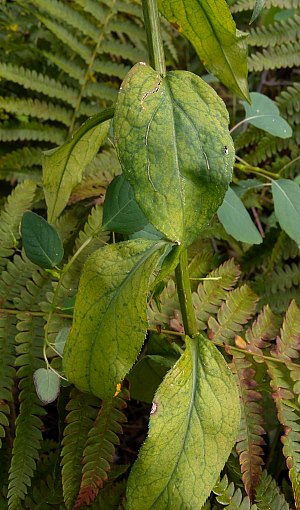
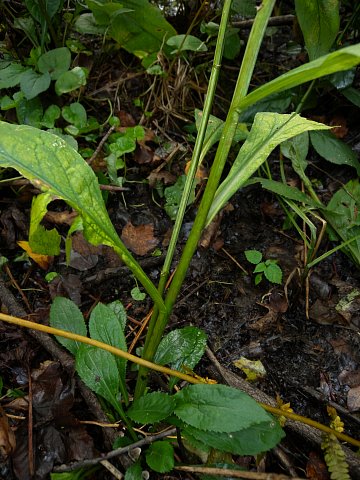
Comments: This tall goldenrod has a rather messy inflorescence that sends flowering branches in all directions. Swamp Goldenrod is relatively easy to distinguish from other Solidago spp. (Goldenrods): 1) It usually occurs in shaded wetlands, rather than areas that are more sunny or dry, 2) it often has large basal and lower cauline leaves up to 12" long and 4" across, 3) its central stem is sharply angular and sometimes winged, and 4) on robust plants, it has an open inflorescence with flowering branches that are widely spreading or recurved.