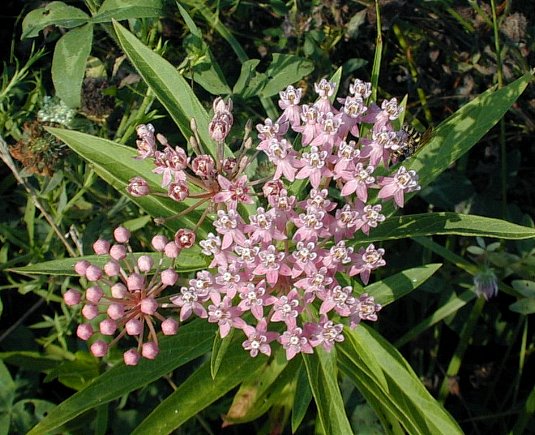
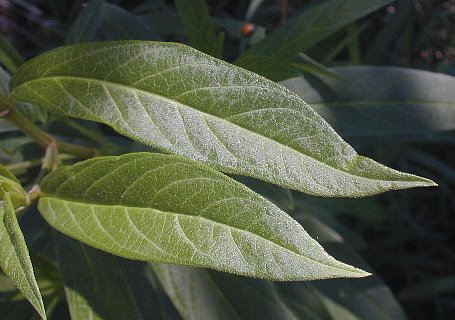
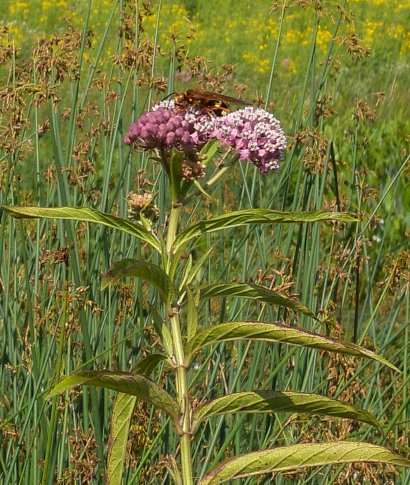
Description: This perennial wildflower is highly variable in size (2-6' tall), depending on environmental conditions. The central stem branches occasionally, forming ascending lateral stems; these stems are light green, terete, and glabrous. The opposite leaves are up to 6" long and 1½" across, although they are more typically about 3" long and ½" across. They are narrowly lanceolate or oblong-lanceolate in shape, smooth (entire) along their margins, and glabrous. Upper leaf surfaces are medium to dark green, although they can become yellowish green or pale green in response to bright sunlight and hot dry conditions. The leaves are either sessile or their bases clasp the stems. Upper stems terminate in pink umbels of flowers spanning about 2-3½" across. Each flower is about ¼" across, consisting of 5 upright whitish hoods and 5 surrounding pink petals that droop downward in the manner of most milkweeds. The blooming period occurs during late summer and lasts about a month. The flowers exude a pleasant fragrance that resembles cinnamon. Afterwards, successfully cross-pollinated flowers are replaced by seedpods. The seedpods (follicles) are 3-4" long and narrowly lanceoloid-ellipsoid in shape. Immature seedpods are light green, smooth, and glabrous, turning brown at maturity. Each seedpod splits open along one side to release its seeds. These seeds have large tufts of white hair and they are distributed by the wind during the fall. The root system is rhizomatous, from which clonal colonies of plants occasionally develop.
Cultivation:
The preference is full to partial sun, wet to moist conditions,
and soil containing mucky clay, rich loam, or silt with rotting organic
material. Occasional flooding is tolerated if it is temporary.
Tolerance to hot dry conditions is poor. The leaves have a tendency to
become more broad in shape in response to shady conditions.
Range & Habitat:
The native Swamp Milkweed is a fairly common plant that occurs in
nearly all counties of Illinois (see Distribution
Map). Habitats include open to partially shaded areas in
floodplain forests, swamps, thickets, moist black soil prairies, low
areas along rivers and ponds, seeps and fens, marshes, and drainage
ditches. Swamp Milkweed
can be found in both high quality and degraded habitats.
Faunal Associations: The flowers are very popular with many kinds of insects, including bumblebees, honeybees, long-horned bees (Melissodes spp., Svastra spp.), Halictid bees, Sphecid wasps, Vespid wasps, Tiphiid wasps, Spider wasps, Mydas flies, thick-headed flies, Tachinid flies, Swallowtail butterflies, Greater Fritillaries, Monarch butterflies, and skippers. Another occasional visitor of the flowers is the Ruby-Throated Hummingbird. All of these visitors seek nectar. Some insects feed destructively on the foliage and other parts of Swamp Milkweed and other Asclepias spp. (milkweeds). These insect feeders include caterpillars of the butterfly Danaus plexippes (Monarch), Labidomera clavicollis (Swamp Milkweed Leaf Beetle), Oncopeltus fasciatus (Large Milkweed Bug), and Aphis nerii (Yellow Milkweed Aphid). The latter aphid often congregates on the upper stems and young leaves (see Insect Table for other insects that feed on milkweeds). Mammalian herbivores leave this plant alone because the foliage is both bitter and toxic, containing cardiac glycosides.
Photographic
Location:
The photographs were taken at Meadowbrook Park in Urbana, Illinois, and
at Weaver Park of the same city.
Comments:
This is usually an attractive and elegant plant. It is almost the only
milkweed in Illinois that favors wetland habitats. Swamp Milkweed is
easily distinguished from other milkweeds (Asclepias spp.)
by its erect umbels of pink flowers, tall branching habit, and
relatively narrow leaves. Other milkweeds with pink flowers, such
as Asclepias syriaca (Common Milkweed) and Asclepias
sullivantii (Prairie Milkweed), are shorter and less
branched plants with wider leaves. Sometimes stray plants of Swamp
Milkweed occur in drier areas; these specimens are usually much shorter
and little branched, but their leaves remain narrow in shape.