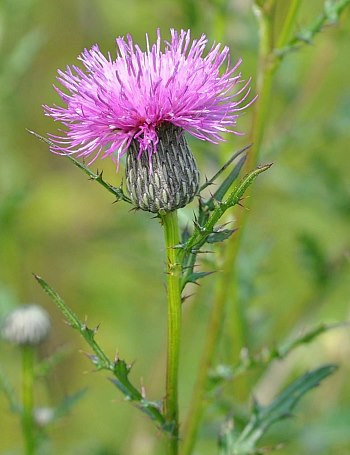
The central stem and any upper stems terminate in either individual flowerheads or open corymbs of 2-5 flowerheads. The peduncles of these flowerhead are 1-6" long, light green (less often pale purple), terete, finely grooved, and finely hairy to nearly glabrous. There is usually a single leafy bract (up to 3" long) at the base of each peduncle and, less often, there may be a whorl of a few leafy bracts (up to 1½" long) underneath the flowerhead. Otherwise, the peduncle is naked. The leafy bracts resemble the alternate leaves, except they are smaller in size and their spiny lobes are more narrow. Each peduncle terminates in a flowerhead that is about 1¼-2" across and similarly in length. At the flattened top of the flowerhead, there is a dense cluster of numerous disk florets; there are no ray florets. The disk florets are perfect and fertile. The corollas of the disk florets are narrowly cylindrical below, becoming slightly wider above with 5 narrow lobes. These corollas vary in color from pink to pinkish purple. The sides of the flowerhead consist of overlapping floral bracts (phyllaries) that are appressed together in several series. These floral bracts are lanceolate to ovate in shape; their tips taper into erect minute spines, or such spines may be absent. The sticky floral bracts have narrow mid-ribs that are pale green, otherwise they are blackish green; appressed woolly hair usually occurs between the floral bracts. The blooming period occurs from mid-summer to early fall, lasting about 1½ months. Afterwards, the ray florets are replaced by small achenes with tufts of white hair. Individual achenes are about 5 mm. long, oblongoid, and dark brown to black with bands of yellow at their upper ends. They are distributed by the wind. The root system consists of a stout taproot.
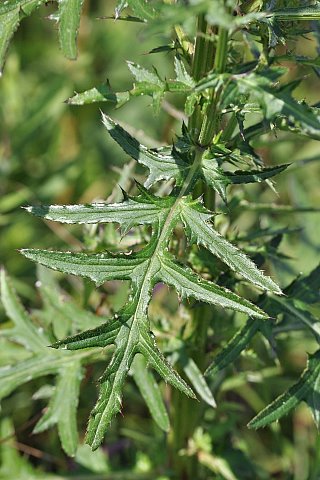
Cultivation: The preference is full sun, wet to moist conditions, and calcareous sand, although partial sun and other soil types are tolerated. The size of individual plants can be highly variable, depending on moisture level, soil fertility, and competition from other plants.
Range & Habitat: The native Swamp Thistle (Cirsium muticum) is occasional in NE Illinois, otherwise it is uncommon or absent elsewhere in the state (see Distribution Map). This plant is more common further to the north. Habitats include wet sand prairies, sandy swamps, marshes, fens, interdunal swales near Lake Michigan, limestone bluffs (where some seepage of ground water occurs), pastures, and abandoned sandy fields. Swamp Thistle is found primarily in sandy wetlands and rocky areas where seepage through limestone occurs. It is perhaps most common in fens.
Faunal Associations: The flowerheads of Swamp Thistle (Cirsium muticum) attract many insects, especially long-tongued bees, butterflies, and skippers. Typical floral visitors include honeybees, bumblebees, little carpenter bees (Ceratina spp.), leaf-cutting bees (Megachile spp.), cuckoo bees
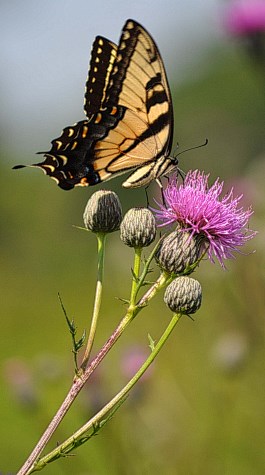 (Triepeolus spp.), Halictid bees,
Swallowtail butterflies (Papilio
spp.),
Painted Lady butterflies
(Vanessa spp.), skippers (Polites spp., etc.),
day-flying moths, and leaf beetles (Diabrotica spp., etc.). Most of
these insects suck
nectar, although some bees collect pollen and leaf beetles probably
feed on pollen (Wilhelm & Rericha, 2017; Voss, 1983). A
long-horned bee,
Melissodes desponsa,
is an oligolege (specialist pollinator) of
thistles. Other insects feed destructively on these plants. Swamp
Thistle is the preferred host plant for the caterpillars of an uncommon
butterfly, the Swamp Metalmark (Calephelis
mutica). Other insect feeders of
thistles include caterpillars of the butterfly, Painted Lady (Vanessa
cardui),
caterpillars of the Artichoke Plume Moth (Platyptilia
carduidactyla) and Northern Burdock Borer Moth (Papaipema
arctivorens), Thistle Tortoise Beetle (Cassida rubiginosa), Northern
Grasshopper (Melanoplus borealis),
stem-boring larvae of the Rhubarb Weevil (Lixus
concavus), Thistle Aphid (Brachycaudus
cardui) and Artichoke Aphid (Capitophorus elaeagni), and the
treehopper, Entylia
bactriana. See the Insect Table for a
more
complete listing of these species. Because Swamp Thistle has some
protection from its spines and it occurs in less accessible wetland
habitats, it is less likely to be eaten by mammalian herbivores. Some
small
songbirds, however, eat the seeds of thistles, especially the American
Goldfinch. This bird also uses the hair tufts of thistle seeds in the
construction of its nests. Another small bird, the Ruby-Throated
Hummingbird, occasionally visits the flowerheads of thistles for their
nectar (Martin et al., 1951/1961; personal observations).
(Triepeolus spp.), Halictid bees,
Swallowtail butterflies (Papilio
spp.),
Painted Lady butterflies
(Vanessa spp.), skippers (Polites spp., etc.),
day-flying moths, and leaf beetles (Diabrotica spp., etc.). Most of
these insects suck
nectar, although some bees collect pollen and leaf beetles probably
feed on pollen (Wilhelm & Rericha, 2017; Voss, 1983). A
long-horned bee,
Melissodes desponsa,
is an oligolege (specialist pollinator) of
thistles. Other insects feed destructively on these plants. Swamp
Thistle is the preferred host plant for the caterpillars of an uncommon
butterfly, the Swamp Metalmark (Calephelis
mutica). Other insect feeders of
thistles include caterpillars of the butterfly, Painted Lady (Vanessa
cardui),
caterpillars of the Artichoke Plume Moth (Platyptilia
carduidactyla) and Northern Burdock Borer Moth (Papaipema
arctivorens), Thistle Tortoise Beetle (Cassida rubiginosa), Northern
Grasshopper (Melanoplus borealis),
stem-boring larvae of the Rhubarb Weevil (Lixus
concavus), Thistle Aphid (Brachycaudus
cardui) and Artichoke Aphid (Capitophorus elaeagni), and the
treehopper, Entylia
bactriana. See the Insect Table for a
more
complete listing of these species. Because Swamp Thistle has some
protection from its spines and it occurs in less accessible wetland
habitats, it is less likely to be eaten by mammalian herbivores. Some
small
songbirds, however, eat the seeds of thistles, especially the American
Goldfinch. This bird also uses the hair tufts of thistle seeds in the
construction of its nests. Another small bird, the Ruby-Throated
Hummingbird, occasionally visits the flowerheads of thistles for their
nectar (Martin et al., 1951/1961; personal observations).Photographic Location: A fen in NE Illinois. The photographs were taken by Lisa Culp (Copyright © 2011).
Comments: Swamp Thistle (Cirsium muticum) resembles the more common Pasture Thistle (Cirsium discolor) and other tall-growing thistle species. It can be distinguished from these other species by the lack of significant spines on its floral bracts (phyllaries) and its preference for wetland habitats. While the leaf undersides of Swamp Thistle tend to be somewhat whitened, they are usually less whitened than either the Pasture Thistle or Tall Thistle (Cirsium altissimum). A Eurasian species that has not been found in Illinois, but appears to be spreading in other areas of the United States, is the Marsh Thistle (Cirsium palustre). Like the Swamp Thistle, Marsh Thistle also prefers wetland habitats, but it has smaller flowerheads (1" across or less) and its floral bracts have outward-pointing fine spines. This Eurasian thistle also tends to be somewhat smaller in size than the Swamp Thistle. Another common name of Cirsium muticum is Fen Thistle.