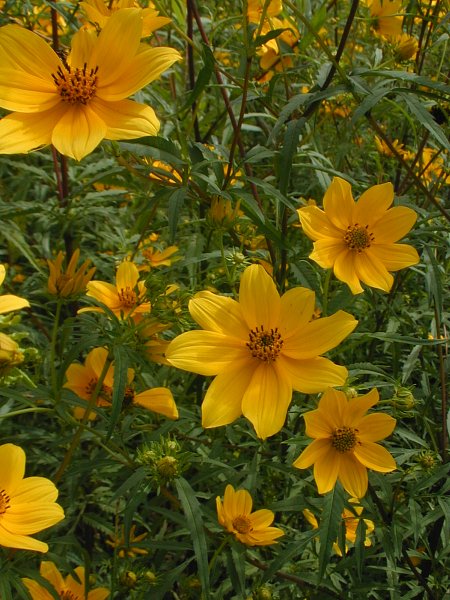
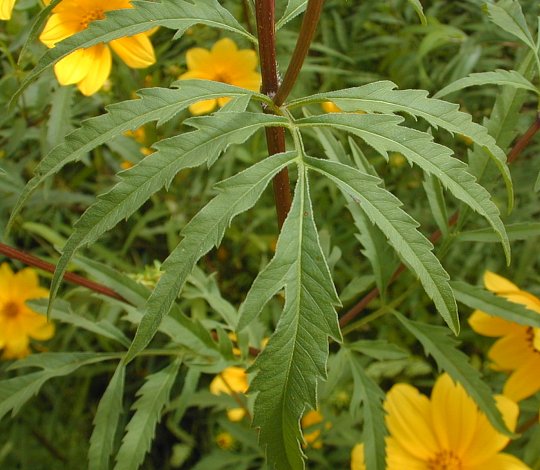
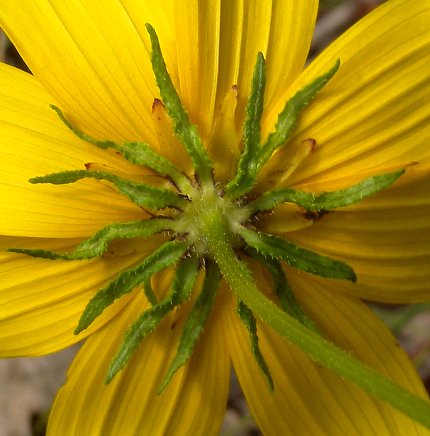
Description: This annual or biennial plant is 1-4' tall, branching occasionally. The green or reddish stems are glabrous to slightly hairy. The opposite compound leaves are odd-pinnate, dividing into 3-7 slender segments. Compound leaves are up to 8" long and 4" across; they are much wider at their bases than toward their tips. The leaflets are slightly ciliate and coarsely dentate; sometimes they are divided into narrow pointed lobes. From terminal stems, or from the axils of upper leaves, there develops from 1 to 3 flowerheads on slender and slightly hairy stalks. An individual plant may have several flowerheads in bloom at the same time. Each daisy-like flowerhead is about 2" across, consisting of 8-10 ray florets that surround numerous disk florets. The tiny corollas of the disk florets are tubular in shape and golden yellow, while the petaloid rays are bright yellow and oblong-elliptic in shape. Each flowerhead is subtended by 12-18 green outer bracts (phyllaries) that are each about ¾" long, linear in shape, coarsely ciliate, and rather contorted. Less visible, there are also several inner bracts that are pale yellow and lanceolate in shape. The blooming period occurs from late summer to early fall, lasting about 1-2 months. The flowers are slightly fragrant, which becomes quite noticeable in a large colony of plants. The dark brown achenes are rather flat and rough-textured with central longitudinal ridges; they are about 1½–2 times as long as they are wide. These achenes lack significant awns at their apices. The root system consists of a shallow branching taproot.
Cultivation:
The
preference is full sun and wet to moist conditions. The soil should be
rich in organic material. This plant is easy to grow, but tends to be
aggressive at a disturbed site that is sunny and moist. It can form
large colonies by reseeding itself. This species of Bidens
appears to have some tolerance of hot dry weather.
Range & Habitat:
Long-Bracted
Tickseed Sunflower is occasional in the southern half of Illinois and
NE Illinois, but it is rare or absent in the remaining northern
counties (see Distribution
Map). This plant is native. Habitats include moist prairies,
prairie swales, low
areas along ponds and streams, gravelly seeps, ditches along railroads
and roadsides, muddy fields, and miscellaneous waste areas. It usually
occurs in or around poorly drained areas that are prone to standing
water, or near sources of more or less permanent water. Disturbed areas
are favored because of reduced competition from deep-rooted perennial
plants.
Faunal Associations: The flowerheads are popular with many kinds of insects, including long-tongued bees, short-tongued bees, wasps, flies, butterflies, skippers, and beetles. Typical bee visitors include bumblebees, cuckoo bees (Epeolus spp., Coelioxys spp.), long-horned bees (Melissodes spp.), leaf-cutting bees (Megachile spp.), green metallic bees, plasterer bees (Colletes spp.), and Andrenid bees (Calliopsis spp., Heterosarus spp.). The caterpillars of the butterfly Nathalis iole (Dainty Sulfur) are known to favor the foliage of Bidens spp. as a food source. The caterpillars of several moths feed on the foliage, flowerheads, or the pith of stems, including Epiblema otiosana (Bidens Borer Moth), Condica mobilis (Mobile Groundling), Condica confederata (The Confederate), Cirrhophanus triangulifer (Goldenrod Stowaway), and Palthis asopialis (Faint-Spotted Palthis). Other insect feeders include leaf beetles (Calligrapha spp.), larvae of the fruit fly Icterica seriata, and several aphid species.
The seeds are
eaten by small rodents and various birds, including the Ring-Necked
Pheasant, Bobwhite, Swamp Sparrow, and Purple Finch. The foliage is
eaten occasionally by the Cottontail Rabbit. Even though their awns are
tiny or absent, the achenes of Bidens polylepis can
cling to the the fur of animals or clothing of humans; this is largely
because of their rough edges. Small rodents can carry the achenes to
their dens for some distance from the mother plants.
Photographic Location:
The photographs were taken at a prairie swale in Meadowbrook Park,
Urbana, Illinois.
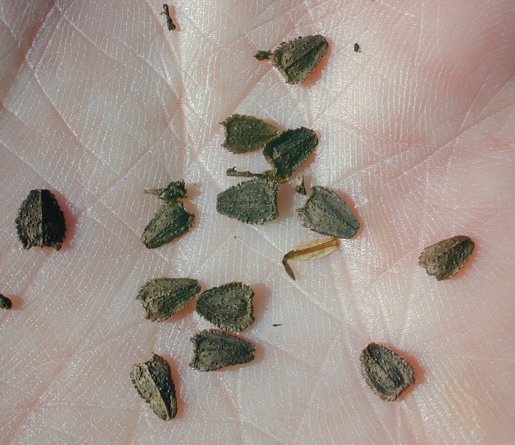
Comments: This is one of the more pretty and drought-tolerant Bidens spp. that occasionally strays from wetlands to moist prairies. Long-Bracted Tickseed Sunflower can be distinguished from other Bidens spp. by its attractive flowers and slender pinnate foliage. It has a very similar appearance to Bidens aristosa (Tickseed Sunflower). However, the flowerheads of this latter species are individually subtended by 8-10 outer bracts (phyllaries); these bracts are shorter, less hairy, and less contorted than those of Bidens polylepis. The achenes of Bidens aristosa usually have pairs of conspicuous awns at their apices, otherwise they are very similar in appearance to those of Bidens polylepis. However, a rare variety of the Tickseed Sunflower, Bidens aristosa mutica, also has achenes that lack significant awns. Because of its distinct outer bracts and awnless achenes, Long-Bracted Tickseed Sunflower is usually classified as a distinct species (Mohlenbrock, 2002). Scientific synonyms of this species are Bidens aristosa retrorsa and Bidens involucrata.