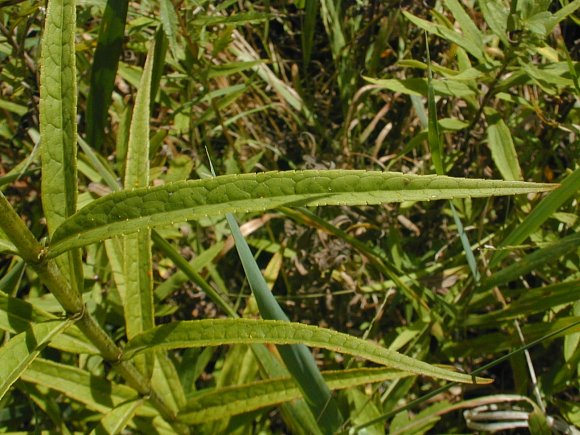
Description: This perennial plant is about 2-3' tall and unbranched or sparingly branched. The central stem is glabrous and either terete or 4-angled. Each pair of opposite leaves rotates 90° from the position of the pair of leaves immediately below. For var. linifolia of White Turtlehead, these leaves are less than ¾" across and they are linear-lanceolate in shape. However, the typical variety of White Turtlehead has some leaves greater than ¾" and they are lanceolate or oblong-lanceolate in shape. The leaves are hairless and finely serrated along their margins. At their bases, the leaves are sessile, or they have petioles that are less than ¼" in length. The central stem terminates in a dense spike of white flowers about 3-6" in length, blooming from the bottom to the top.
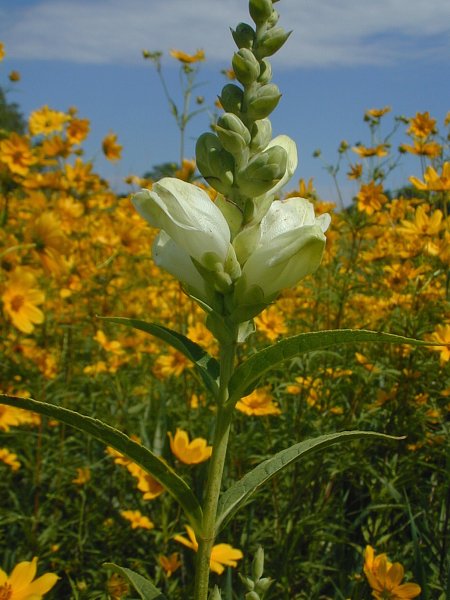
Each flower is
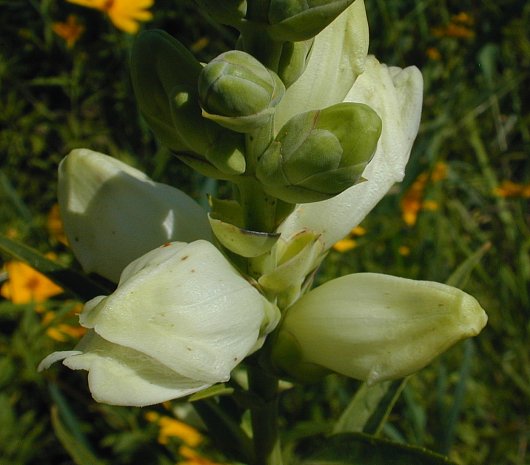
about 1¼" long, consisting of a 2-lipped white corolla, a green calyx
with 5 oval teeth, a slender white style, and 5 hairy stamens. Four of
these stamens have fertile anthers, while the remaining stamen
is sterile and green. The tubular corolla is somewhat flattened at the
mouth, where it is more wide than tall. The upper lip of the corolla
functions as a protective hood, while the lower lip has 2-3 shallow
lobes and functions as a landing pad for visiting insects. The lower
interior of the corolla has abundant white hairs. At the base of the
calyx, there are a few green bracts that resemble the sepals. The
blooming period occurs from late summer to fall and lasts about 1month.
There is no noticeable floral scent. Each flower is replaced by
an ovoid seed capsule containing several seeds that are flattened and
broadly winged; these seeds can be blown about by the wind and probably
float on water. The root system consists of a taproot and rhizomes.
Vegetative colonies may form as a result of these rhizomes.
Cultivation:
The preference is full or partial sun, wet to moist conditions, and a
fertile soil containing some organic matter. Temporary flooding is
tolerated. This plant can be maintained in gardens if it is watered
during dry spells.
Range &
Habitat:
The native White Turtlehead occurs occasionally in central and northern
Illinois,
but it is rare in the southern part of the state (see Distribution
Map). The typical variety of this species is more abundant
than var. linifolia. Habitats include open
woodlands in floodplain areas, thickets in floodplain areas, wet
prairies, sedge meadows, seeps, springs, marshes, and fens. These
habitats can be either sandy or non-sandy. White
Turtlehead is an indicator plant of fens, where the ground water ranges
from slightly acid to alkaline, but it occurs in other high quality
wetland habitats as well.
Faunal Associations:
The flowers are pollinated by nectar-seeking bumblebees; sometimes they
also attract the Ruby-Throated Hummingbird. In the northern half of
Illinois, White Turtlehead is the preferred host for caterpillars
of the butterfly Euphydryas phaeton phaeton
(Baltimore). This butterfly is fairly uncommon. Other insects that feed
on the foliage of White Turtle include leaf-mining larvae of
the flea beetle Diabolia
chelones, larvae of the sawfly Tenthredo grandis,
and larvae of the sawfly Macrophya
nigra. The seeds are eaten by larvae of the fly Phytomyza chelonei
and larvae of the polyphagous moth Endothenia
hebesana, while larvae of Papaipema nepheleptena
(Turtlehead Borer Moth) bore through the stems (Clark et al. 2004,
Smith 2006, Eastman, 1995). The foliage is bitter and usually avoided
by White-Tailed Deer and other mammalian herbivores.
Photographic
Location:
A prairie swale at Meadowbrook Park in Urbana, Illinois. In
some photographs, the plants with yellow flowerheads in the background
are Bidens polylepis.
Comments:
The interesting flowers of this species resemble the head of a turtle,
hence the common name. Because of these unique flowers, Chelone
spp. (turtleheads) are easy to distinguish from other groups
of plants. Among the turtleheads occurring in the Midwest, White
Turtlehead is unique in having white flowers (although they are
sometimes tinted light pink or pale purple). It also has more narrow
leaves than other turtleheads, which is especially pronounced in var.
linifolia, as illustrated in the photograph of the leaves.
The other turtlehead species that occurs in Illinois, Chelone
obliqua
(Pink Turtlehead), has pink flowers and broader leaves with longer
petioles (these petioles exceed ¼" in length). This species is uncommon
and usually occurs in damp wooded habitats.