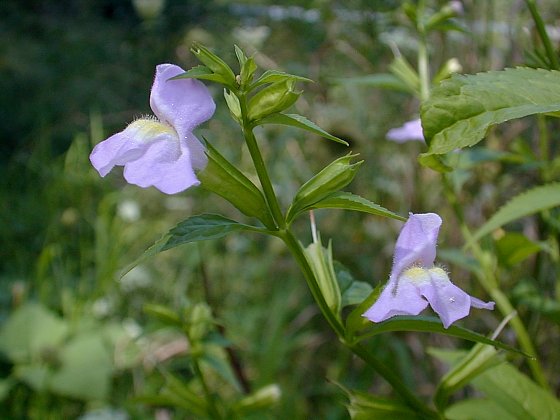
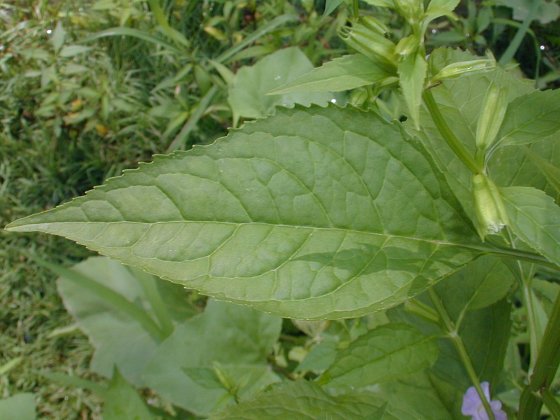
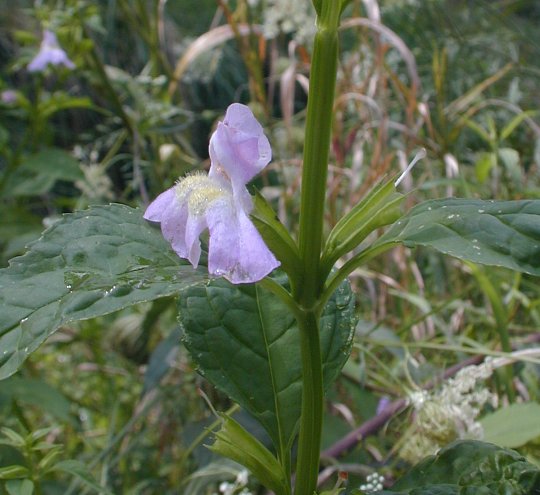
Description: This perennial plant is ½–3' tall, branching occasionally. The stems are glabrous, 4-angled, and more or less winged. The opposite leaves are up to 5" long and 2" across. They are ovate, lanceolate-ovate, or lanceolate, becoming smaller and more narrow where the flowers occur. The leaves are glabrous and either dentate or serrate along the margins their petioles are narrowly winged and about ½" in length or more. The flowers occur individually above the axils of the middle to upper leaves; their pedicels vary from nearly zero to ½" in length. Each flower is about 1" long, consisting of a two-lipped corolla and a tubular calyx. The throat of the corolla has a patch of yellow that is surrounded by a narrow band of white, otherwise it is pale violet or pink. The upper lip has a pair of lobes that fold backward laterally, while the lower lip has 3 well-rounded lobes that spread outward and function as a landing pad for visiting insects. The surface of the corolla is often covered with fine white hairs, particularly at the base of its throat. The light green calyx is about as long as the corolla and glabrous; it has 5 winged ridges along its length and 5 linear teeth along its outer rim.
The blooming
period occurs from mid-summer to early fall and
lasts about 1-2 months. Only a few flowers on a plant are in bloom at
the same; there is no floral scent. After the corolla falls off, the
persistent calyx surrounds a capsule containing several smooth seeds.
The root system is rhizomatous. Although this plant is not a strong
colonizer, clonal offsets are occasionally formed from the rhizomes.
Cultivation:
The preference is partial sun, wet to consistently moist conditions,
and rich soil containing an abundance of organic matter. Full
sun and light shade are also tolerated. When plants are grown in
conditions that are too dry and sunny, they remain small in size and
their foliage becomes yellowish green. Foliar disease is rarely a
problem.
Range &
Habitat:
The native Winged Monkeyflower is occasional in southern and central
Illinois, but
it is uncommon or absent in northern Illinois (see Distribution
Map). Habitats include openings in floodplain and bottomland
forests, swamps, seeps, edges of small rivers and drainage canals,
soggy areas of alluvial meadows, and roadside ditches. This plant is
somewhat conservative in its habitat preferences, but it can be found
in disturbed wetlands occasionally.
Faunal Associations:
The
nectar of the flowers attracts Bombus pensylvanica
and other bumblebees. Insects that feed destructively on Mimulus spp.
(Monkeyflowers) include caterpillars of the moth, Elaphria chalcedonia
(Chalcedony Midget), and caterpillars of the butterfly, Junonia coenia
(Buckeye). An aphid, Aphis
mimuli,
uses these plants as summer hosts. Little appears to be known about the
ecological relationships of these plants to vertebrate animals,
although they are large enough to provide some protective cover in
wetland areas.
Photographic
Location:
Within the floodplain of a small drainage canal at Judge Webber Park in
Urbana, Illinois.
Comments:
Winged Monkeyflower is a very attractive plant that can withstand
occasional flooding. It has a similar appearance to Mimulus
ringens (Monkeyflower) and it occurs in the same habitats.
Winged Monkeyflower differs from the latter species in the following
characteristics: 1) Its flowers are often pink rather than blue-violet,
2) Its leaves have narrowly winged petioles about ½" long or more,
while Mimulus ringens has sessile leaves, and 3)
The pedicels of its
flowers vary in length from nearly zero to ½" in length, while
Mimulus ringens has pedicels that are greater than
½" in length. Another monkeyflower that occurs in Illinois, Mimulus
glabratus fremontii (Yellow Monkeyflower), differs from the
preceding species by its smaller yellow flowers.