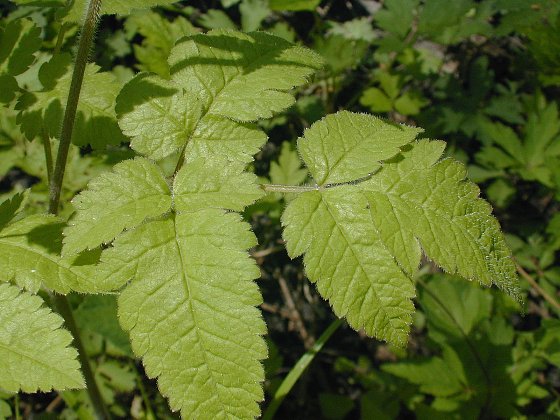
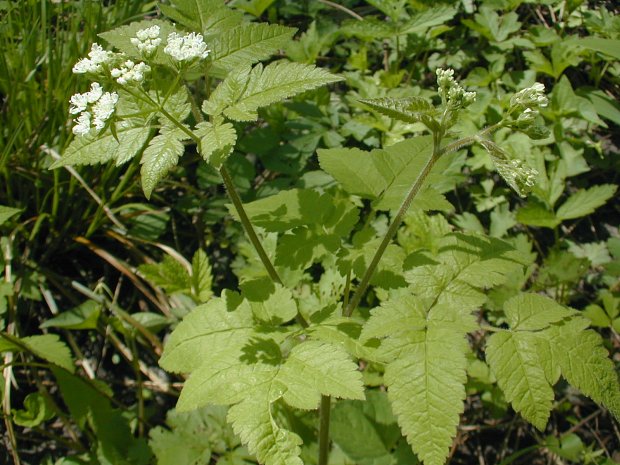
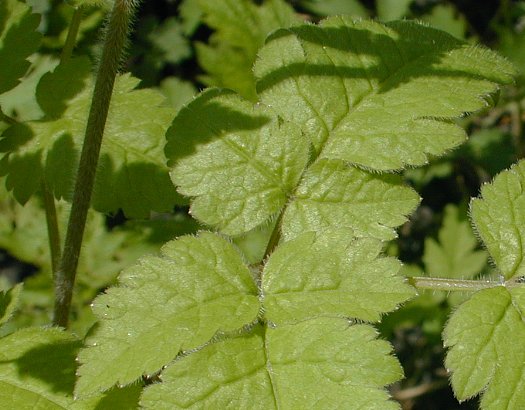
Description: This herbaceous perennial plant is about 1-2½' tall, branching occasionally. The stems are light green to reddish purple, terete, and glabrous (var. longistylis) to hairy (var. villicaulis). The alternate leaves are ternately compound; the lower compound leaves are up to 9" long and 9" across, while the upper compound leaves are much smaller in size. Each compound leaf is divided into 3 compound leaflets; the terminal compound leaflet is the largest. Each compound leaflet is further divided into 3 subleaflets; the terminal subleaflet is the largest, sometimes appearing to be divided into 3 even smaller subleaflets. The subleaflets are 1-4" long, ½-1½" across, and lanceolate to oval-ovate shape in shape; their margins are coarsely serrated-crenate or shallowly cleft. The upper subleaflet surface is yellowish green to green and nearly glabrous (var. longistylis) to moderately covered with appressed hairs (var. villicaulis).
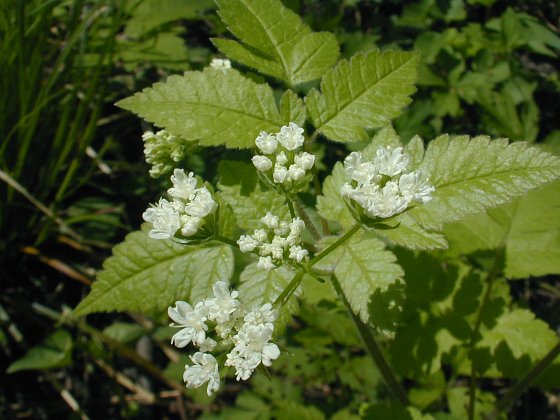
The petioles of compound leaves are light green to reddish purple and up to 6" in length. The petiolules of leaflets are light green to reddish green and up to 2" long, while those of subleaflets are nearly sessile to ¼" (6 mm.) long. The foliage of this plant releases a mild anise fragrance when it is rubbed. The upper stems terminate in compound umbels of white flowers about 1½-3" across. There are about 3-6 umbellets per compound umbel on rays (floral stalks) up to 2" long. An umbellet has 7-16 flowers that are clustered together on rays (floral stalklets) up to ¼" (6 mm.) long. Each flower (about 3 mm. across) has 5 white petals with incurved tips, 5 white stamens, a pistil with a divided white style (stylopodium), and an insignificant calyx that is light green. At the base of each compound umbel, there are several linear-lanceolate bracts with ciliate margins; they are up to 8 mm. in length. At the base of each umbellet, there are several linear-lanceolate bractlets with ciliate margins; they are also up to 8 mm. in length.
The
blooming period occurs during the late spring or early summer,
lasting about 2-3 weeks. Afterwards, the flowers are replaced by
2-seeded fruits (schizocarps). While these fruits are still immature,
the persistent divided style is 2.0-3.5 mm. in length (it is smaller
than this when the flowers are still in bloom). The small seeds are
narrowly ellipsoid-oblanceoloid, 5-ribbed, and slightly bristly along
their ribs.
The root system consists of a cluster of fleshy roots with a strong
anise fragrance.
Cultivation:
The preference is dappled sunlight to moderate shade, moist to
mesic conditions, and rich loamy soil with decaying organic matter. In
a garden situation, this plant will probably thrive in a sheltered area
underneath a deciduous tree.
Range & Habitat: The native Aniseroot occurs in most counties of central and northern Illinois, where it is occasional to locally common; in southern Illinois, it is uncommon or absent (see Distribution Map). This map combines information for both varieties of Aniseroot; the typical variety is slightly more common than the hairy variety (var. villicaulis). Habitats include moist to mesic deciduous woodlands and gentle slopes of wooded ravines, where a variety of deciduous trees are dominant. Aniseroot can be found in average to high quality natural areas.
Faunal
Associations:
The nectar and pollen of the flowers attract small to medium-sized
bees, wasps, beetles, and flies, including cuckoo bees (Nomada spp.),
mason bees (Osmia spp.),
Halictid bees (Agapostemon
spp.,
Augochloropsis spp.,
Halictus spp.,
Lasioglossum spp.),
masked bees
(Hylaeus spp.),
Syrphid flies, bee flies (Bombyliidae), dance flies
(Empis spp.),
Tachinid flies, and Anthomyiid flies. The caterpillars of
the butterfly Papilio polyxenes asturias (Black
Swallowtail) feed on the foliage. The slightly bristly seeds
may cling
to the fur of mammals, the feathers of birds, and the clothing
of humans to some extent, dispersing them to new locations.
Photographic Location:
A mesic deciduous woodland at Busey Woods in Urbana, Illinois.
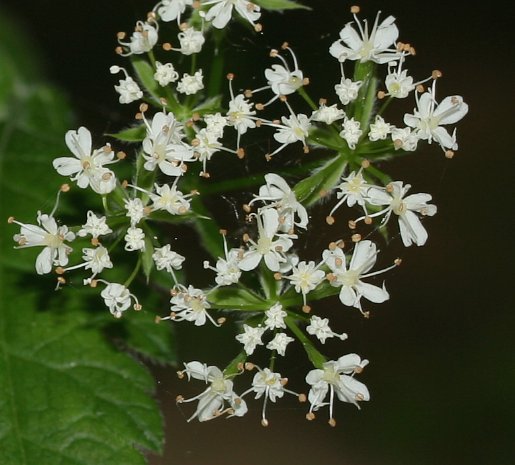
Comments: Aniseroot (Osmorhiza longistylis) can be distinguished from many similar species in the Carrot family by the anise fragance of its foliage and roots. This species closely resembles Sweet Cicely (Osmorhiza claytonii) and they are often confused with each other. However, Sweet Cicely has only 4-7 flowers per umbellet, while Aniseroot has 7-16 flowers per umbellet. While the fruits of these two species are still immature, the persistent styles of Sweet Cicely are 1.0-2.0 mm. in length, while the persistent styles of Aniseroot are 2.0-3.5 mm. in length. The foliage and roots of Aniseroot have a stronger anise scent than those of Sweet Cicely, and its root can be used as a substitute for black licorice.