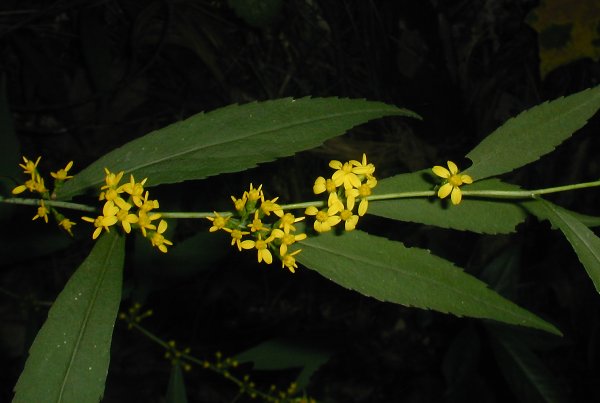
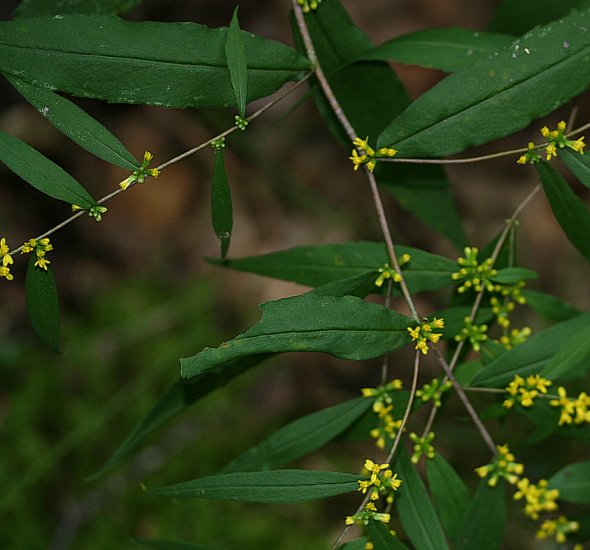
Description: This herbaceous perennial wildflower is about 1½–3' tall and either unbranched or sparingly so. The central stem usually leans over to one side; it is terete, glabrous, and light green while young, however sometimes it becomes blue-gray or burgundy-gray and glaucous with age. Along the central stem and any lateral stems there are alternate leaves up to 5" long and ¾" across; these leaves become gradually smaller as they ascend the stem(s). The leaves are medium to dark green, elliptic-oblong to elliptic in shape, smooth to serrated along their margins (usually the latter), hairless or nearly so, and sessile. The upper surface of each leaf has a prominent central vein and faint lateral veins. At the axils of the middle to upper leaves, there develops small clusters of 1-12 flowerheads. In addition, the central stem may terminate in a small panicle of flowerheads up to 3" long and 1½" across.
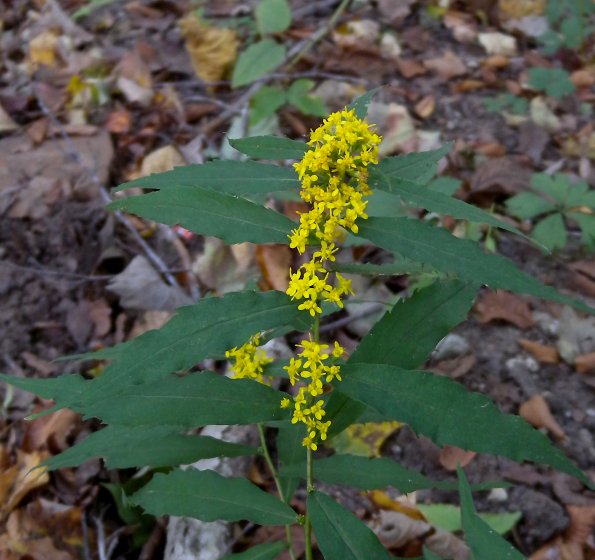
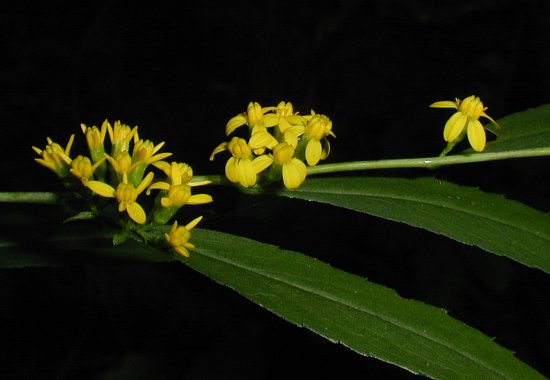
Each flowerhead is about 3 mm. (1/8") across or a little wider, consisting of 4-5 ray florets that surround a similar number of disk florets. The short-tubular corollas of the disk florets are golden yellow and 5-lobed. The petaloid rays are yellow and elliptic-oblong in shape. Around the base of each flowerhead, there are light to medium green bracts (phyllaries) in about 3 overlapping series; these bracts are glabrous and oblong in shape. The short pedicels of the flowers and the branches of any terminal inflorescence are light to medium green, terete, and hairless or nearly so. The blooming period occurs from late summer into the fall, lasting about 1 month. Fertile florets are replaced by small bullet-shaped achenes that are finely pubescent; each achene has a small tuft of hairs. The achenes are distributed by the wind. The root system is fibrous and rhizomatous. Occasionally, small loose colonies of plants will develop at favorable sites.
Cultivation:
The preference is medium shade to partial sun, mesic to dry-mesic
conditions, and soil that contains loam, clay-loam, or some rocky
material. During dry weather, some of the lower leaves may
wither away, otherwise they usually remain in good condition.
Range & Habitat:
The native Blue-Stemmed Goldenrod is occasional in the far eastern,
southern, and west-central areas of Illinois, but it is rare or absent
elsewhere in the state (see Distribution
Map). Illinois lies along the western
range-limit of this species; it is more common in Indiana and other
eastern states. Habitats include upland woodlands, woodland openings,
bluffs, upper slopes of ravines, and rocky cliffs in shaded or
partially shaded areas. This species is usually found in higher quality
habitats consisting of upland woodland areas where deciduous trees
(especially oaks) are dominant.
Faunal Associations: The nectar and pollen of the flowers can attract a wide variety of insects, especially short-tongued bees, wasps, and flies. The caterpillars of Gnorimoschema gallaeastrella and other species of moths feed on goldenrods (see Moth Table). Blue-Stemmed Goldenrod is one of the host plants of the leaf beetle Microrhopala xerene, the leafhopper Prescottia lobata, and the larvae of such polyphagous leaf-miner flies as Calycomyza jucunda, Nemorimyza posticata, and Ophiomyia texana. Other insects that feed on goldenrods (Solidago spp.) include aphids, treehoppers, spittlebugs, plant bugs, stink bugs, the larvae of fruit flies, and grasshoppers. The seeds of goldenrods are eaten sparingly by the Indigo Bunting, Slate-Colored Junco, Tree Sparrow, Eastern Goldfinch, and other songbirds. White-Tailed Deer are especially likely to feed on the foliage of goldenrods in woodlands.
Photographic
Location:
A rocky upland woodlands in west-central Indiana.
Comments:
This distinctive goldenrod is both elegant and shade-tolerant. Of the
many goldenrod species that occur in Illinois, only two species produce
primarily axillary clusters of flowers: Blue-Stemmed Goldenrod
(Solidago caesia)
and Zigzag Goldenrod (Solidago flexicaulis).
Blue-Stemmed Goldenrod is typically found in upland woodlands,
while Zigzag Goldenrod is more often found in lowland
woodlands. Zigzag Goldenrod has much wider leaves (exceeding 1¼"
across) that are ovate and coarsely serrated; the leaves of this latter
species have petioles, while the leaves of Blue-Stemmed Goldenrod are
sessile. Blue-Stemmed Goldenrod sometimes develops glaucous stems that
are blue-gray or burgundy-gray, while the stems of Zigzag Goldenrod are
consistently green.