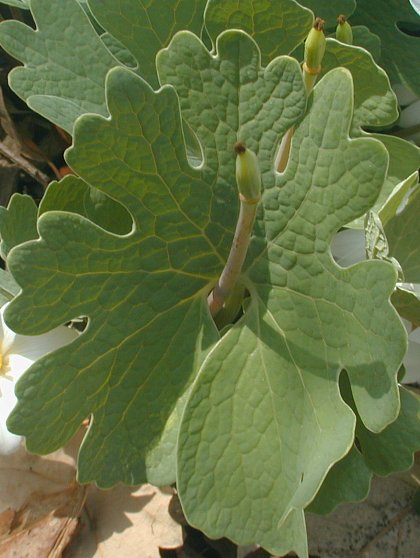
Description: Depending on its stage of development, this herbaceous perennial plant is about 3-12" tall. It produces only basal leaves that are about 3-5" wide and across. Each of these basal leaves is wrapped around the stalk of a single flower (sometimes two stalks are produced) as the flower begins to bloom. The basal leaves continue to unfold to their fullest extent as the flowers wither away. Each basal leaf is oval-orbicular in outline and palmate-reticulately veined, with 5-9 major lobes and several minor lobes along the undulating margins. The palmate-reticulate venation is fairly prominent and provides the rather succulent leaves with a wrinkly appearance, especially on their lower surfaces. The color of the leaves on the upper surface is light green, sometimes with greyish or bluish tints, while the lower surface is whitish green. The terete petioles are about 4" long and rather stout. The foliage of this plant is glabrous and glaucous.
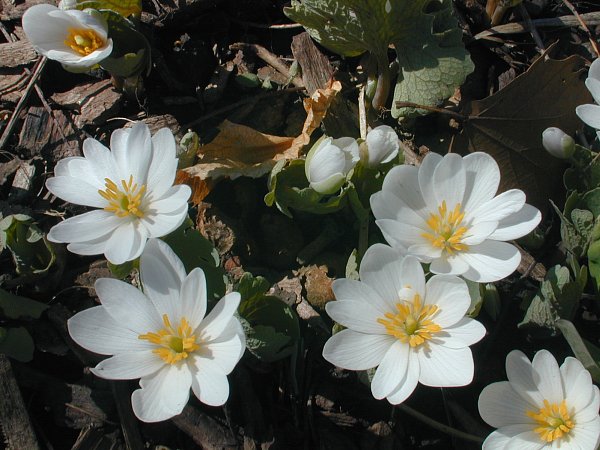
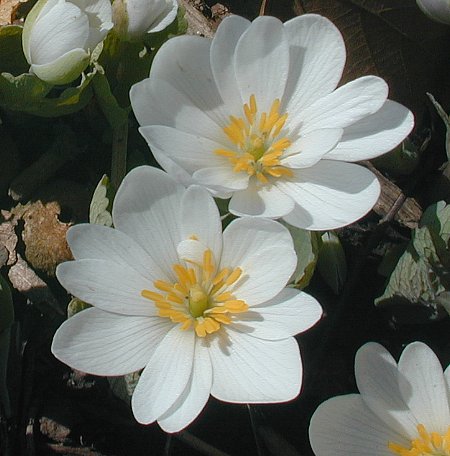
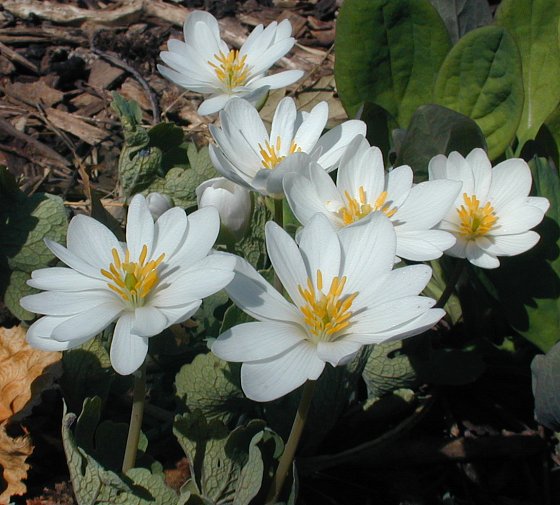
The flowering stalk is terete, stout, glabrous, and sometimes slightly reddish, terminating in a single large flower. This stalk is about 3-4" tall when the flower begins to bloom. The flower is about 1½–3" across, consisting of 8-16 white petals, a green oval pistil, and numerous stamens with prominent yellow anthers. The pistil has a pale yellow stigma at its apex. There are 2 light green sepals that are nearly as long as the petals, but they fall off the flowering stalk as soon as the flower begins to bloom. The blooming period occurs from early to mid-spring, lasting about 2 weeks. Each flower remains in bloom for only 1 or 2 days (when it is sunny), producing a fragrant scent. Afterwards, each flower is replaced by a seed capsule that becomes enlarged and eventually turns yellow, splitting open to release its seeds. The root system consists of thick reddish rhizomes with coarse fibrous roots. Both the foliage and the rhizomes contain an acrid reddish juice. This plants often forms vegetative colonies.
Cultivation:
During early to mid-spring, this plant should have access to
some sunlight, otherwise the flowers may fail to open. After the trees
begin to form leaves later in the spring, considerable shade is
tolerated. The soil should be fertile and loamy, with average moisture
levels (by woodland standards). The foliage is not affected by disease
significantly, although it will gradually wither away as the summer
progresses.
Range & Habitat:
Bloodroot is a common plant that occurs in most counties of Illinois
(see Distribution
Map), where it is native. Habitats include rich deciduous
woodlands, wooded slopes, edges of bluffs, shaded ravines, banks of
rivers in wooded areas, and areas along woodland paths.
Faunal Associations: The pollen of the flowers attracts various kinds of bees, including honeybees, bumblebees, little carpenter bees (Ceratina spp.), Halictid bees (Halictus spp., Lasioglossum spp.), and Andrenid bees (Andrena spp.). Other insects that visit the flowers include Syrphid flies and beetles, which feed on the pollen (or search vainly for nectar). An aphid, Linosiphon sanguinarium, sucks plant juices from the leaf undersides. The seeds of Bloodroot are distributed by ants because of their fleshy appendages. This is a common method of seed distribution for woodland wildflowers, as wind speeds are greatly reduced in wooded areas. The foliage and rhizomes contain an acrid reddish juice and they are toxic. Consequently, this plant is not often eaten by mammalian herbivores, although White-Tailed Deer browse sparingly on the succulent leaves.
Photographic
Location:
A partially-shaded flower garden near Busey Woods in Urbana, Illinois.
Comments:
Bloodroot is one of the spring ephemerals of deciduous woodlands. It
has very showy flowers and unusual-looking, but attractive, foliage.
Unfortunately, the flowers are relatively short-lived. Across
different localities, there are significant variations in this plant,
involving such characteristics as the number of petals and size of the
flowers, and the appearance of the foliage. On rare occasions, light
pink flowers are produced. The Amerindians created a red dye from the
juice of the rhizomes. The juice of plants in this genus possesses
anti-bacterial properties with possible pharmaceutical applications,
including an anti-plaque mouthwash.