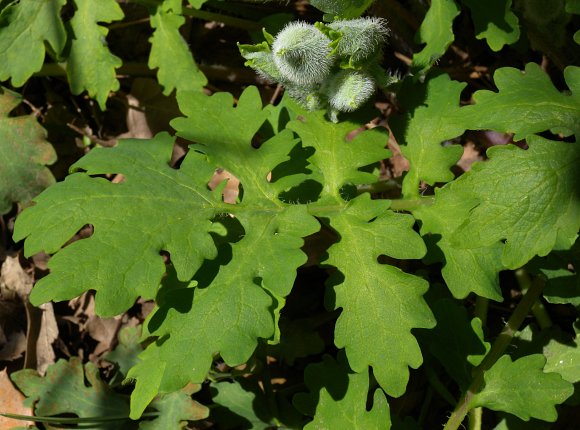
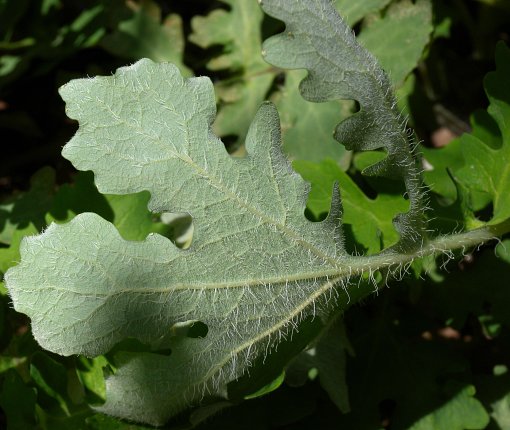
Description: This herbaceous perennial plant is 1-1½' tall, consisting of both basal leaves and a flowering stem with a pair of opposite leaves. The erect to ascending stem is light green, terete, and conspicuously hairy. Both types of leaves are up to 6" long and 4" across (excluding the petioles); they are bipinnatifid, consisting of 1-3 pairs of primary lateral lobes and a primary terminal lobe. The primary lateral lobes are up to 2" long and 1" across, while the primary terminal lobe is up to 2" long and 2" across. Both types of lobes have shallow to moderately deep secondary lobes with rounded tips. For mature leaves, the upper leaf surface is yellowish green to dark green and glabrous, while the lower leaf surface is pale green and pubescent to hairy. Immature leaves may have short appressed hairs on their upper surfaces. The petioles of the leaves are up to 4" long and sparsely hairy. There is little difference in the appearance of the basal and opposite leaves, although the latter have shorter petioles. The foliage contains a yellow-orange sap.
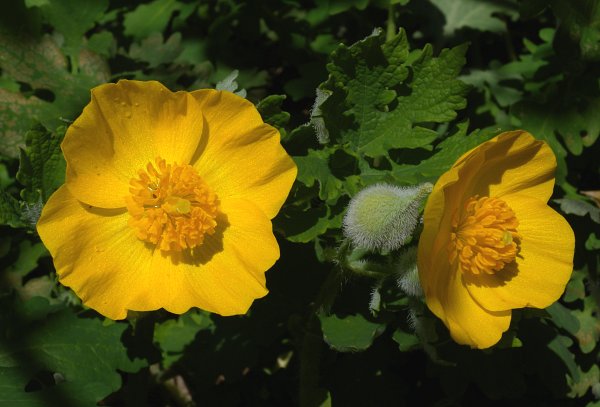
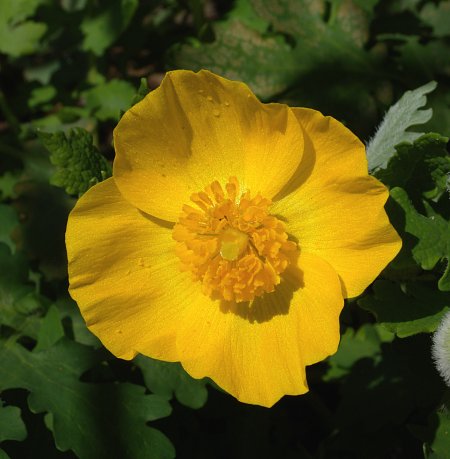
The upper stem terminates in either an individual flower or an umbel of 2-4 flowers. Each flower is about 1¼-2¼" across, consisting of 4 yellow petals, 2 early-deciduous sepals, numerous stamens with golden yellow anthers, and a pistil with a single stout style and knobby stigma. The petals are orbicular-obovate in shape, while the sepals are light green and very hairy. The ovary of the pistil is ¼-½" in length, narrowly ovoid in shape, more or less yellow, and finely hairy. The pedicels are ¼-2" long, light green, hairy, and terete; they are ascending to erect while the flowers are in bloom. The blooming period occurs from mid- to late spring, lasting about 2-3 weeks. In the absence of insect pollination, the flowers can self-pollinate. Shortly afterward, the flowers are replaced by ovoid seed capsules about ¾-1" long that nod from their pedicels; these capsules are 4-segmented and densely hairy. Numerous seeds are released after each capsule splits apart. They are dark brown and about 1.5 mm. in diameter; there is a white fringe of oil bodies (elaisomes) along one side of each seed. The root system consists of a woody caudex with coarse fibrous roots.
Cultivation:
The
Celandine Poppy should be grown in dappled sunlight underneath a tree,
or along the foundation of a building in partial shade. It adapts best
to rich loamy soil and moist to mesic conditions. Most vegetative
growth and development occurs during the spring before the trees fully
leaf out. This plant adapts to flower gardens readily.
Range & Habitat:
The
native Celandine Poppy is an uncommon plant that occurs primarily in
southern Illinois; it has also been observed in Vermilion and Cook
counties further to the north (see Distribution
Map).
Habitats include mesic deciduous woodlands, lower slopes of
ravines, bases and lower slopes of bluffs, and rocky banks of
streams. The Celandine Poppy is found in high quality woodlands; it is
one of the woodland wildflowers that is threatened by the invasion of Alliaria
petiolata (Garlic Mustard) and Microstegium vimineum
(Japanese Stiltgrass).
Faunal
Associations:
Little is known about the floral-faunal relationships for this species.
The flowers provide only pollen as a reward to floral visitors. MacRae
(1991) has observed adults of some metallic wood-boring beetles
(Acmaeodera spp.)
visiting the flowers. It is also likely that the
flowers are visited by various bees and flies. The seeds are
distributed to new locations by ants, which are attracted to their oily
appendages (elaisomes). Woodland mice eat the seeds. The toxic foliage
is avoided by mammalian herbivores.
Photographic Location:
A flower garden in Urbana, Illinois.
Comments: The Celandine Poppy has attractive flowers and foliage. It resembles another species of the Poppy family, Celandine (Chelidonium majus), but the latter has yellow flowers that are smaller in size (¾" across or less) and its seed capsules are hairless, narrowly cylindrical, and erect. Celandine is a somewhat weedy species that was introduced from Europe; it is a biennial that blooms during the summer. Other species of the Poppy family in Illinois have flowers that are white, pink, orange-red, or purplish red. Most of these species have been introduced from Eurasia, although one of them, Bloodroot (Sanguinaria canadensis) is native to Illinois. Another common name of Stylophorum diphyllum is the Wood Poppy.