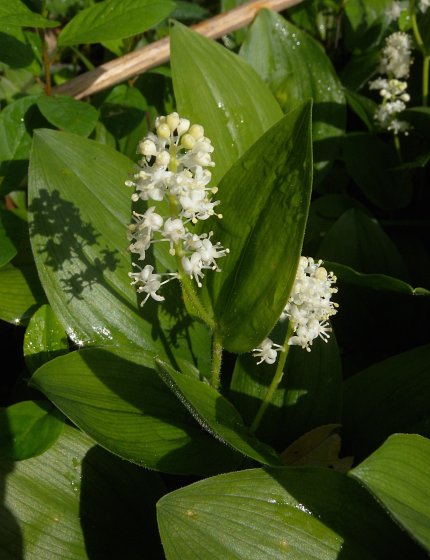
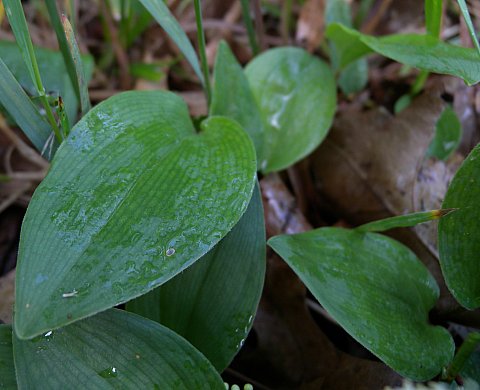
Description: This herbaceous perennial wildflower is 3-8" tall. An infertile shoot usually consists of a single basal leaf, while a fertile shoot consists of a flowering stalk with 2 alternate leaves (less often, there are 3 leaves). Both basal and alternate leaves are similar in appearance, although the former have petioles up to 2" long. The leaves are up to 3" long and 2" across, smooth (entire) along their margins, and ovate-oblong to oval in shape. Leaf venation is parallel. The upper leaf surface is medium green and glabrous, while the lower leaf surface is pale green and finely pubescent. Unlike var. interius, the typical variety of Canada Mayflower has leaves without hairs. The base of each alternate leaf is clasping, sessile, or short-petioled. The central stalk is light to medium green, terete, and glabrous or hairy. At the apex of each flowering stalk, there is a short-cylindrical raceme of flowers about 1-2" long.
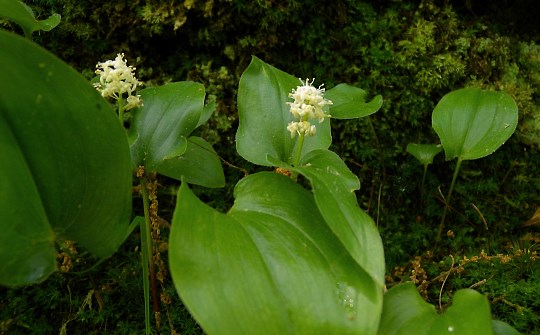
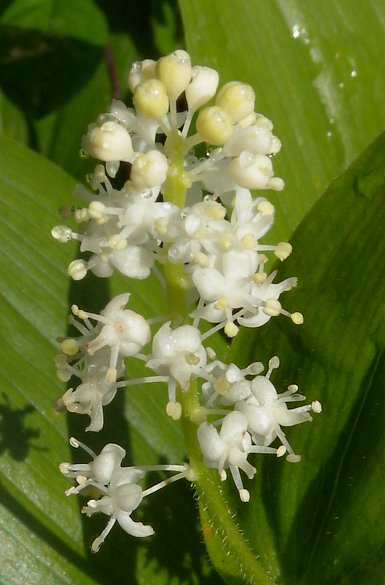
The flowers typically occur in pairs along the raceme on slender pedicels. Individual flowers have 4 white tepals, 4 stamens with white filaments and pale yellow anthers, and a white to greenish white pistil with a pair of knobby stigmata. The tepals are lanceolate and strongly recurved, fully exposing the reproductive organs. Each flower is a little less than ¼" (6 mm.) across. The blooming period occurs from late spring to early summer. The flowers are fragrant. During the summer, fertile flowers are replaced by globoid berries that are individually a little less than ¼" (6 mm.) across. At maturity, these berries are speckled pale red, and each berry typically contains 2 seeds. The root system is rhizomatous and fibrous. Vegetative colonies are often formed via the rhizomes. In a typical colony, infertile shoots usually outnumber flowering fertile shoots.
Cultivation:
The
preference is dappled sunlight to moderate shade, moist to slightly dry
conditions, high humidity, and cool temperatures. This wildflower
adapts to an acidic soil containing peat, sand, or rocky material
(e.g., sandstone). It doesn't tolerate much competition from taller
plants.
Range & Habitat:
The native Canada Mayflower is uncommon in Illinois; it is restricted
to the
northern section of the state (see Distribution
Map). Illinois lies at the southern range limit of this
largely boreal species; it is more common further to the north in the
Great Lakes region and further to the northeast in New England. The
western variety of Canada Mayflower, var. interius,
is far more common within the state than the more eastern typical
variety. Habitats include sandy meadows, sandy thickets, sandy
woodlands, north-facing wooded slopes, shaded bogs, and sandstone
ledges along ravines in wooded areas. In Illinois, Canada Mayflower is
associated with high quality natural areas.
Faunal Associations: The flowers are cross-pollinated by small bees, flies, and beetles. These floral visitors include Halictid bees (Halictus spp., Lasioglossum spp.), Andrenid bees (Andrena spp.), Syrphid flies, bee flies (Bombylius spp.), and Anthomyiid flies. No nectar is available to floral visitors. The bees collect pollen, while the flies and beetles feed on pollen. The foliage is consumed by the introduced Lilioceris lilii (Lily Leaf Beetle), while the larvae of a fly, Dasineura toronotensis, cause fusiform galls to develop on the roots. The berries are eaten by the Ruffed Grouse, White-Footed Mouse, and Eastern Chipmunk; these animals (particularly the Ruffed Grouse) help to spread the seeds of this plant into new areas.
Photographic
Location:
The photographs were taken at a sandstone ledge along a wooded ravine
at the Fall Creek Gorge in
west-central Indiana (also known as 'The Potholes'), and in a sandy
thicket at the Irwin Prairie State Nature Preserve in NW Ohio.
Comments:
This dainty wildflower resembles a dwarf Smilacina racemosa
(False Solomon's Seal) or a dwarf Smilacina stellata
(Starry Solomon's Plume). Unlike the preceding species, flowering
stalks of Canada Mayflower typically have only 2 leaves. Another common
name is False Lily-of-the-Valley. Among species of the Lily family,
Canada Mayflower is very unusual in having only 4 tepals and 4 stamens
per flower – other plants in this family typically have flowers with 6
tepals and 6 stamens.