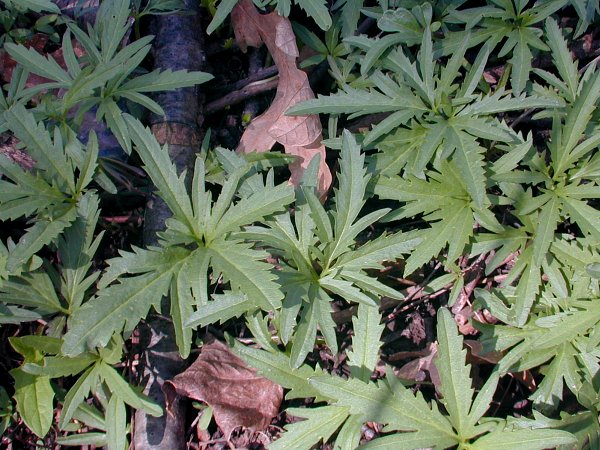
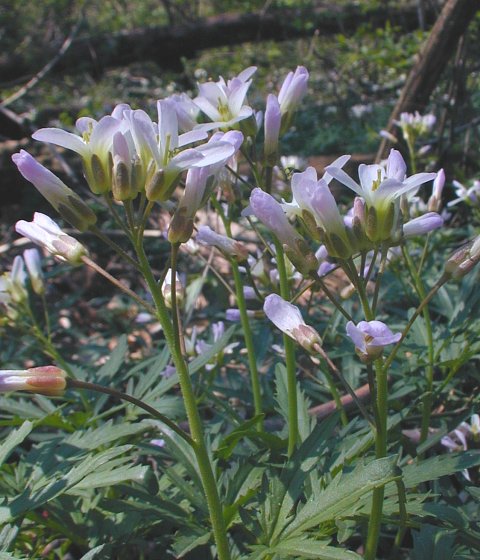
Description: This herbaceous perennial plant is about 3-10" tall, producing from its rootstock both basal leaves and fertile shoots with cauline leaves. The basal leaves are separate from the fertile shoots; they help to store energy for next year's fertile shoots. A fertile shoot consists of a single flowering stalk with a whorl of 3 leaves. Each leaf is up to 3" long and across, but palmately cleft into 3-5 narrow lobes with dentate teeth along the margins. The basal leaves have a similar appearance to the cauline leaves; both types of leaves are greyish green to medium green and largely hairless. The central stalk is greyish green to medium green, glabrous or slightly pubescent, terete, and unbranched. This stalk terminates into a short raceme of white flowers that becomes longer as it matures. This inflorescence is rather floppy; the flowers open up and become more erect in the presence of sunshine on warm spring days.
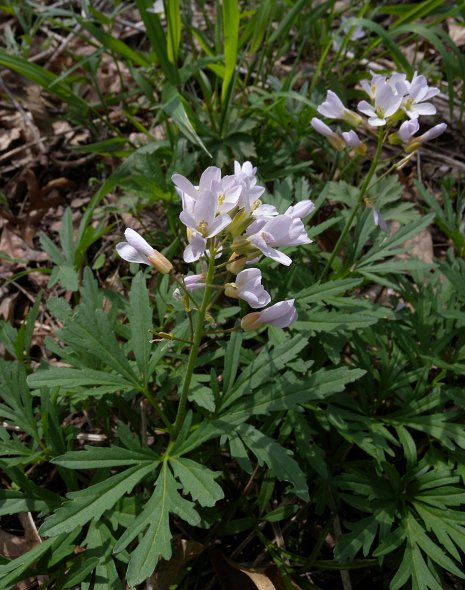
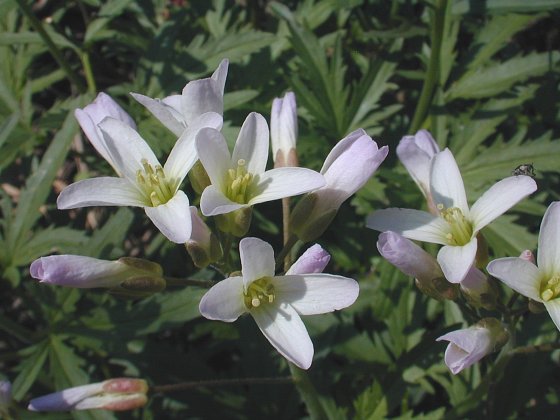
Each flower is about ½" across when fully open, consisting of 4 predominately white petals, 4 green or purple sepals, several stamens with conspicuous yellow anthers, and a single pistil. The petals are lanceolate-oblong and sometimes tinted with pink or light purple. The sepals are oblong and shorter than the petals. The slender pedicels are at least as long as the flowers; they are light green to purplish green and terete. The blooming period occurs during mid-spring and lasts about 2 weeks. The flowers are quite fragrant. Each flower is replaced by an elongated seedpod that has a short beak (i.e., a silique); this seedpod is held more or less erect. The seeds are arranged in a single row within the seedpods; they are ovoid and somewhat flattened in shape. The root system produces fleshy rhizomes that are jointed and knobby; they are parallel to the surface of the ground and fairly shallow. In addition to these rhizomes and their secondary roots, the root system produces small fleshy tubers. This plant often forms vegetative colonies from its spreading rhizomes; it also reproduces by seed.
Cultivation:
Its
easiest to start plants from pieces of the rhizome. These should be
planted a little below the surface of the ground in an area with sparse
ground cover that receives shade during the summer. Cutleaf Toothwort
develops quickly and it is one of the earlier spring wildflowers of
woodlands. The foliage turns yellow and fades away by the end of
spring. This plant typically grows in dappled sunlight before the trees
leaf out; it prefers moist to mesic conditions and a rich
loamy soil with decaying leaves.
Range & Habitat:
The native Cutleaf Toothwort is a common plant that occurs in nearly
every county of Illinois (see Distribution
Map).
Habitats include
deciduous mesic woodlands, floodplain woodlands, wooded
bluffs, and upland savannas. The presence of this species in a
woodlands indicates that its soil has never been plowed under or
subjected to heavy construction activities. However, this species can
survive some disturbance caused by occasional grazing and less
disruptive activities of human society. When the introduced Alliaria
petiolata (Garlic Mustard) invades a woodlands, this is one
of the spring wildflowers that declines in abundance.
Faunal Associations: The nectar of the flowers attracts both long-tongued and short-tongued bees, including honey bees, bumblebees, mason bees (Osmia spp.), cuckoo bees (Nomada spp.), Halictid bees (Halictus spp., Lasioglossum spp.), and Andrenid bees (Andrena spp.). Less often, the nectar of the flowers attracts early spring butterflies and Bombylius major (Giant Bee Fly). Short-tongued bees also collect pollen from the flowers. Caterpillars of the butterflies Pieris napi oleraceae (Mustard White) and Pieris virginiensis (West Virginia White) feed on the foliage of Dentaria spp. (Toothworts); however, the former butterfly has not been observed in Illinois since the late 19th century, while the latter butterfly is found in areas that are SE of the state. Other insect feeders include the flea beetles Phyllotreta bipustulata and Phyllotreta zimmermanni. The tubers of Toothworts were a minor food source of Ectopistes migratorius (Passenger Pigeon); this bird species became extinct in the United States during the early 20th century.
Photographic
Location:
An upland savanna in McLean County, Illinois, and a
mesic woodland in Urbana, Illinois.
Comments:
Cutleaf Toothwort is the only native Dentaria sp.
(Toothwort) in Illinois. Other species of Toothwort can be
found in areas to the east and north of Illinois, including Indiana.
The species Dentaria diphylla (Two-Leaved
Toothwort) has been observed in Kane County, Illinois, where it is
probably adventive. This latter species has two cauline leaves on each
flowering stalk, while Cutleaf Toothwort usually has three. Both the
basal and cauline leaves of Two-Leaved Toothwort have broader lobes
than those found on the leaves of Cutleaf Toothwort. Some authorities
have merged the Toothworts into the genus Cardamine (Bitter Cress), in
which case the scientific name of Cutleaf Toothwort is Cardamine
concatenata.