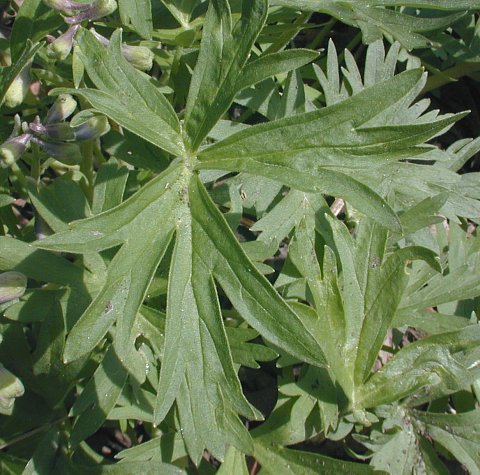
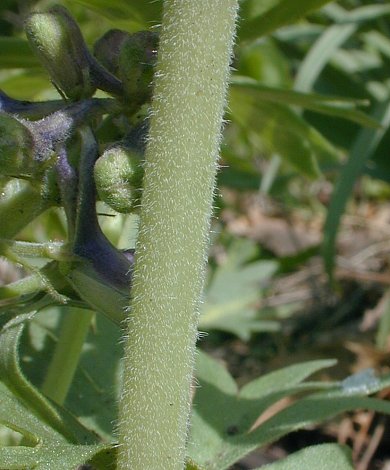
Description: This herbaceous perennial plant is about ½–1½' tall. It consists of a loose cluster of basal leaves on long petioles and a flowering stalk with a few alternate leaves. The basal leaves are up to 4" long and across; they are palmately cleft into about 5 deep lobes, which are in turn divided into 2-3 shallow secondary lobes. These leaves are usually sparsely pubescent and they may have a few dentate teeth along the margins. Their petioles are pubescent or hairy and rather stout. The alternate leaves are clustered near the base of the flowering stalk and they are few in number; their appearance is similar to the basal leaves. Both the basal and alternate leaves are pale greyish green to green. The flowering stalk is more or less erect, terete, stout, and rather fleshy. This stalk is whitish green or whitish red and it is usually covered with fine white hairs; less often, it is glabrous. A raceme of flowers about 3-8" long occurs at the apex of this stalk; each raceme has 6-24 flowers.
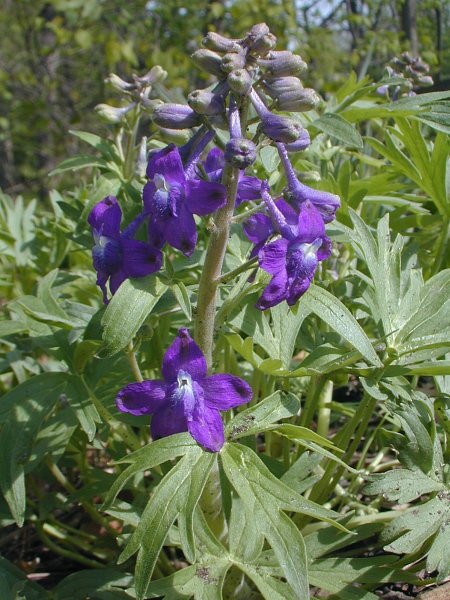
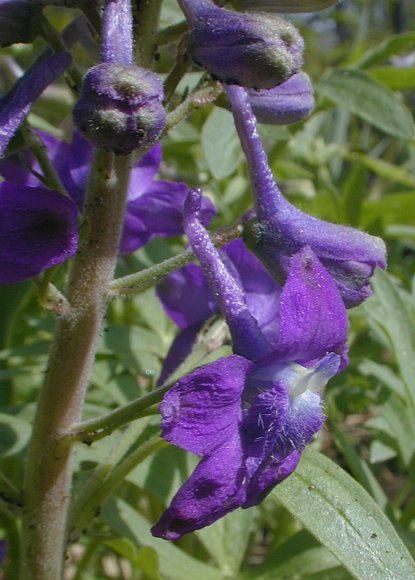
Each flower is about ¾–1" across, consisting of 5 petal-like sepals, 4 petals, 3 inner pistils, and stamens. The sepals spread outward from the center of the flower and they are usually some shade of purple or blue-violet; far less often, they are white. The upper sepal forms a long nectar spur behind the rest of the flower; this spur angles upward and it is fairly straight. A few cobwebby hairs may occur along the nectar spur and the posterior surface of the sepals. The upper two petals are quite small and usually white toward the base; they extend backward into the nectar spur. The lower two petals are quite hairy and usually purple or blue-violet like the sepals. These small petals surround the whitish opening that leads to the nectar spur. The pedicels are up to ¾" long and they are usually pubescent. The blooming period occurs during the late spring, lasting about 3 weeks. Each fertile flower is replaced by three spreading follicles (a seed capsule that splits open along one side). Each follicle is oblongoid and angular, terminating in a short beak; it contains several chunky seeds. The root system is tuberous and can form clonal offsets.
Cultivation:
The preference is light dappled shade or partial sun, mesic to slightly
dry conditions, and soil containing loam, clay-loam, or rocky
material. Vegetative growth and flowering proceed quickly during the
spring. This wildflower can be cultivated successfully in gardens.
Range & Habitat:
The native Dwarf Larkspur occurs occasionally in the southern half of
Illinois, while in the upper half of the state it is uncommon or absent
(see Distribution
Map). Illinois lies along the upper range limit of
this species. Habitats include mesic woodlands, moist ravines
and thinly wooded slopes (often rocky), thinly wooded bluffs,
and partially shaded cliffs along river banks. This species displays a
preference for hilly deciduous woodlands.
Faunal
Associations:
The flowers are cross-pollinated by long-tongued bees primarily,
including bumblebees, Anthophorid bees (Anthophora spp., Ptilothrix bombiformis,
Synhalonia speciosa),
and miner bees (Osmia
spp.). These insects suck nectar and sometimes collect
pollen. Other floral visitors include the Ruby-Throated Hummingbird,
Giant Bee Fly (Bombylius
major), swallowtail butterflies (Papilio spp.),
other butterflies, skippers, and Sphinx moths. However, the bee fly,
butterflies, skippers, and moths are probably less effective
pollinators. Insect that feed destructively on Spring Larkspur and
other larkspurs (Delphinium
spp.) include the aphid Brachycaudus rociadae
(found on stems & leaves), flower-eating caterpillars of the
moth Heliothis phloxiphagus (Dark-spotted Straw),
and
maggots of a leaf-miner fly, Phytomyza aconiti. The
foliage of Dwarf Larkspur is toxic to most
mammalian herbivores.
Photographic Location:
A wildflower garden at Crystal Lake Park in Urbana, Illinois.
Comments: The attractive flowers have the shape of the little starmen in children's cartoons. Dwarf Larkspur is shorter and blooms earlier than other Delphinium spp. – this is an adaptation to its woodland habitat. It is distinctive in having 3 widely spreading follicles per flower, while many other Delphinium spp. have follicles that are more or less united at the base. There is some variation in color of the flowers, appearance of the leaves, and hairiness of the stalks and leaves across different populations of Dwarf Larkspur. The only other species in this genus that is native to Illinois, Delphinium carolinianum (Tall Larkspur), consists of an eastern subspecies with pale blue to blue-violet flowers and a western subspecies with pale blue or white flowers (the latter subspecies is often called Prairie Larkspur). Compared to Dwarf Larkspur, Tall Larkspur has more finely divided leaves. Various larkspurs (Delphinium spp.) are often cultivated in flower gardens, but they are usually native to areas that lie west of Illinois, or they are annual species (Consolida spp.) from the Mediterranean area of Europe.