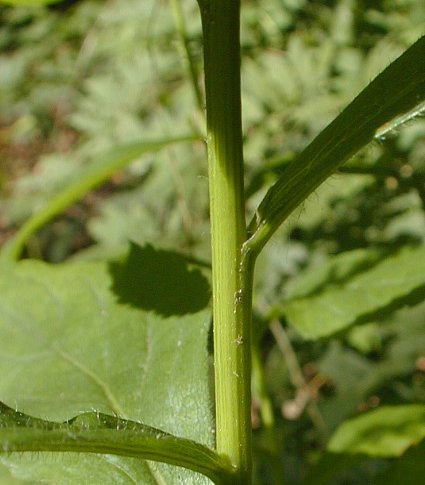
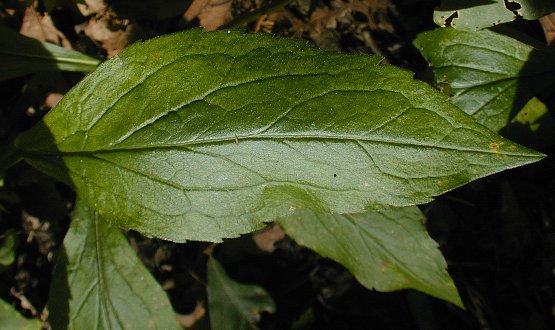
Description: This herbaceous perennial plant is about 1¼-3' tall and usually unbranched, except toward the apex where the flowers occur. The central stem is light green, terete, and glabrous to slightly hairy. The alternate leaves are up to 4" long and 1¾" across, becoming gradually smaller as they ascend the stems. They are lanceolate to ovate, serrated along their margins, and pinnately veined. The upper leaf surface is medium green and glabrous to sparsely short-pubescent, while the lower surface is light green and mostly glabrous, except for some hairs along the major veins. The bases of lower leaves taper into short winged petioles, while the bases of upper leaves are sessile. The tips of leaves are mostly acute (less often bluntly acute). The central stem terminates in a panicle of flowerheads up to 1' tall and 1' across. The major branches of this panicle are arching, widely spreading, and racemose (raceme-like in appearance). The flowerheads are borne on short lateral branchlets along the major branches, facing upward; they are nearly sessile. Both the branches and branchlets are light to medium green and pubescent. The panicle is rather open in structure and it often causes the entire plant to lean over because of the weight of the flowerheads.
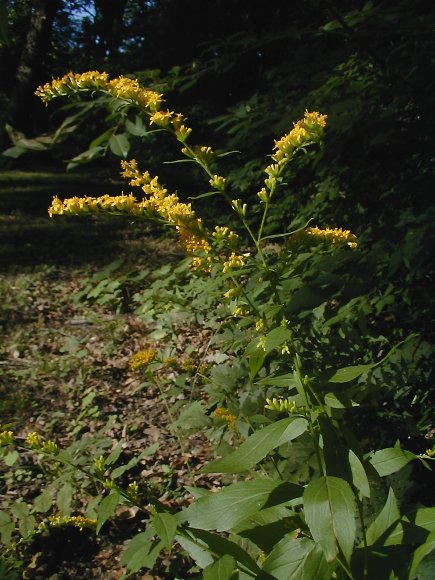
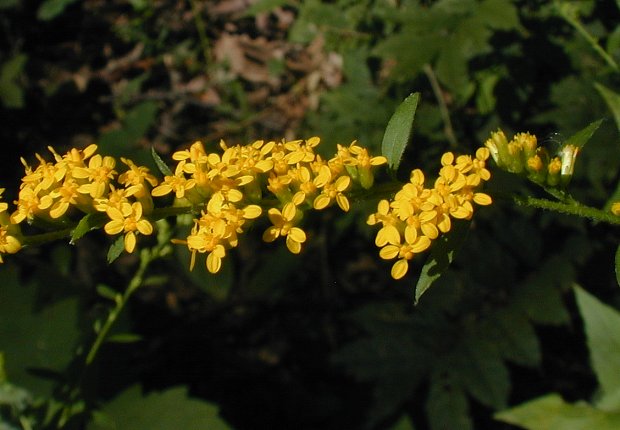
Each flowerhead is about 3 mm. (1/8") across, consisting of several ray florets (3-8) that surround a similar number of disk florets. Both the petaloid rays and corollas of the florets are yellow; the petaloid rays are linear-oblong, while the corollas are short-tubular and minutely lobed above. Surrounding the base of each flowerhead, there are several overlapping series of phyllaries (scaly floral bracts); these phyllaries are light green to yellowish green, appressed together, and linear-lanceolate in shape. In addition to the flowerheads, small leafy bracts (up to 1" long) occur along the branches and branchlets of the panicle. On robust plants, smaller secondary panicles or racemes of flowerheads often develop from the axils of upper leaves. The blooming period occurs from late summer to early fall and lasts about 3-4 weeks. Afterwards, fertile florets are replaced by small achenes with tufts of hair at their apices. These achenes are oblongoid in shape and 2-3 mm. long; they are dispersed by the wind. The root system consists of a branching caudex with secondary fibrous roots; rhizomes are also produced, enabling this plant to form clonal colonies.
Cultivation:
The preference is light shade to partial sun, moist to slightly dry
conditions, and soil containing loam, sandy loam, glacial till, or some
rocky
material. This goldenrod readily adapts to cultivation and it should be
planted in gardens more often.
Range & Habitat:
The native Elm-Leaved Goldenrod is a common plant that has been
observed in nearly all counties of Illinois (see Distribution
Map).
Among woodland goldenrods (Solidago
spp.),
it is the most common species in the state. Habitats include mesic to
upland woodlands, woodland edges, thinly wooded bluffs, edges
of limestone
glades, partially shaded banks of rivers, and thickets. This goldenrod
can spread to edges of lawns in semi-shaded areas from adjacent
woodlands. It is found in both higher quality and degraded habitats.
Wildfires and other kinds of disturbance are beneficial if they reduce
excessive shade from overhead canopy trees and competing shrubs.
Faunal Associations: The flowers attract various kinds of bees, wasps, and flies. These insects seek nectar; bees also collect pollen. Among the bees, are such floral visitors as miner bees (Melissodes spp.), Halictid bees, masked bees (Hylaeus spp.), plasterer bees (Colletes spp.), Andrenid bees, dagger bees (Panurginae), and leaf-Cutting bees (Megachile spp.). Many insects feed destructively on Elm-Leaved Goldenrod and other goldenrods (Solidago spp.); this includes Sumitrosis inaequalis and other leaf beetles, the Goldenrod Plant Bug (Lopidea media) and other plant bugs, the Green Stink Bug (Acrosternum hilaris) and other stink bugs, the Goldenrod Lace Bug (Corythucha marmorata), Acuticauda solidaginifoliae and other aphids, various leafhoppers and treehoppers, and caterpillars of the Goldenrod Flower Moth (Schinia nundina) and many other moths (see the Moth Table). Some vertebrate animals also feed on goldenrods. For example, the Ruffed Grouse, Cottontail Rabbit, and White-Tailed Deer browse on the foliage occasionally, while such granivorous songbirds as the Eastern Goldfinch, Slate-Colored Junco, and Tree Sparrow eat the seeds during the autumn and winter.
Photographic
Location:
At the edge of a wooded area in Crystal Lake Park, Urbana, Illinois.
Comments:
This woodland goldenrod has a terminal inflorescence that is rather
lanky and spreading, while its lower leaves are lanceolate-ovate and
coarsely serrated (superficially resembling the leaves of American Elm,
but more narrow and thin-textured). Elm-Leaved Goldenrod
is similar in appearance to Canada Goldenrod (Solidago canadensis),
but the latter has lower leaves with 3 parallel veins (a central
vein and two lateral veins). Canada Goldenrod also has more hairy
leaves and stems, and the major branches of its panicles are usually
less divergent than those of Elm-Leaved Goldenrod. Other goldenrods (Solidago spp.)
can be distinguished by some combination of characteristics involving
the appearance of their leaves, stems, or inflorescences. Because there
are many goldenrod species in Illinois, they can be difficult to
distinguish.