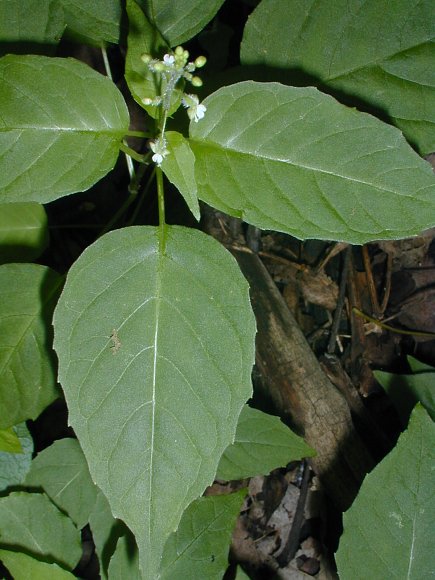
Description: This perennial plant is about ¾-2' tall and unbranched or little branched. Scattered white hairs occur occasionally along the central stem, although it becomes glabrous with age. The opposite leaves are up to 5" long and 3" across (excluding the petioles); they are ovate-cordate, dentate along their margins, and largely hairless. The upper leaf surface is medium to dark green and hairless. The slender petioles of the leaves are up to 1½" long and medium green. The central stem terminates in a raceme of flowers up to 6" long. The stalk of this raceme has scattered white hairs. The small flowers are sparsely, but evenly, distributed along this stalk on slender pedicels up to ½" long. These pedicels spread outward.
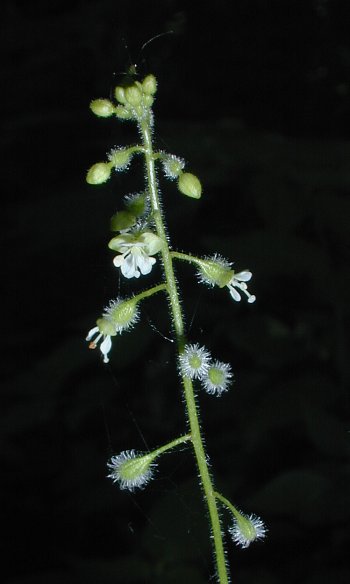
Each flower
consists of 2 white petals,
2 green sepals, 2 stamens, and a slender style. Each petal is deeply
divided into 2 lobes. At the base of each flower, there is a 2-celled
ovary that is green and covered with stiff hooked hairs; it is obovoid
in shape. Each cell of this ovary contains a single seed. The blooming
period for a colony of plants occurs during the summer and lasts about
a month. Each flower is short-lived and replaced by a small bur-like
fruit (see the description of the ovary above). The root system can
produce rhizomes or stolons that extend through the soil or leaf mould
to create clonal offsets from the mother plant.
Cultivation:
The preference is dappled sunlight to medium shade, more or less mesic
conditions, and a rich loamy soil with abundant organic matter.
Range &
Habitat:
The native Enchanter's Nightshade is an occasional to locally common
plant that
occurs in most counties of Illinois (see Distribution
Map).
This plant may be less abundant than in the past because
of browsing by deer. Habitats include mesic deciduous
woodlands,
including oak woodlands and maple/basswood woodlands, and areas that
are adjacent to woodland paths. Sometimes this species occurs in wooded
upland areas and along ravine slopes.
Faunal Associations:
The nectar and pollen of the flowers attract small bees, including
Halictid bees (Lasioglossum
spp.) and little carpenter bees (Ceratina spp.);
they are also visited by Syrphid flies and bee flies (Bombyliidae). The
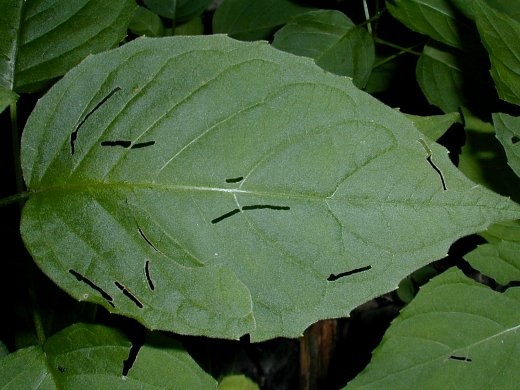
caterpillars of a moth, Mompha
terminella (Enchanter's Cosmet), are blotch leaf-miners.
Birds and mammals help to distribute the seeds, as the small bur-like
fruits can cling to feathers and fur; these fruits can
cling to the clothing of humans as well. Deer occasionally browse on
the foliage of Enchanter's Nightshade.
Photographic
Location:
A mesic deciduous woodlands at Busey Woods in Urbana, Illinois.
Comments:
This is one of the woodland wildflowers that blooms during the summer
in shaded areas. The flowers of such species are usually small, white,
and not very showy. Enchanter's Nightshade is a rather odd member of
the Evening Primrose family, as its flowers have only 2 petals, 2
sepals, and 2 stamens. This is a distinctive characteristic of the Circaea
genus in this family. The only other member of this genus that occurs
in Illinois, Circaea alpina (Small Enchanter's
Nightshade), is an uncommon species that is restricted to the cool
moist woodlands of northern Illinois. It has leaves that are more
cordate and indented at the base, and its flowers are clustered toward
the apex of the flowering stalk (rather than being evenly distributed
along this stalk). While Enchanter's Nightshade is ¾-2' tall and it has
2-celled ovaries, Small Enchanter's Nightshade is less than 1' tall and
it has 1-celled ovaries.