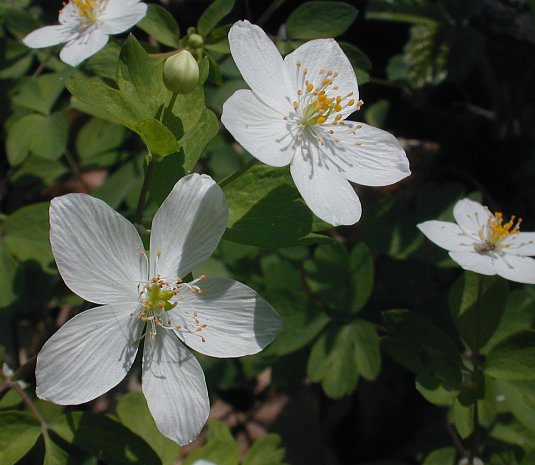
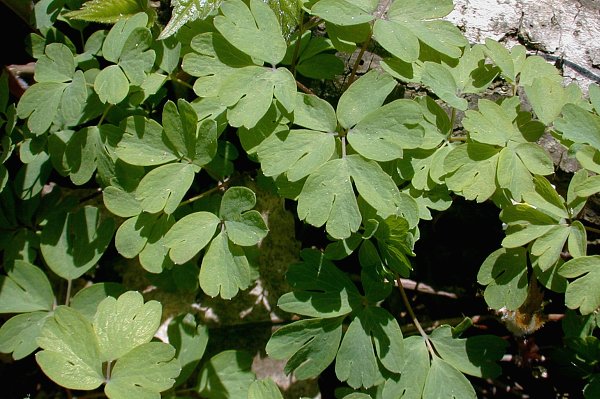
Description: This herbaceous perennial plant is up to 1' tall, branching sparingly. It produces both basal and alternate compound leaves with a similar appearance. The stems are reddish green, hairless, and slender. The compound leaves are trifoliate and they have slender petioles. The terminal leaflet has a longer petiolule (basal stalklet) than the two lateral leaflets. These leaflets are up to 1" long and ¾" across. They are ternately lobed, cleft, and hairless. The white flowers occur individually or in groups of 2-3. Each flower spans about ¾" across, consisting of 5 petal-like sepals that are white, no petals, several slender stamens with yellow anthers, and a few green pistils in the center. The blooming period occurs during mid-spring and lasts about 3 weeks. Afterwards, the pistils are replaced by beaked follicles (seedpods that split open along one side) that individually contain several seeds. The root system is fibrous and occasionally small tubers are produced. Vegetative clones of the mother plant are often produced from these tubers; reproduction also occurs by the seeds. False Rue Anemone often forms dense colonies of plants.
Cultivation:
The
preference is partial sun to medium shade, moist to mesic
conditions, and a rich loamy soil with abundant leaf mould.
Range & Habitat:
The native False Rue Anemone is fairly common in the majority of
counties in Illinois, otherwise it is uncommon or absent (see Distribution
Map).
Habitats include in rich mesic woodlands and low woodlands along
streams where deciduous trees are dominant. This species can be
extirpated from a woodlands by an invasion of Alliaria
petiolata (Garlic Mustard) and non-native shrubs.
Faunal
Associations:
Except for visitors of the flowers, little is known about the
floral-faunal relations of this species. The pollen of the flowers
attracts medium- to small-sized bees and flies primarily, including
Halictid bees (Halictus
spp., Lasioglossum
spp., etc.), Andrenid bees (Andrena spp.),
honeybees, Syrphid flies, and other flies. The bees collect pollen,
while the flies feed on pollen. Occasionally various beetles also feed
on the pollen, but they are less effective at cross-pollination. Some
of these insects probably search in vain for nectar, as the flowers
lack nectaries. The foliage of False Rue Anemone is rarely browsed by
mammalian herbivores (personal observation).
Photographic Location:
A mesic deciduous woodlands at Busey Woods in Urbana, Illinois.
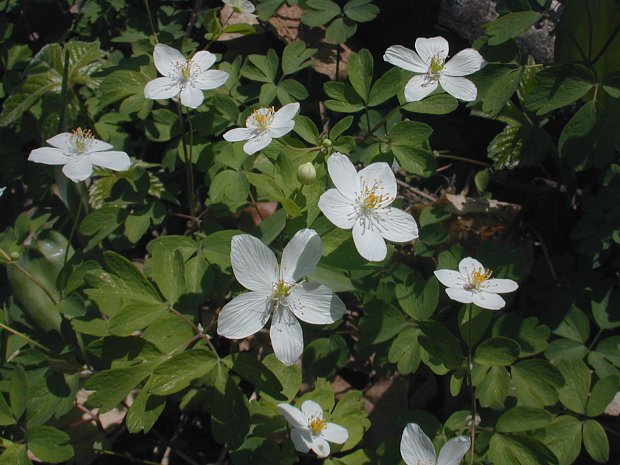
Comments: Another scientific name for False Rue Anemone is Isopyrum biternatum. This species blooms a little earlier than many other spring wildflowers in a woodlands, and it has attractive flowers and foliage. Two other members of the Buttercup family that occur in woodlands, Anemone quinequefolia (Wood Anemone) and Anemonella thalictroides (Rue Anemone), resemble False Rue Anemone. Wood Anemone has leaflets that are coarsely serrated along the margins and their lobes taper to sharp points; it also differs from False Rue Anemone by the whorl of leaves underneath its flowers. Rue Anemone also has whorled leaves underneath its flowers, otherwise its foliage is very similar to that of False Rue Anemone (which has alternate leaves along the stems). While Wood Anemone and Rue Anemone produce small clusters of beaked achenes (each containing a single seed within a hardened exterior), False Rue Anemone produces small clusters of beaked follicles that each contain 2 or more seeds. Sometimes the white flowers of Wood Anemone and Rue Anemone have more than 5 petal-like sepals, while the flowers of False Rue Anemone never have more than 5 petal-like sepals.